Monday, September 18, 2023

Strikes and Bidenomics - Matt Stoler


https://www.thebignewsletter.com/p/strikes-and-bidenomics?utm_source=post-email-title&publication_id=11524&post_id=136785351&utm_campaign=email-post-title&isFreemail=true&r=3qu3t&utm_medium=email

Strikes and Bidenomics

The White House is trying to sell 'Bidenomics,' but poll after poll shows that the public is extremely unhappy with the economy. What does the public see that the bureaucrats don't?

Sep 16, 2023

Welcome to BIG, a newsletter on the politics of monopoly power. If you’d like to sign up to receive issues over email, you can do so here.

Today’s issue is about the incoherence of the Biden economic agenda, so-called ‘Bidenomics.’ With strikes in the auto industry and Hollywood, as well as sour polling numbers, something about the White House framework for policy isn’t working.

First, I want to offer a brief summary of the Google trial, which seems to be going well for the government. Trials are where the rubber meets the road on antitrust, so we set up a special site, Big Tech on Trial, where we’re covering the daily drama of the case. Here’s the TLDR so far of the trial. The government has shown pretty clearly that the search giant is paying large sums of money to block rivals from entering the market. In addition, Google’s gotten busted covering up evidence - or as I put it, Google is following the Stringer Bell rule. In addition, in a separate Google trial, a judge tossed the search firm’s dirty tricks attempt to go after the head of the Antitrust Division Jonathan Kanter as biased.

It hasn’t been all roses for the government, Google drew some blood showing that consumers, when faced with the choice of Bing, do switch to Google. But the basic narrative of Google as a monopolistic liar is working, and Google’s attempt to show this trial as just the government trying to help Microsoft isn’t resonating. The biggest win for Google is Judge Amit Mehta blocking a public audio feed, so the public just isn’t tuned in. You can follow along by signing up at Big Tech on Trial.

This is a real book for sale in D.C. next to bobblehead RBG and Pelosi dolls. This is not a joke. Well it is, but it’s also true.

Strike!

I’ve been out in Los Angeles for the last few days, and the big economic problem here are the strikes against the movie studios, which have shut down production. More broadly, as I read the news, the biggest economic stories are the high cost of living, and then the United Autoworkers going on strike against the big three car companies. The Washington Post had a good article asking workers why they are striking. Most cited inflation and fairness. “We’re not making enough money” said Petrun Williams, a 58 year-old Ford repairman. “People should be able to buy their own houses, but right now it’s not possible.”

It’s a hard problem to tackle, because GM, Ford, and Stellantis are giant wildly inefficient bureaucracies with high costs optimized to make $75,000 trucks, and electric vehicles are a completely different product. But ‘Bidenomics’ isn’t necessarily helping.

In fact, Biden’s White House staff just doesn’t seem to have the capacity to hear what’s going on, or address it. Earlier this month, Biden gave a speech in Philadelphia celebrating Labor Day, and ahead of it he said “I’m not worried about a strike,” and “I don’t think it’s going to happen,” comments that are clearly a result of his senior staff giving him bad info. These delusional comments prompted a Detroit Congresswoman to call up senior White House advisor Steve Ricchetti and scream, “Are you out of your f---ing minds?”

And this gets to a common question I hear in D.C., which goes as follows. Why is the public so unhappy? The economy looks, by most conventional measurements, as if it’s doing so well. Dave Dayen summarized the statistics as follows. Unemployment is low, inflation is down, consumer spending is rolling along, and certain manufacturing areas are booming. “Several measures,” he wrote, “like economic growth and prime-age employment, have actually rebounded to their trends from before the 2008 financial crisis, an almost unthinkable scenario just a few years ago.”

According to consistent polling, the public thinks inflation is high and getting worse, and that Biden has done very little to address any of their problems. What explains how the White House is floundering? One problem is plenty of people in the political class believe that the public is simply wrong to be angry. Paul Krugman, for instance, wrote a column saying that normal people believe the economy is bad, even if it isn’t. I see White House officials interviewed on CNBC periodically, and while they don’t say that outright, it’s clear they think the economy is doing well and inflation is down, and their job is to sell their accomplishments.

There are two reasons why the White House simply cannot seem to govern effectively. The first is that the tools the political class uses to understand inflation are misleading them. The second is that Biden doesn’t have one unified policy agenda, but has a bunch of policy agendas that work against each other. The result of these two factors is that Biden’s story - look at all this prosperity I have delivered - doesn’t work in the face of strikes and anger.

Sticker Price Versus Reality

Let’s start with why the White House doesn’t see a problem. It’s true that key members of Biden’s senior staff are mismanaging the situation, but that doesn’t explain why Krugman, as well as many economists in the administration, don’t see one either. Sure you can look at individual strikes, but those are noisy events, not economy-wide.

How does the government perceive the experience of ordinary people in the economy? There’s a mess of information out there, what information matters, and what doesn’t? The President can’t ask 100 million Americans how they are doing before making a decision. Over the last century, bureaucrats have answered these questions by inventing a host of measurements to serve as proxy for what normal people experience.

The government has been measuring prices using some variant of the Consumer Price Index (CPI) since 1913. When there’s a change to inflation, what that usually means is that the CPI is going up or down. And a change to inflation isn’t a change in absolute price levels. If inflation is, say, down, it doesn’t mean prices are down, only that the rate prices are increasing is less rapid than it was before.

Since 2021, prices have spiked fairly dramatically, with a CPI reaching up to 9% at certain points in 2022 before settling back to 3.7% last month. Once again, that doesn’t mean prices are down, just that the rate of increase is down. The crazy expensive fourteen dollar sandwich is still a crazy expensive fourteen dollars, it’s just not going up to seventeen dollars. One of the bigger contributors to the CPI last month was housing, jumping by 7.3% over the past year.

But does the CPI really show how people experience price increases? After all, one of the most significant changes in what we pay is higher interest rates, which the Federal Reserve has hiked dramatically over the past few years. The Fed’s actions have increased credit card rates, mortgage rates, auto financing, and corporate and government borrowing costs. Surprisingly, none of this is directly included in our inflation metrics. “The CPI’s scope,” writes the Bureau of Labor Statistics, “excludes changes in interest rates or interest costs.” The price of money, which is an input into everything, isn’t included in how we see inflation today.

That’s crazy.

When I was in the archives learning about Congressman Wright Patman, the Chair of the House Banking Committee in the 1960s and 1970s, I found that back then, people included the cost of interest rates in how they understood inflation. The 1960 Democratic Party platform discussed inflation in precisely this manner, saying that high interest rates enacted a “costly toll from every American who has financed a home, an automobile, a refrigerator, or a television set,” and was “itself a factor in inflation.”

This logic made sense. When you borrow to buy a car or a house, the cost of that car or house is your monthly payment, not the sticker price. But in the 1980s, the government changed its method of measuring inflation, so today, the CPI works under different assumptions. So what does this change mean? Well, the two biggest purchases for an American family are a car and a house, and in both of these categories, the CPI excludes the key factor for normal people, which is how interest rates affect the monthly payment. The sticker price for a car is an important number, but it’s the monthly payment that matters.

With that in mind, let’s take a look at the price of cars over the last ten years.
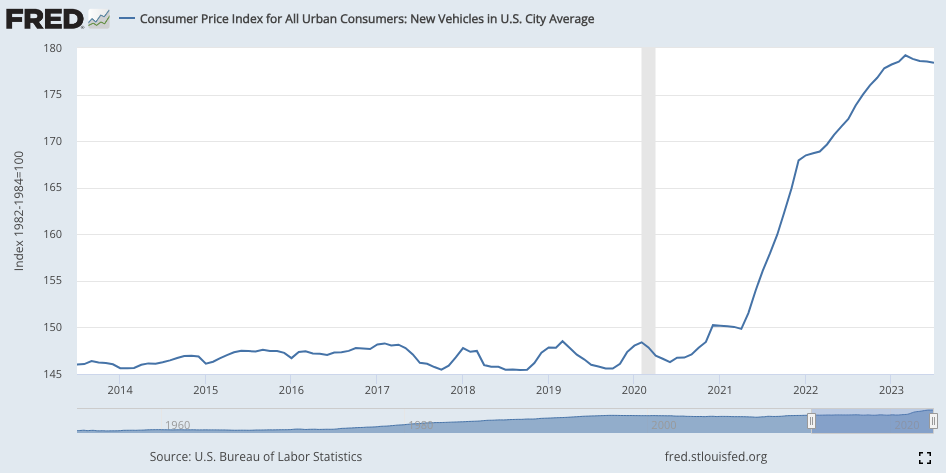
New car prices spiked from the beginning of 2021 to the end of 2022, but price levels are starting to come down, ever so gently. But is the monthly payment coming down?

No. According to Edmunds, in Q2 of 2022, the average monthly payment for a car was $678, in Q2 of 2023, it was $733. So it’s a slight price decline for the CPI due to new vehicle pricing, but an 8% inflation for what people actually pay. Why are monthly payments going up if sticker prices are going down? It’s simple - the price of money has gone up. The average interest rate for a new car jumped to 6.63% in the second quarter of this year. It was 4.60% in Q2 of 2022, and 4.17% in Q2 of 2021.

And housing? Here’s chart from the Daily Shot of the monthly mortgage payment for a median home price.
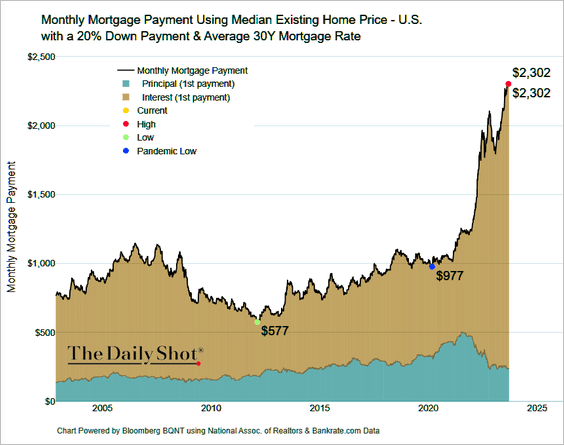
Redfin reports the typical mortgage payment is up 20% from a year ago. And while most homeowners have mortgages they got prior to 2021, and so aren’t paying the higher prices, the exceptionally high currently monthly payment means people can no longer move, and they have to watch their children struggle to find a place to live. Housing prices are social, since the home is so central to the American order, so even if you are financially unaffected, seeing a lot of people be unable to move, buy a home, or rent affordably gives everyone a sense of economic insecurity. That’s why striking auto workers mentioned the price of housing.

The calculation for housing in the CPI is a bit more complicated than that for new cars, but the key piece to understand is that in 1983, the Reagan administration chose to exclude interest costs, instead asking homeowners what they think they would be paying in rent if they didn’t own the home they lived in. The government simply “underestimates changes in housing costs,” according to an economist at Redfin, especially when interest rates are spiking. “And that’s because housing costs for the person who is actually active in the market experiences much greater fluctuation.”

The reason to change this measurement was so that inflation would look lower than it actually was. Over time, subsequent administrations sustained this shift. Lying about the symbols used to govern has a short-term political benefit in that it perhaps gets you some good media coverage, but over time, it meant that the CPI for housing costs isn’t necessarily reliable.

So basically, the price of money is a big deal in terms of our experience paying for things, and it’s being excluded from the inflation metric that policymakers use to look at the economy. So that’s why policymakers are confused. Some of their key tools aren’t reflecting reality, and the people who originally broke the tools for political purposes aren’t there anymore. Today’s political class doesn’t even know what they don’t know.

What Is Bidenomics?

Of course, housing and cars aren’t the only things people buy. Food is much more expensive than it was just a few years ago, as are everything from hotels to airfares to consumer packaged goods to seeds. I mean, Visa and Mastercard, who are barely affected by inflation, are jacking up their swipe fees to merchants. None of that is a secret, the CPI on food shows that inflation might be coming down, but prices are still high. So what is Joe Biden, and the Democrats in Congress, doing about that? Well, White House officials call their plan ‘Bidenomics.’

The best way to explain Bidenomics is to listen to a judge Biden recently appointed to the D.C. district court, Ana Reyes, who was hostile to the Antitrust Division when they brought a case against two smartlock makers. Last month, Reyes sat on an American Bar Association panel where she attacked the idea of stronger antitrust enforcement, focusing specifically on her skepticism around labor-related claims. She bragged to the audience of defense attorneys that during the antitrust case she heard, she 'pranked' government lawyers by spending three minutes pretending to dismiss their key witness, before saying ‘April Fools. "I have never in my life heard stunned silence," she later said gleefully.

Having a corporate lawyer bully turned judge appointed by Biden killing an antitrust suit brought by Biden officials is a great example of Bidenomics, because it shows the lack of coherence of this administration’s policy. I’m a big fan of Federal Trade Commission Chair Lina Khan, but another Biden judge - Jacqueline Corley - let through the largest big tech merger of all time, when Microsoft bought Activision, after Khan challenged the deal.

These judges matter in terms of inflation. Had Biden picked actual populists for the judiciary instead of Corley and Reyes, the White House’s ability to govern would look very different, and corporate America would be changing their pricing behavior due to fear of crackdowns. In early 2022, there was a flurry of interest in using antitrust to attack how corporations were informally colluding to raise prices. But an aggressive legal theory needs judges willing to take market power seriously, and Biden instead chose people who thwart his own administration. It’s not just judges. Factions in the administration - in this case the White House Council of Economic Advisors - explicitly opposed the corporate profit-inflation link.


BIG is a reader-supported newsletter focused on the politics of monopoly and finance. If you haven't done so already, please consider supporting this work by upgrading to a paid subscription. The truth costs a few bucks, but in the long run it’s much cheaper.


I think a lot about antitrust, but the incoherence is systemic across most policy areas (and Democrats in Congress). The pro-labor administration indicated support for the strikes in Hollywood against powerful studios, then a few months later the former White House Domestic Policy Council head - Susan Rice - rejoined the board of Netflix. For every attempt to make electric vehicles in America there’s Treasury Secretary Janet Yellen pushing hard to ensure these cars are made abroad.

Normally, policy disagreements would be decided by the President and his staff. But Joe Biden is a procrastinator, and doesn’t like making choices. He’s also very old. As for his staff, well, while Biden’s former chief of staff Ron Klain was aggressive in terms of policy goals, his new chief of staff, Jeff Zients, is a relentlessly cheerful former management consultant wholly focused on process. Other important figures, such as Tim Wu and Brian Deese, have also left. With Klain gone, there’s an insular clubbiness at the top, and an inability to provide a vision or pay attention to policy implementation. Even if you were to make the point that housing prices need attention, there’s just no one there who could or would do anything about it.

And that brings us back to the strikes. The Biden administration should have headed off the UAW labor action with discrete steps to help the workers, but the White House just doesn’t have any coherence. And so while Biden is saying pro-labor things and agreeing the CEOs are paid too much, there’s this.

There is also a sense among some Democrats and labor officials that Biden’s team miscalculated the standoff and hasn’t understood the severity of labor’s frustration or concerns. Even the news this week that the Biden administration was considering providing aid to auto suppliers rankled some in the union world, who thought it could undermine the strike and saw it as evidence that there are always funds available for companies, but not workers.

This isn’t to say there aren’t significant achievements. Biden’s industrial policy push is real, with increases in investment in semiconductor production, electric vehicles, and batteries, as well new factories in general. His competition policy approach is also real, with new merger guidelines, as well as crackdowns in pharmaceuticals, mergers, the prohibition of non-competes, and the Google suit.

There are routinely good decisions coming out of some of the regulators. The other day, for instance, the Department of Labor proposed a rule opening up 4 million more workers to overtime pay. Meanwhile, the Securities and Exchange Commission begins a crackdown on private equity.

Unlike the Obama administration, which was ideologically oriented to push wealth and power upward, the Biden administration has a few populists trying to do the opposite. But in an inflationary environment where the stats are juiced to mislead policymakers, that’s not good enough.

What Happened to Biden’s State of the Union?

In February, Biden gave a State of the Union speech focused on making things in the U.S., going after junk fees, and taking on corporate power. His polling temporarily spiked. Since then, there has been no messaging follow-up from the White House on anything he said in that speech, almost as if Zients and the rest of the White House were embarrassed that Biden put forward a populist set of arguments.

Instead, various officials are out there on TV saying ‘look at these charts!’ They want credit for inflation being down, economic growth being up, and unemployment being low. But without recognizing that the actual costs of housing and transportation are increasingly unaffordable and going up, that just looks weird. Moreover, there’s no actual policy regime, just a disjointed set of factions trying to get as much done as possible according to their preferred view. It’s mostly unclear how Biden is actually affecting people’s lives, and the only genuinely organized groups of workers, are showing that things aren’t ok.

The economy isn’t great, and there’s no point in trying to pretend it is. That said, Biden can save his administration. He has accomplishments, and his State of the Union messaging resonated. He can argue that his first term was about having America recover from Covid by re-shoring factories, restoring full employment, and fixing supply chain problems. He can brag about all the big companies suing him, like various pharmaceutical firms mad that the White House is imposing price caps. Then he can pledge that he’ll focus on bringing down housing costs in his second term. Will such a story work? I don’t know. Maybe the current pitch will work, in the 2022 midterms, Biden out-performed expectations. But it’s at least more relatable than ‘Eat some charts!’


Thanks for reading! Your tips make this newsletter what it is, so please send me tips on weird monopolies, stories I’ve missed, or other thoughts. And if you liked this issue of BIG, you can sign up here for more issues, a newsletter on how to restore fair commerce, innovation and democracy. And consider becoming a paying subscriber to support this work, or if you are a paying subscriber, giving a gift subscription to a friend, colleague, or family member.

cheers,

Matt Stoller


Tuesday, September 12, 2023

NYC Labor Day Parade Showdown: Retirees Challenge Union Leaders On Medicare Advantage Push


 https://www.work-bites.com/view-all/nougnesb242r1g8nr8z58i2fhtegwt?

NYC Labor Day Parade Showdown: Retirees Challenge Union Leaders On Medicare Advantage Push

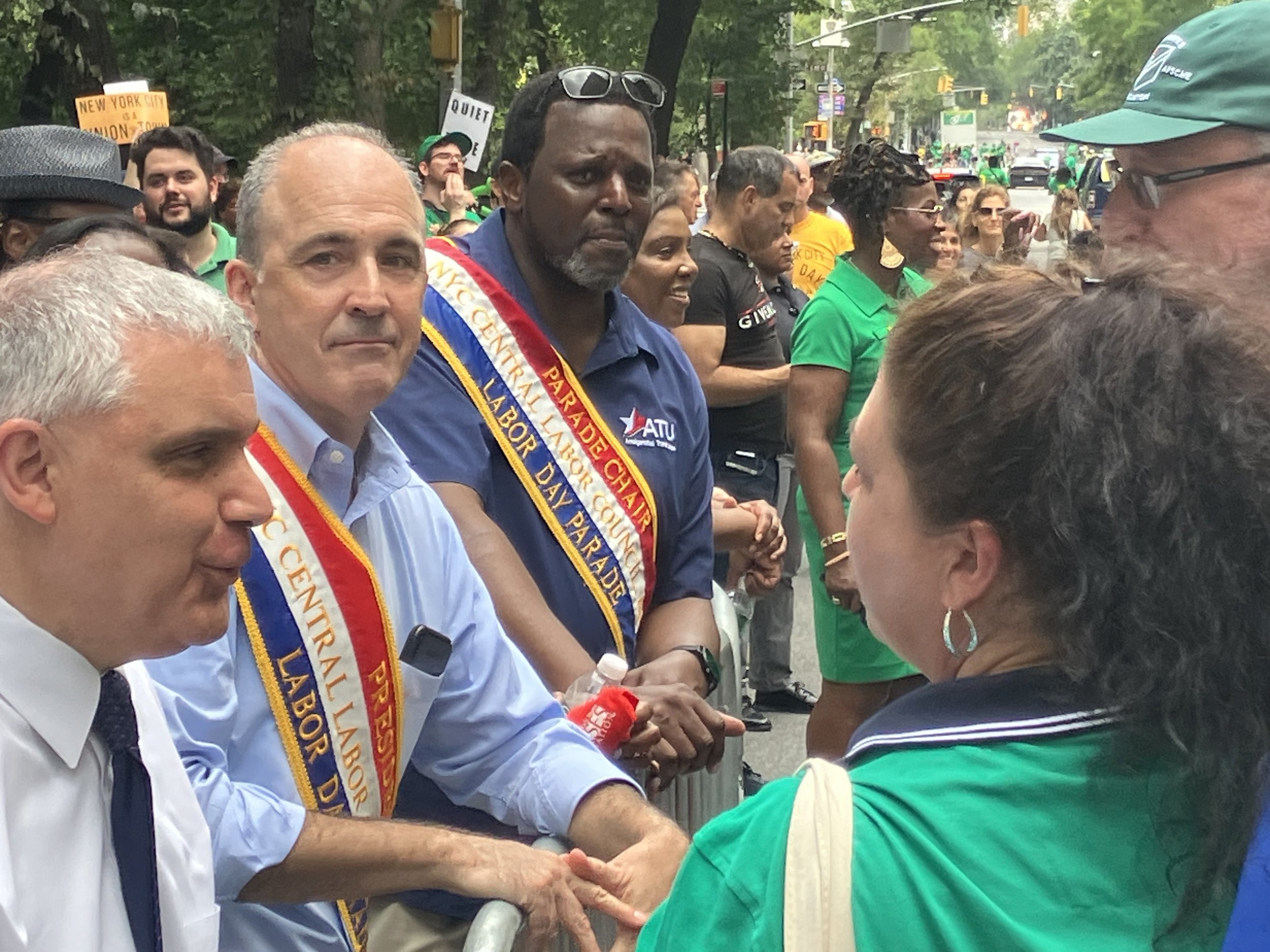
NYCOPSR President Marianne Pizzitola engages with NYS AFL-CIO President Mario Cilento [l] and NYC Central Labor Council President Vinny Alvarez [r] following Saturday’s Labor Day Parade. Photos and video by Joe Maniscalco

Video follows story…

By Joe Maniscalco

This weekend’s New York City Labor Day Parade saw municipal retirees fighting to retain their Medicare coverage tangle with the heads of both the state AFL-CIO and NYC Central Labor Council over the duo’s opposition to Intro. 1099 — the City Council bill aimed at shielding traditional health insurance from Medicare Advantage and privatization.   

The exchange happened at 5th Avenue and 64th Street after the retired civil servants marching behind the DC37 Retirees Association banner finished the parade route and spotted New York State AFL-CIO President Mario Cilento and NYC Central Labor Council President Vinny Alvarez near the reviewing stand.

“Shame,” New York City Organization of Public Service Retirees [NYCOPCR] Treasurer Carol Whitton told Cilento, while an increasingly antsy Alvarez looked on. The UFT retiree reminded the head of the New York State AFL-CIO that it was civil servants like her who helped the City of New York survive the financial crisis of 1975.

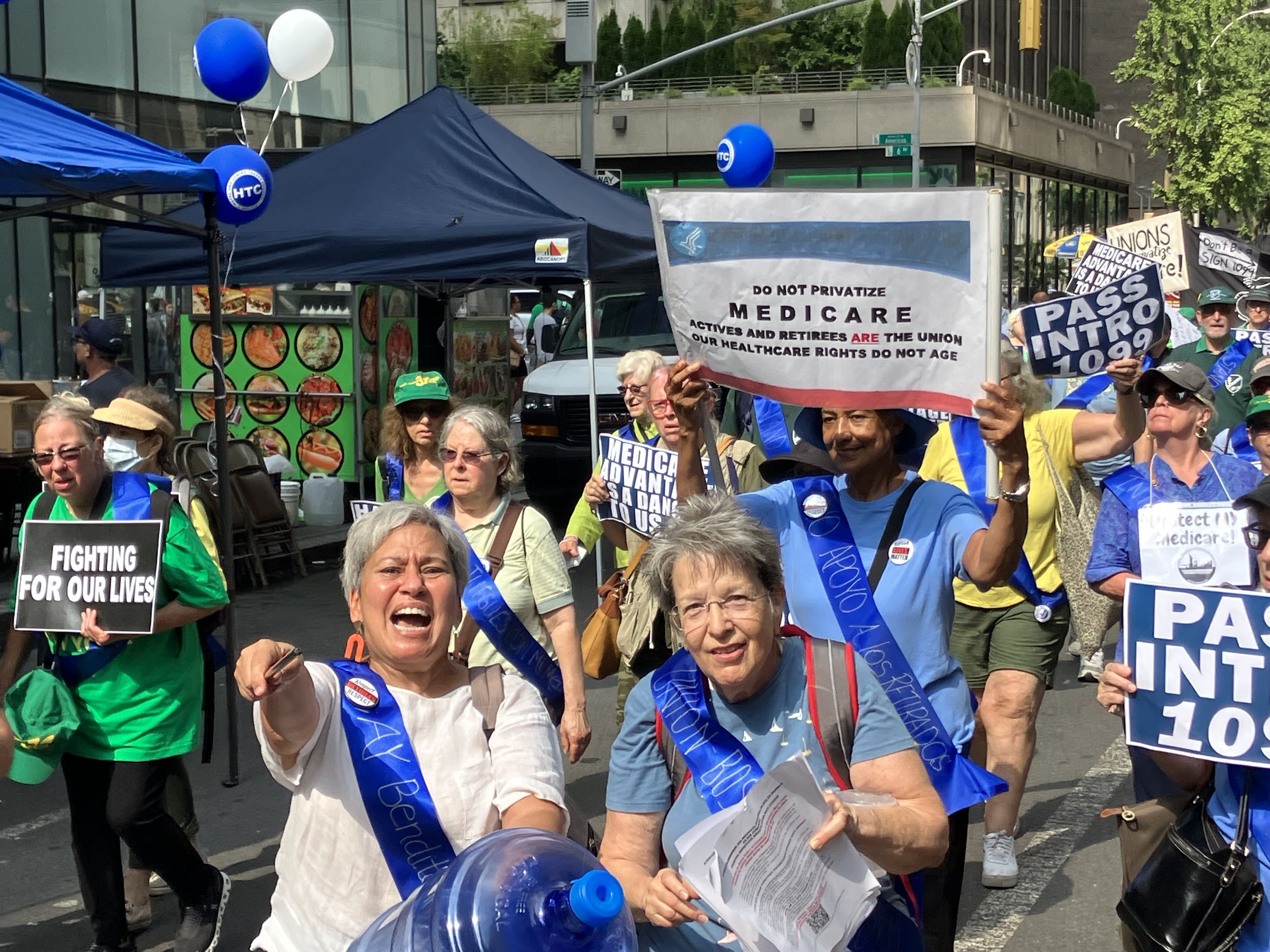
“My pension was put at risk in 1975 to save this city from bankruptcy and this is how you thank me?” Whitton told Cilento. Fellow municipal retirees wearing DC 37 green held up signs supporting passage of Intro. 1099 and chanted, “New York City, Don’t You Dare Touch My Medicare.”

New York City municipal retirees, along with their counterparts in other cities around the country, have long maintained union leaders pushing profit-driven Medicare Advantage programs are helping to destroy traditional Medicare and jeopardizing the future of the entire American labor movement.

"There was a very large contingent of both DC37 Retirees and NYCOPSR members marching with DC 37 in the parade,” Council of Municipal Retiree Organizations President Stu Eber later said. “We were chanting to save our Medicare and to enact Intro 1099."

Last month, the Municipal Labor Committee [MLC], the umbrella organization representing the city’s public sector unions, sent out a letter to City Council Speaker Adrienne Adams [D-28th District] trashing Intro. 1099 as “an attack on fundamental tenets of collective bargaining” and urging its demise. The names of both Cilento and Alvarez headed a list of labor leaders in apparent support.

New York City municipal retirees vehemently deny Intro. 1099 impacts collective bargaining in any way — and they keep winning in court.

NYC municipal retirees fighting the privatization of their traditional Medicare coverage march in this year’s NYC Labor Day Parade.

So far, however, less than 20 City Council members have signed on in support of Intro. 1099. 

Retired EMT and NYCOPSR President Marianne Pizzitola briefly engaged the labor leaders ahead of Whitton. Parade Grand Marshal Nancy Hagans, president of the New York State Nurses Association, and Parade Chair Mark Henry, vice-chair of the Amalgamated Transit Union, stood nearby.

“I went up to Mario Cilento and Vinny Alverez,” Pizzitola later told Work-Bites. “I told Vinny I wanted to speak with you, but you didn’t want to speak to me. So, we came to you as retired labor to be seen and heard — because no union — and no president of a labor organization — should advocate for diminishing benefits or privatizing Medicare against a retired union worker.”

Pizzitola then implored Cilento for a meeting to discuss the issue and urged Hagans to support municipal retirees in their defense of traditional Medicare health insurance coverage.

“I said you’re a union leader — you should be standing by our side,” Pizzitola told Work-Bites. “You should be explaining to Mario and Vinny that no union should be advocating for diminishing a retired union worker’s benefits — and should not be privatizing Medicare. She said, ‘That’s why I stand for the New York Health Act.’”

Work-Bites has reached out to Cilento, Alvarez and Hagans — and is awaiting comment.

Last week, UFT President and MLC leader Michael Mulgrew, expressed his disdain for the NY Health Act, saying, “You cannot bankrupt your state's economy to make a point."

Meanwhile, back at the parade — Jenny Roper, a municipal retiree who left the Human Resources Administration in 2010, talked about losing her husband to cancer last year.

“He was covered by my insurance,” she told Work-Bites following the parade. “And I think if we had lost this [Medicare] battle, I would have lost him sooner.” 

Neal Frumkin, vice-president of Inter-Union Relations for the DC37 Retirees Association, sounded energized following the exchange with union leaders. 

“We’ll turn out anywhere — anytime,” Frumkin said. “We’re in this fight for the long haul. We’re winning — and we’re not gonna be turned around.”

00:00
00:59
00:00


Tuesday, September 05, 2023

Melissa Williams, Uncensored: "The game is rigged. It was rigged for two years. We are only now seeing the full force of the abuse of power in a union with one-party rule."


Melissa Williams, Uncensored: "The game is rigged. It was rigged for two years. We are only now seeing the full force of the abuse of power in a union with one-party rule."

Melissa Williams, shares her experience as chapter leader for occupational and physical therapists under Michael Mulgrew's Unity - the partisan patronage caucus machine that controls UFT leadership.

 Note:  I am publishing this outside of UFT email because none of what I say would get through the editing of UFT leadership.
 

When members of OTs and PTs for a Fair Contract ran and won the Chapter Leadership in 2021, we ran without much information provided about what the job would entail because (as I have  learned very well over 2 years) very few union HR policies and procedures are actually in writing.

At my first solo meeting with union leadership in July 2021, I was asked, “Why did you run?”, and was told “the chapter leader job is what you make of it.”

In fact, our Executive Board was not allowed to make the job as we wanted. The first evidence of that is when we were not allowed to place our own elected members into the PM staff positions (the 12 hours a week of  time that was theoretically available to assist the chapter leader). The prior elected chapter  leader and PM staffer were allowed to keep the job, but this was not made clear to me until October 2021. I learned by accident when I was “taken out of the sandbox” of the Salesforce HR  system (the system with all union members’ information) in October 2021 and saw that the prior PM Staffers had been working for weeks without informing me. I was finally informed in my office, in the next breath after I told leadership that my dad was just put in hospice, that “we don’t just fire people.” If our group would have known that we would not have been able to place our own people in PM staff jobs, I don’t think we would have run.

In my mind it is the equivalent of Mayor Adams being forced to keep all of De Blasio’s former staff. They were both Democratic mayors, but they each have their own ideas and priorities. This idea that “we are all one chapter” and should work together, when there was deception right in the beginning and a pattern of steering people to PM staff on social media to bypass the actual elected chapter leadership was the first of many challenges in our tenure.

Following the advice of Barbara Madeloni, former Massachusetts Teacher Association president who mentored me in the early months of my chapter leadership, “don’t make private beef public because the average therapist doesn’t care,” I did not make public the early undermining of our elected leadership.  At the time, I was trying out her philosophy to “stand somewhere while drawing people in at the same time.” Over time, my ideas about this philosophy in the context of the UFT power structure have changed.  

The first three months were a whirlwind made worse by the sudden and horrible way my father died in October 2021 due to medical errors caused by extreme understaffing on his dementia unit. There were times in the first six months of my tenure that I didn’t take lunch because I was answering emails nonstop about COVID policies, pivoting to remote tele-therapy, and the mess of the recovery payment issues. Concurrently, I returned to in-person therapy after 18 months of working remotely and dealt with all the normal stressors of being a clinician in a pandemic. I quickly realized that if I didn’t start erecting some boundaries, that the chapter leader job would take over my life.

At this time, I was also told by numerous male, highly paid, full-time union staffers that “the chapter leader job is 24/7.” I countered that with, “but you said the chapter leader job is what I make of it.” I began setting a 30-minute timer at the union office to hold myself accountable for taking a duty-free lunch. I began placing limits on checking union emails on non-union days. The job still took over my life. 

Our Executive Board’s successes during this time were to have many members of the Executive Board plus members of the rank and file to present the items on our consultation agenda each month. As much as I don’t think consultation made a significant change in our working conditions, I do hope that the practice of giving average therapists “voice” in consultation continues after our leadership. We also conducted remote meetings with 200 plus attendees each month when the expectation is only 6 chapter meetings a year, not twelve.

This year on top of contract negotiations we ran 12 chapter meetings, a new hire orientation, an itinerant PK meetings, a D75 meeting, and a meeting to unpack the racist comments by the former AOTA  president at the AOTA conference this year. The use of remote meetings increased the ability to conduct more meetings and increase access and participation. I also went to numerous Panel of Education Policy meetings, sometimes staying up until 1 AM on a school night to testify about our working conditions.  

The winter of 2021 and spring of 2022, our chapter leadership was consumed by understanding  the parameters of the payment issues and became drafted payroll experts. I began to see that the pattern of dealing with these types of issues one by one, instead of as a systemic issue, was part of a pattern of UFT leadership enabling the DOE to be negligent in their basic duties to pay people in a timely manner.

One union leader framed it to me as a type of “harm reduction,” but I remain convinced that if leadership continues to enable the DOE not to perform the basic functions as an employer, the DOE will have no incentive to do right by us.

The current Summer 2023 paraprofessional pay issue is a perfect example. I learned that our union leadership tends to play defense instead of offense on these payment issues. After all the many months of work our OT/PT Executive Board did gathering data for the UFT Grievance Department, the UFT Grievance Department failed to pursue the Transfer List 2022 issue, the recovery pay  arbitration, or substantively address the months of non-payment some therapists experience  coming off of parental leave. The success we had addressing the SEED Payment issues this year  is because we showed up at Panel of Educational Policy meetings, Citywide Council of Special Education meetings, and leveraged our relationships with parent leaders.

All of that was achieved outside of the union power structure.  

In the Spring of 2022, when I was given the list of therapists who wanted to be on the  negotiation subcommittee, I chose Marilena Marchetti, delegate Jen Clavin, Susan Paul, OT vice-Chair Hannah Fleury, Chapter Secretary Rachel Feinsilver, Regional OT At Large Beth Salzman, and Itinerant PK PT, Peter Romagnuolo. Jen Clavin withdrew so OT delegate Mimi Greenberg was replaced as an alternate. When Marilena left the DOE in the Summer of 2022, we were not allowed to replace her. However, the union leadership, without prior consent or consultation, placed two former chapter leaders and an OT PM staffer on our committee as well. This is yet another example of union leadership organizing around the elected leadership of our chapter.

During our many subcommittee meetings we were told by union leadership to “shoot for the moon,” only to have those demands such as the 7th session later weaponized  against us by the members of the subcommittee that were paced without elected chapter leadership consent by union leadership. During bargaining, it did feel that we had reached consensus as a group after very careful and thoughtful planning of demands.

The fact that the members of the committee that were placed there without consent are now mischaracterizing what happened at the table seems like it was the design all along. Most of the therapists on the OT/PT bargaining subcommittee did not go to their second and third jobs so they could attend  these meetings. Everyone there had a stake in the outcome of our bargaining. Everyone there faced the city when they turned down every single one of our demands. Everyone there could see that the city’s two demands were an attempt to get us to begin servicing charter schools  and to maximize our productivity in a way that could potentially displace therapists with less  seniority who happened to be payrolled in co-located schools.

At the end of the last session with the city, the UFT staffer who was the leader of our subcommittee said to us, “I hate to say this, but this is an example of effective bargaining.” He stated that sometimes the best you can do is avoid future harm. If the leader of our subcommittee stated that we engaged in effective bargaining, one has to ask themselves what the motivation is of the prior OT/PT chapter leadership as well as current union leadership to characterize our bargaining as rigid in our seeking of pay parity as well as a form of “politics and games” by an “extreme group who has  taken over our chapter.”  

Our subcommittee took the negotiation process very seriously. The seriousness and good faith with which we approached the process was assaulted by the information we received with the entire 500-person bargaining committee that an optional 9th session was added at the 11th hour  without our consent. The explanation given was that “you all said you wanted us to get more  money for you and all of this happened quickly.” We were promised that if anything happened  in the governance committee that would directly affect us that we would be consulted. That was a lie.

The majority of our subcommittee would have said no to the 9th session because we  have been fighting any form of the 9th session since at least 2007. We would have said no to the new rate of pay that is not our regular overtime rate. We were not given that option.

For many of us on the committee, it was an affront to the entire integrity of the bargaining process and formulation of demands. It is particularly offensive when our legitimate concerns are dismissed by comments such as, “We are all adults, just don’t take the work”.

(There is a magic word, ‘no’” without a touch of insight into the irony about asserting that we should exercise our right to say NO in this instance but not when voting down the contract).

Many therapists in understaffed D75 schools who are already pressured to “partially serve” students will now be coerced to perform 9th sessions and it is a minimization of our concerns and a lack of understanding of our actual working conditions to state otherwise.  

When this current Executive Board ran, we ran on and were elected on the understanding that we were going to fight for pay parity. There were other members of our bargaining unit who also refused to back down from the idea of pay parity, yet curiously that fact is not being weaponized against them as it is now weaponized against us by union leadership.

In 2018, there was a financial subcommittee where money could be moved around. This time around we were  informed that there was no such subcommittee. We were not informed of the extra money  from the stabilization fund that was used to give the supervisors a raise until after the tentative  agreement was released. Had we known, perhaps the other chapters in our bargaining unit would have also tried to get some of that money which would have resulted in less for supervisors.

I am curious as to why the stabilization fund was not presented to our subcommittee. It fits a pattern of union leadership pitting chapters in our bargaining unit  against each other in a zero-sum game. We did not create our bargaining unit, nor do we have control over the fact that union leadership refused to break up the bargaining unit in 2018 and 2019 when they were asked by the smaller chapters in our bargaining unit, just as we now have no control that union leadership is framing it as an “injustice” to the other members of our unit that we voted “No”.  

When the information came out about us voting down our contract with 56% voter turnout and 2/3 of therapists voting no, it was immediately presented to us by union leadership as if it was a mistake to exercise our right to vote no. The tone was demeaning and paternalistic.

Union leadership made it very clear that they had no intention of fighting the city on our behalf. A meeting was called by union leadership in which the functional chapter leaders in our bargaining unit were not involved. Instead of inoculating us against fear of a prolonged fight and congratulating us about exercising the only leverage we have under the Taylor Law, a NO vote, the wheels of an unprecedented revote were already set in motion.  

It is important to think about what it means in our union to have a “mandate” to lead as elected  leaders. Our current chapter leadership won our positions with a wide margin in an election with low voter turnout. Although 200 therapists routinely logged in to monthly Zoom meetings, that is still only about 7% of our chapter. At our two meetings in June 2023 where over 1,000 therapists logged in, that is still only about 25% of the chapter. 44% of our chapter did not mail in a contract ratification ballot.

Despite the words of our union president who accuses current chapter leadership of “politics and games,” a union is a political organization. Politics exist to address social problems. Our lack of pay parity sits at the intersection of women’s rights, disability rights, civil rights, and racial inequality. Every union decision is inherently political and  the idea that “politics” is weaponized against our elected chapter leadership is deeply disturbing.

Our chapter leadership led with information we gleaned from the therapists who  showed up and engaged in the work of unionism. We lead despite active antipathy, like this post that was written by a caucus whose president is also the Staff Director of the UFT.

The game is rigged. It was rigged for two years. We are only now seeing the full force of the abuse of power in a union with one-party rule.  

In the face of a revote, I am stepping down as chapter leader of occupational and physical therapists. The precedent of our union has always been to run votes through the American Arbitration Association and to accept the results of those votes. These are my bare minimum expectations if I am to continue to give my time to a “democratic” organization.

A revote is undemocratic on its face. If our chapter votes no, I will still be a member of the bargaining subcommittee unless union leadership decides to remove me which at this point seems a strong  possibility. I am deeply sorry to the therapists who exercised their right to vote only to have  union leadership humoring the possibility of a revote, encouraging an email campaign, refusing  to perform their fiduciary responsibility to bargain based on our vote, and using a convenient sample of emails to justify a revote to get the desired outcome of both union leadership and the city.

Many therapists who voted no have told me they are going to throw the new ballot in the garbage, and I understand the sentiment. I encourage everyone to exercise their right to vote again to continue to fight for the pay and working conditions of our students and therapists in the richest city in the history of humanity deserves.  

At the beginning of my tenure, I wrestled with the question, “how do you stand somewhere and welcome people in at the same time?” After two years, the question I began to ask myself was “how do I stand somewhere, with the mandate of the therapists who elected me, and  effectively lead when union leadership exercises their power and control of the mechanisms of communication to undermine me at every turn?” With the current structure of the functional chapter leader job, my answer is that I am unable and unwilling to continue to engage with that question.

It has been posited by the ruling union caucus that I am “taking my ball and going home.” In fact, I am engaging in the regenerative Politics of Refusal.

To paraphrase poet Mira Mattar, this is not a NO, but a YES to “not-this.” Despite my best efforts, to use the language and analysis of my profession, the environmental barriers set up by the ruling union caucus made it  impossible to do the “occupation” of chapter leadership in the way I promised in my original campaign statement. It also required me to neglect other areas of occupation in my life, including the role of parent, grieving daughter, and friend in order to perform a job that was not living up to its promise.

The occupational and physical therapist chapter leader represents 2,963 people on two work release days . It is my opinion that the job will be effective if there is a chapter leader or delegate for each borough with dedicated time and pay to represent each borough.

We also need a dedicated group of therapists organizing and mobilizing outside of  official union positions at the district and D75 levels. A huge barrier to this work is the fact that up to 75% of us still work second jobs, which is why we fight for pay parity. 

Our anger about our pay and working conditions seems to have gotten lost amid this “disorganization” campaign this summer. This conciliatory energy to accept these crumbs is not the energy of the 200 therapists who showed up to monthly meetings the past two years.

I look forward to wrestling with these questions outside of the current chapter leader position after I restore some “occupational  balance” to my life. I will have more energy for actual organizing instead of acting as an unwilling enabler of the DOE HR and payroll department.

Thank you for the support of those who elected me over the past two years.


Healthcare is a human right - Labor Day Parade Sept. 9


The Central Labor Council website, in the issue section on health, states 
"Health care is a basic human right." 
and
"Of course, the most cost-effective and equitable way to provide quality health care is through the social insurance model (“Medicare for All”), as other industrialized countries have shown." 
It's time for New York State and the power of labor to lead the way


 NYC Labor Day Parade 

BCanvass  Sept. 9th *b

*Never canvassed or flyered before? Rusty on the New York Health Act? 
The flyers have our talking points (see below). Also, there will be canvass trainings and NYHA 101's offered evenings Wednesday, Sept. 6 RSVP  and  Thursday Sept.7th . RSVP to get details TBD.


Clickable RSVP Link 


Click here to check out our constantly-updated page for all things M2EFF!


To see more events click here for NYPAN's Calendar
Got anything you want publicized? To get your events in the NYPAN calendar  Email it to the Calendar here!

Support Grassroots Action New York
Follow us on social media!
Grassroots Action New York is a founding chapter of the New York Progressive Action Network (NYPAN) and an affiliate of Our Revolution.