Monday, August 21, 2023

From Detroit to Hollywood, New Union Leaders Take a Harder Line Pushed by angry members, unions representing actors, autoworkers and UPS employees are becoming increasingly assertive under new leadership.


GT Zura
Bowling Green, KYAug. 17

NEGOTIATIONS FOOD FOR THOUGHT 1975 to 2022 GM auto worker pay of $6.25/hr adjusted for inflation would be $36.67. BASICALLY THE SAME, except for tiers. GM president Lee Iacocca pay of $292K adjusted for inflation would be $1.7M. Mary Barra yearly compensation $29M SEVENTEEN TIMES HIGHER! According to Barra Math and my calculations the auto worker should be making $600 PER HOUR!

Arguably my two leftmost political opinions are on display in this delightful bit of news: 1) All workplaces should be unionized, and 2) If what it takes to overcome runaway corporate executive compensation is to bring the economy to its knees through labor stoppage, then so be it, let's have more strikes than a bowling tournament.

MikeH
Upstate NYAug. 17

@Jerry Davenport Going bankrupt is a rather extreme way of calling their bluff, wouldn't you say? Yellow went under because of years of poor management, not because of union demands.


Carter

I was involved in my union for decades. Over the years I rose up through the ranks and was elected to a high position and sat on the executive council of our International Union. One of the largest in the country. The higher I rose in the Union, the less it was about the membership. It became almost solely about organizing new members (money) and politics. Whenever I voiced my concern and issues about the members I represented I was quickly shut down. If there was even a whisper of one of my locals going on strike I was immediately pressured to quash it. There was hardly ever any attention or dollars allocated to helping the members unless a local was attempting to decert from the Union. Then that local was flooded with organizers, t -shirts, etc. When I was reassigned to cover a different area the members were shocked to see me at the local meetings or worksites. Most members had never seen a union rep before. Don't get me wrong. Organizing the unorganized and electing politicians who support workers are important. But if a union is not visible to their members and do not represent their concerns than that Union really has no power. The members do not support their Union if they don't see a return on their dues. I don't work for that Union anymore. But I do support unions and believe workers do need representation. This article gives me hope that maybe unions are changing back to listening to their members and representing them. Real power comes from the members


Lydia
PortlandAug. 17

@Carter I spent nearly two decades working as an internal/external organizer at both the National field and state-affiliate level. Half the time at AFSCME, half at an AFT-affiliated nurses union. Agree in large part with what you expressed (and- I wonder if we may have even crossed paths). As a worker in those settings (and as union member myself)- I was often frustrated by the decisions made by out-of-touch, entrenched, trollish leaders at every level of those organizations. From the bargaining unit level- all the way to the top-most brass on the National scene. I spent much of my career trying to push the organizations I worked for to be more progressive, more inclusive, more aggressive, and more directly responsive to the rank and file. I wasn’t alone in trying. Many union members have been frustrated with the movement for a long, long while. And- they’ve been organizing internally to push for something better. This cultural shift we’re seeing now is - in part- a culmination of that.

From Detroit to Hollywood, New Union Leaders Take a Harder Line

Pushed by angry members, unions representing actors, autoworkers and UPS employees are becoming increasingly assertive under new leadership.

https://www.nytimes.com/2023/08/16/business/economy/union-leaders-teamsters-uaw-hollywood.html

Shawn Fain is not a typical president of the United Automobile Workers union.

Mr. Fain recently declined a symbolic handshake with the chief executives of the major Detroit automakers, a gesture that traditionally kicks off contract negotiations. He is seeking an ambitious 40 percent wage increase for rank-and-file members — in line, he says, with the pay gains of those corporate leaders over the past four years. And in a video meeting with members this month, Mr. Fain threw a list of proposals from Stellantis, the maker of Chrysler and Jeep, into a wastebasket, saying it belonged in the trash “because that’s what it is.”

On one level, the circumstances that produced the union’s more aggressive leadership are idiosyncratic. Mr. Fain, who won his position in March, is the first president in the union’s history, dating back nearly 90 years, to be elected directly by its members. The change took place after a major corruption scandal engulfed two of his predecessors and several more union officials.

But on another level, the forces that swept Mr. Fain into power are the same ones that have borne down on unions across a variety of industries: a feeling among members that they have spent years enduring out-of-touch leaders, meager wage growth and concession-filled labor agreements, which forced some to do similar jobs as co-workers for less pay.

“We kept being told, ‘This is a good contract,’” said Shana Shaw, a U.A.W. member who has worked at a General Motors plant in Missouri since 2008. “And our members are saying, ‘It’s not a good contract!’”

The long-simmering rage helps explain why, in addition to Mr. Fain, several prominent unions are now in the hands of outspoken leaders who have taken their membership to the brink of high-stakes labor stoppages — or beyond.

Sean O’Brien, president of the International Brotherhood of Teamsters, has repeatedly referred to corporate leaders as a “white-collar crime syndicate” and warned that a strike of the union’s 300,000-plus United Parcel Service members appeared inevitable. (The union recently reached a tentative agreement that members are voting on.)

Just after a union of more than 150,000 Hollywood actors called a strike in July, Fran Drescher, president of SAG-AFTRA, said that she was “shocked by the way the people that we have been in business with are treating us.” She added: “It is disgusting. Shame on them!”

The companies, including UPS and the automakers, have indicated that they are willing to increase compensation but cannot jeopardize their long-term viability. The large Hollywood studios have offered actors pay increases but say they must be able to adapt to the decline of traditional television.

Some executives have called out the unions’ more confrontational gestures. “The theatrics and personal insults will not help us reach an agreement,” Mark Stewart, a top Stellantis official, said in a letter to employees after Mr. Fain literally discarded the company’s proposals.

And channeling members’ anger is not without risk: It can raise expectations and make it difficult for leaders to finalize contracts. Mr. O’Brien is facing a “vote no” campaign organized largely by UPS part-timers who argue that the union did not secure large enough raises.

The populist approach is not unique to labor unions. The 2008 financial crisis and the grindingly slow recovery produced a more militant style of politics that upended established institutions around the world. The crisis helped lay the groundwork for the unexpected support of Bernie Sanders and Donald Trump in the 2016 presidential race.

If anything, unions were slower to adapt to the rising anger than other institutions, largely because they were less democratic.

In 2018, UPS employees voted down a labor contract negotiated by the Teamsters leadership, which created a new category of lower-paid drivers. The union’s president, James P. Hoffa, who had served in the position for nearly 20 years, used a procedural rule to impose the contract anyway.

But even the change-averse labor movement could not withstand a final blow: Covid-19, and union members’ anger over their perilous working conditions as corporate profits grew at one of the fastest rates in decades.

“There’s a historical memory of all the concessions they made,” said Ruth Milkman, a sociologist of labor at the Graduate Center of the City University of New York, referring to union members. “And they feel shafted. The C.E.O.s are sitting pretty with all this pandemic money that didn’t go into their pockets.”

Many nonunion workers saw their wages rise rapidly thanks to a tight job market, but contracts negotiated before the pandemic often locked union members into smaller wage increases as inflation surged.

Mr. O’Brien has tapped into that resentment.

A vice president and ally of Mr. Hoffa in the mid-2010s, Mr. O’Brien ran to replace him in 2021, deriding his predecessor for foisting concessionary contracts onto members. He vowed to raise pay for part-timers at UPS — an unusual concern for a would-be Teamster president, even though part-timers make up a majority of the union’s members there — and secured a significant wage increase.

Other union leaders have followed a similar arc. In 2021, Ms. Drescher ran for president of SAG-AFTRA, the actors’ union now on strike, on the union’s moderate slate and narrowly won. But she came to channel her members’ anxieties over the rise of streaming, which has led to longer gaps in work for many actors and more limited royalties as shows are reused less often.

“The streaming contracts negotiated back at the beginning of this, when certain individuals thought this would be a fad, set us up for failure,” said Linsay Rousseau, a SAG-AFTRA member who works primarily as a voice actor. She said Ms. Drescher’s outspokenness had won over even members who voted against her.

In some cases, outraged rank-and-filers have taken matters into their own hands. Edward Hall, a rail worker and local union official in Tucson, said he decided to run for the presidency of the more than 25,000-member Brotherhood of Locomotive Engineers and Trainmen in early 2022. The union’s longtime president had arrived to hold a town-hall meeting about labor negotiations that had dragged on for over two years. But, Mr. Hall said, he was unable to provide frustrated members with a timetable for a deal. (Dennis Pierce, the former president, declined to comment.)

Mr. Hall was elected last fall, shortly after Congress intervened to enact a labor agreement that members of several rail unions had voted down. Many workers felt the agreement did not go far enough to rein in a system of railroad operations that sought to minimize equipment and employees.

“It was profitable for them,” Mr. Hall said, referring to rail carriers. “But for lack of a better way to put it, it made life on the railroad hell for regular employees.”

The combination of agitated members and more assertive leaders can sometimes pry loose concessions from employers even without a strike, especially amid a worker shortage. This year, rail carriers began voluntarily addressing one of the workers’ biggest concerns: the lack of paid sick days.

At UPS, Mr. O’Brien spent months preparing his members for a possible strike, even holding training sessions for strike captains and practice pickets. The pressure appeared to yield significant gains in the recent tentative agreement between the two sides, including more than $7 an hour in raises over the five years of the contract.

In an interview last month, Mr. O’Brien said the Teamsters’ actions under his leadership had made the strike threat credible. “We’ve been striking since I took over,” said Mr. O’Brien, pointing to other companies where the union represents workers.

David Pryzbylski, a labor lawyer at Barnes & Thornburg who represents employers, said the strident rhetoric of union leaders often reflected a genuine shift in workers’ attitudes. Still, he added, negotiations more often hinge on fundamentals like a company’s profitability and the union’s ability to disrupt operations through a strike, making it wise for employers to ignore the bluster.

“A lot of times that stuff stops: They go out and say what they wanted to say, they send up a signal flare and move on,” Mr. Pryzbylski said. “If you start responding, it stays in the news cycle.”

The full-throated demands can also backfire in economic terms. Yellow, a trucking company with 30,000 employees, declared bankruptcy several months after talks with the Teamsters broke down. The company’s chief executive said in a statement that the Teamsters’ intransigence drove Yellow out of business, though analysts note that the company showed signs of mismanagement for years.

The risks may be even higher in industries under pressure to embrace a new business model.

The major U.S. automakers have said that they need the ability to team up with nonunion battery manufacturers to secure additional capital and expertise. But Mr. Fain, the new U.A.W. president, has said that the failure to organize more battery workers was a major failure of his predecessors, and that battery workers must receive the same pay and working conditions that union workers enjoy at the Big Three.

Many U.A.W. members say the tension between the automakers’ goals and the union’s indicates that a strike will be hard to avoid when their contract expires in mid-September. But they do not appear to be shrinking from that possibility.

“We have an extremely well-oiled machine,” said Ms. Shaw, who also serves as a co-chair of the organizing committee of Unite All Workers for Democracy, a reform group within the union that assembled the slate of candidates Mr. Fain ran on. “We’ll be ready to go if happens.”

Noam Scheiber is a Chicago-based reporter who covers workers and the workplace. He spent nearly 15 years at The New Republic, where he covered economic policy and three presidential campaigns. He is the author of “The Escape Artists.” More about Noam Scheiber


Sunday, August 20, 2023

Why Are School Therapists in NYC Revoting on a ‘Nothing’ Contract? - Work Bites -


https://www.work-bites.com/view-all/osjr2qq7qpknkk5xfqd8f7dipgqgdh

Why Are School Therapists in NYC Revoting on a ‘Nothing’ Contract?


“The next step should have been to go back to the bargaining table. It was a fair and certified vote. It was not close. It was not compromised in any way.” - Alison Loebel Bertoni.

By Steve Wishnia

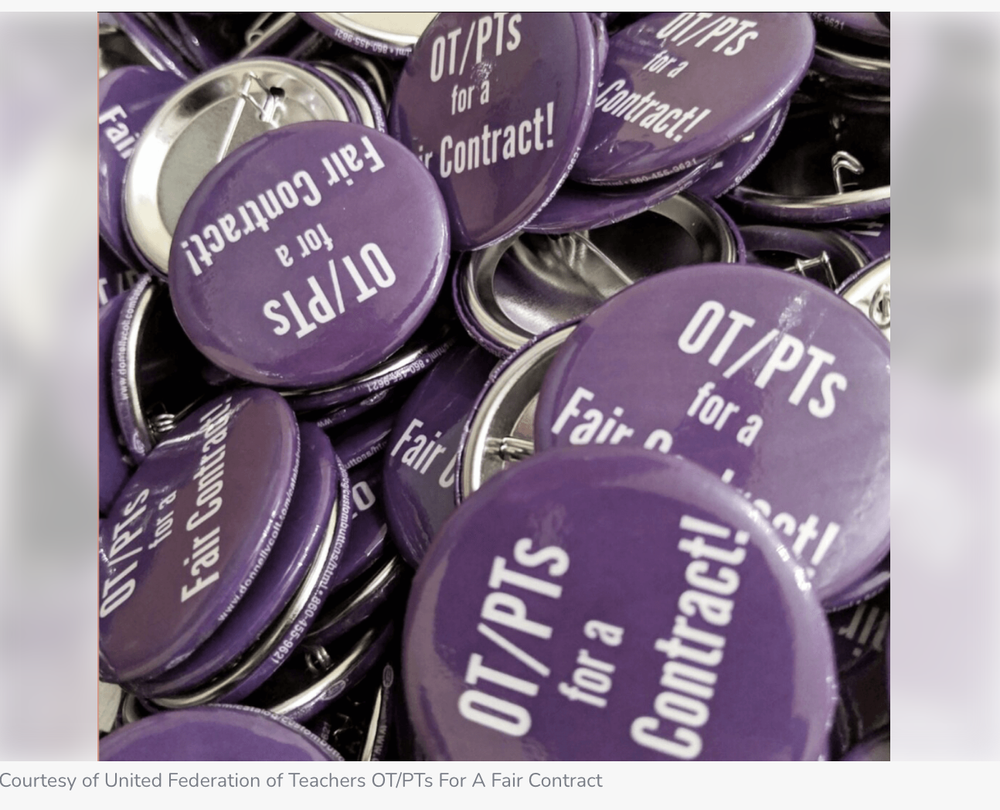
Almost 3,000 occupational and physical therapists [OT/PT] in New York City public schools are in the process of revoting on a contract they rejected by a 2–1 margin last month.

Officials of their chapter in the United Federation of Teachers say the union’s leadership refused to try to renegotiate the agreement, which members overall ratified by a 3–1 margin. The UFT says bargaining-unit members requested the revote.

“The next step should have been to go back to the bargaining table,” Alison Loebel Bertoni, a member of the OT/PT chapter’s executive board, told Work-Bites. “It was a fair and certified vote. It was not close. It was not compromised in any way.”

“Members of the OT/PT chapter considered possible options and next steps, and after consideration, it was the members of the chapter who asked for a revote,” UFT spokesperson Alison Gendar said.

The revote began Aug. 8, and ballots are due Aug. 29.

The bargaining unit was the only one of 12 in the UFT to reject the contract. Its members opposed ratification by 1,129-782, according to the results announced July 5. That margin covered a split among different occupations in the unit: OTs and PTs voted no by 1,074-545, while other members — school nurses, supervisors, and audiologists — voted 237-55 for ratification.

On Aug. 4, the UFT decided to put those groups of workers in a different bargaining unit. Loebel Bertoni says they had all asked to be removed.

‘Nothing for us’

“There was nothing in the contract for us,” says Mimi Greenberg, a member of the chapter’s bargaining committee.

Occupational and physical therapists work with special-education pupils. Physical therapists help them with gross motor coordination, Greenberg explains. Occupational therapists work with fine motor skills, such as whether pupils can use their hands well enough to write and use “manipulatives” such as the small blocks used to teach elementary math, and visual and perceptive skills such as being able to recognize numbers and write them.

“I don’t think the union has any interest in going back,” Alison Loebel Bertoni says. She describes UFT President Michael Mulgrew’s behavior as “dismissive” and “patronizing.” ”

Those children are “the most vulnerable people in our society,” Greenberg adds. She’s been an OT for 22 years and now works in Upper East Side schools.

Their main issue in the contract talks, she says, was parity with the other professionals who help develop the “IEPs” — individual education programs —required for each child in special education. OTs and PTs must have master’s degrees, but are paid significantly less than teachers, social workers, and speech therapists. Their top salary rate is more than $15,000 a year lower.

OTs and PTs get a 30-minute unpaid lunch, Loebel Bertoni says, while the others get a 50-minute paid break.

When the tentative agreement was revealed to the bargaining committee, Greenberg says, it included an unpleasant surprise: OTs and PTs normally do eight sessions a day, and a provision allowing them to do an optional ninth session had been added.

“It never came to the bargaining table,” Greenberg says, and chapter leaders had not been told about it. She fears that OTs and PTs will face pressure to do the extra session, or that the added workload could be used to reduce staff.

‘Scare tactics’

When the OT/PT chapter voted against the UFT’s previous contract in 2018, Loebel Bertoni says, the union “very quickly” went back to the bargaining table. They won somewhat better pay increases.

This time, she says, “I don’t think the union has any interest in going back.” She describes UFT President Michael Mulgrew’s behavior as “dismissive” and “patronizing.”

“The union tells the members this is the best we can get. We didn’t fall in line,” Loebel Bertoni says.

The OT/PT chapter is the only one in the UFT not led by the Unity Caucus, the group that has run the union since the days of Albert Shanker.

“I would expect a union leader to say, ‘you guys voted this down, there’s something wrong here, let’s try to get the city back to the table,’” Greenberg tells Work-Bites. “Instead, we got an email telling us what we would not be getting.”

“Your contract was voted down,” UFT Vice President Richard Mantell wrote in a July 10 email to chapter members. “As a result, all the new contractual benefits, including the pay increases and the $3,000 ratification bonus, will not be available for the therapists, school nurses, audiologists, and supervisors of nurses and therapists covered by this contract. You will continue to work under the terms of the previous contract.”

The latter groups got those benefits once they were separated from the OT/PT unit.

Both Greenberg and Loebel Bertoni call that message “scare tactics.” The UFT leadership said it got more than 1,000 emails from members asking for a revote after it went out, Loebel Bertoni says.

In a July meeting with chapter leaders, President Mulgrew “made it clear that the chapter had no good options,” Loebel Bertoni says; he told them that if they voted no, they wouldn’t get raises or new contract talks for years.

“They’re having a do-over on the same agreement,” Greenberg says. “Democracy has been stomped on.”


Monday, August 14, 2023

Our Health Care System is fundamentally a criminal enterprise - The Majority Report


I read your latest posts. I don't see that it's Aetn, Aetna, Aetna -- but in a propaganda war the focus had to emphasize their faults. If the come back with United Health that will be the focus.
But when I went to DC last week the focus was on the entire MedAdv program.

My favorite daily watch/listen had a good segment on healthcare on Wednesday with a reporter for The American Prospect which has been doing a major work on healthcare.
She calls the entire healthcare system fundamentally a criminal enterprise. Her segment probably starts at around 20 minutes in. I have to listen to it again as I was taking a walk and missed some points.
I think I'm going to start paying for the Prospect. I already pay $10 a month for Majority Report.

8/9 U.S. Healthcare: A “Sick” System; What’s Next For SAG-AFTRA w/ Moe Tkacik & Nicole Cyrille (M)

August 9, 2023
% buffered2:32:25Current time2:41:53

FUN HALF LINK HERE: https://www.youtube.com/watch?v=z3BQtrKFU8w&ab_channel=TheMajorityReportw%2FSamSeder


Sam and Emma speak with Moe Tkacik, investigations editor at The American Prospect, to discuss her recent suite of pieces in this month’s issue on the U.S. healthcare system. Then, they’re joined by Nicole Cyrille, member of the SAG-AFTRA negotiating committee, to discuss the recent developments in the strike and what to expect going forward. Sam and Emma start off the show by reacting to the big victory in Ohio surrounding Issue 1, the ballot measure that Ohio Republicans were attempting to utilize to make it harder for Ohioans to codify abortion rights into the state Constitution in the fall. Ohio Secretary of State Frank LaRose spoke with Steve Doocy on Fox & Friends this morning, to make clear that actually, it’s totally fine that his side lost by millions of votes! Then, they’re joined by Moe to discuss her astounding amount of reporting in this month’s issue of The American Prospect about the U.S. healthcare system, and its frankly near-criminal origins. Moe traces back how the healthcare industry as we know it, dating back to the 1960’s, was essentially created by crooks, leading to the essential codification of healthcare law that is rarely ever enforced, and which essentially benefits a sprawling network of middlemen at the expense of actual patients. The structure of this policy Moe claims, ultimately leads to adverse outcomes: making patients sicker then healthier, while a smaller group of individuals become richer and richer. Moe also traces some of the history of the American Medical Association (AMA), the standard for healthcare administration prior to the 1960’s, as well as an organization characterized in opposition to socialized medicine. Moe then tells the story of United Healthcare, one of the premier organizations that characterized and revolutionized the inequitable structure of U.S. healthcare through the advert of HMO’s, or health maintenance organizations, and how, through their financing structure, HMO’s make it extremely difficult for medical professionals to maintain a successful practice via lowballing them, while also making pains to only offer coverage for necessary care. Sam, Emma, and Moe, discuss how United Healthcare and the HMO model is essentially a vertical integration model, and how that model spread from United Healthcare to other aspects of the industry, like drug pricing. Moe enlightens Sam and Emma on the weird tale of Pharma Bro Martin Shkreli actually *taking on* price gougers of a certain drug before he got into his own troubles doing some price gouging of his own. Moe also breaks down pharmacy benefit managers (PBM’s), the distributors of pharmaceuticals and their presence within the supplying of drugs to pharmacies and customers, and the inherently corrupt bargain that legitimizes them in the healthcare supply chain. Moe finally breaks down some potential solutions to the inherent corruption, grift, and mismanagement within the U.S. healthcare system, including a more robust enforcement of Medicare fraud laws.


 Here's one of the best reports on the medadv scandal herre in NYC and the judge ruling in favor of retirees.


Retirees Health Care: win permanent protection - Press coverage

 We heard Friday Aug. 11 that the judge made his temp ruling permanent. Here are the news coverages. I will add more as they come in.


https://www.thecity.nyc/health/2023/8/11/23828912/medicare-advantage-switch-ban-retirees-adams?fbclid=IwAR2MXOPl66BCwzXGuOCbui-oCaFRvQZYv3Aaug5MtXm6cZsE26DTSFjksSw_aem_AVxyUrqCM-n2xFe3re6xhuvG1hoqyRh6KOF5GOfiyvnzy-YhGfjp2l0HhvN64B8GwV8&mibextid=Zxz2cZ 

Judge ‘Permanently’ Bans Medicare Advantage Switch for City Retirees 

The Adams administration had intended to switch 250,000 retired public-sector workers to a controversial privately run health care plan on Sept. 1.

A Manhattan Supreme Court judge issued a ruling Friday “permanently” prohibiting New York City from switching its 250,000 retired employees and their elderly or disabled dependents to a privatized Medicare Advantage plan managed by Aetna.

Manhattan Supreme Court Justice Lyle Frank sided with city retirees, finding merit to their argument that the planned switchover violated longstanding guarantees by the city that every active and retired city worker is entitled to city-funded healthcare through a combination of Medicare and other supplemental insurance.

In his decision, Frank ordered the city “permanently enjoined from requiring any City retirees, and their dependents from being removed from their current health insurance plan(s), and from being required to either enroll in an Aetna Medicare Advantage Plan or seek their own health coverage.”

Frank granted the retirees’ petition to stop the switch for the reasons he outlined in a July 6 ruling granting a preliminary injunction. In that decision, Frank wrote that the retirees “have shown that numerous promises were made by the City to then-New York City employees and future retirees that they would receive a Medicare supplemental plan when they retired, and that their first level of coverage once [they] retired would [be] Medicare.”

The administration of Mayor Eric Adams moved to switch retirees as of September 1, adhering to pacts with unions made under former Mayor Bill de Blasio that aimed to save the city $600 million annually.

The Adams administration inked the Aetna deal with the support of the Municipal Labor Committee, a consortium of 102 public sector unions. The MLC voted to approve the Aetna contract in March.

“We are extremely disappointed in this ruling and intend to appeal” Frank’s decision, said mayoral spokesperson Jonah Allon.

“This Medicare Advantage plan, which was negotiated closely with and supported by the Municipal Labor Committee, would improve upon retirees’ current plans, including offering a lower deductible, a cap on out-of-pocket expenses, and new benefits, like transportation, fitness programs, and wellness incentives,” Allon said. “This decision only creates confusion and uncertainty among our retirees.”

The head of the NYC Organization of Public Service Retirees, a lead plaintiff in the case, said she hopes the retirees’ victory will inspire other retirees nationwide to act to prevent their employers and unions “from privatizing the Federal Public Health Benefit of Medicare.”

“This is now the third time in the last two years that courts have had to step in and stop the City from violating retirees’ healthcare rights,” Marianne Pizzitola, the groups’ president, said in a statement Friday afternoon. “We once again call on the City and the Municipal Labor Committee to end their ruthless and unlawful campaign to deprive retired municipal workers of the healthcare benefits they earned.”

It’s not the first time the courts have sided with retired city workers on the issue: Retirees successfully sued last year to block a previous version of the plan. In that case, a judge barred the city’s alternative offer, which would have been allowed retirees to keep their existing Medicare with Medigap health plans — if they paid $191 a month.

The Aetna deal that’s now enjoined was key to locking in an estimated $600 million in annual savings that municipal unions agreed to, in order to help cover the cost of wage boosts and benefits. 

Many retirees have argued that the long-planned switch from traditional Medicare to the privately run Medicare Advantage would increase their health care costs and make it more difficult to get approvals for procedures.

As Frank noted in his prior decision, an attorney representing Aetna acknowledged in court that some people might not be able to keep their doctors under the plan.

A prominent labor historian said the retirees’ victory signals the “beginnings of an effort to create a nationwide movement” to enable retirees to retain their traditional Medicare. 

“I think the New York example shows that if retirees who know how to organize — and after all these people who had experience in the union movement, people who are used to acting together — if they band together and dig in their heels, they can really tie up the city and other government entities into knots,” said Joshua Freeman, professor emeritus at Queens College and a member of the CUNY Professional Staff Congress retiree council.

“They’re pushing back and they have been remarkable in what they’ve achieved in New York City so far — it’s not over, but it’s pretty incredible what’s happened.”

 ====


The Court Amended the Order for a typo.  Because we believe in accuracy in reporting we are sharing the correction.  AND…   an updated statement in response to the Mayor’s Office!  There is always A LOT to say!

Mayor’s Office: “We are extremely disappointed in this ruling, and intend to appeal. This Medicare Advantage plan, which was negotiated closely with and supported by the Municipal Labor Committee, would improve upon retirees’ current plans, including offering a lower deductible, a cap on out-of-pocket expenses, and new benefits, like transportation, fitness programs, and wellness incentives. In addition, it would save $600 million annually, especially critical at a time when we are already facing significant fiscal and economic challenges. This decision only creates confusion and uncertainty among our retirees.”

Marianne Pizzitola states, “The only one confused or uncertain is the Mayor if he cannot see that the Aetna  Dis-Advantage plan is:

·        NOT Medicare

·        NOT a savings

·        NOT an improvement to our current plan as even Congress knows that!

·        Trades access to health care and our lives for cheap “perks” like SilverSneakers or processed meals we do not need nor want

·        A danger due to prior authorizations, wrongful delays and denials of care and drains the Federal Medicare Trust with ‘upcoding’

·        A diminished health plan that will harm retirees

·        Will NOT save $600 million annually

The Court repeatedly found the City is on the wrong side of history, breaking several laws to implement this scheme which would harm the very people who built this City.  If the Mayor wants to save the City money, he should live up to the promise made to us as we lived up to ours, and he should stop spending taxpayer dollars to harm senior citizens and the disabled.  The City and the Municipal Labor Committee sought to sell off Retiree Healthcare to enrich a fund they misused.  Their savings agreement has been found illegal and they should drop this idea and go back to the drawing board.   Call a mulligan already and come up with better solutions like we suggested and leave retirees alone.”


State Supreme Court Rules Against New York City’s Plan to 

Strip City Retirees of Promised Medicare Benefits


\

Court Had Issued Preliminary Injunction in July; Today’s Ruling Permanently Bans City From Implementing Inferior Aetna Medicare Advantage Plan


NEW YORK, August 11, 2023  — Today, the New York County Supreme Court issued a final ruling permanently stopping the City from forcing a quarter-million elderly and disabled retirees off of their longstanding Medicare insurance and onto an inferior type of insurance called “Medicare Advantage.”  Unlike Medicare—a public program that has protected City retirees for the past 57 years—the City’s new Aetna Medicare Advantage plan is a private, for-profit endeavor that would limit retirees’ access to their medical providers, prevent retirees from receiving care prescribed by their doctors unless Aetna deemed it “medically necessary,” and expose retirees to increased healthcare costs.


The Court had issued a preliminary injunction last month, with Supreme Court Justice Lyle E. Frank noting that the retirees “have shown by clear and convincing evidence” that implementation of the new Aetna Medicare Advantage plan would likely violate their rights in numerous ways.  Justice Frank also ruled that “should this plan go forward, irreparable harm would result” to countless retirees.

Today the Court ruled in favor of the retirees on multiple grounds.  Among them was the fact that, since the 1960s, the City has guaranteed every active and retired City worker—by statute and through written and verbal promises—that when they became elderly or disabled, they would be entitled to City-funded healthcare through a combination of Medicare plus Medicare “supplemental” insurance, which covers healthcare expenses that Medicare does not.  

The decision is available here. 

Jake Gardener, a partner at Walden Macht & Haran LLP, counsel to the retirees, says, “We are grateful to Justice Frank for again recognizing the multiple ways in which the health and healthcare rights of retired City workers would be imperiled by the City’s new Medicare Advantage plan.  Because of Justice Frank’s well-reasoned decision, hundreds of thousands of senior citizens and disabled first responders will be able to continue receiving the medical care they desperately need and to which they are entitled.”


Marianne Pizzitola, President of the New York City Organization of Public Service Retirees, one of the lead plaintiffs, states, “This is now the third time in the last two years that courts have had to step in and stop the City from violating retirees’ healthcare rights.  We once again call on the City and the Municipal Labor Committee to end their ruthless and unlawful campaign to deprive retired municipal workers of the healthcare benefits they earned. Knowing after every win, the City has found a way to go around the Judge’s decision, the City Council should support Intro 1099 sponsored by Councilman Charles Barron, and stop this administration from wasting taxpayer dollars appealing righteous decisions by the Court. NYC Retirees earned their right to Federal Medicare and we relied on the promise we would have this benefit through our lifetime.  We hope this decision will help retirees nationwide stop their former unions and employer from privatizing the Federal Public Health Benefit of Medicare so we can live the rest of our lives in peace.”

Jake Gardener, Attorney:

Marianne Pizzitola, NYC Retiree:

Marianne Pizzitola

President

NYC Organization of Public Service Retirees

And


FDNY EMS Retirees Association


‘Christmas Gift in August’: Retirees Fighting Medicare Privatization Cheer Judge’s Latest Ruling

By Joe Maniscalco

“Yaaaay!”

New York City retiree Roberta Gonzalez reacted with total glee today after learning municipal workers fighting to retain their traditional Medicare health insurance coverage have won yet another big victory in court.

“It feels almost like a Christmas gift in August,” Gonzalez told Work-Bites. “I’m feeling very appreciative.”

“It is hereby ORDERED,” New York State Supreme Court Justice Lyle Frank wrote in his Aug. 11 decision, “that the Respondents are permanently enjoined from requiring any City retirees, and their dependents from being removed from their current health insurance plan(s), and from being required to either enroll in an Aetna Medicare Advantage Plan or seek their own health coverage.”

Municipal retirees like Gonzalez who devoted decades of their lives working for the City of New York with the promise of having problem-free health insurance when all was said and done, have spent at least the last two years fighting one administration after the another bent on taking that very same promise away from them.

Hizzoner Eric Adams used to be a staunch opponent of the profit-driven Medicare Advantage scheme, calling it a “bait and switch” on the campaign trail, and railing into then-Mayor Bill de Blasio for trying to push it on seniors.

On Friday, however, City Hall was quick to release a statement following Judge Frank’s ruling, in which the Adams administration announced its plan to appeal the decision, while also touting the supposed benefits of Aetna’s Medicare Advantage plan.

“We are extremely disappointed in this ruling, and intend to appeal,” the statement said. “This Medicare Advantage plan, which was negotiated closely with and supported by the Municipal Labor Committee, would improve upon retirees’ current plans, including offering a lower deductible, a cap on out-of-pocket expenses, and new benefits, like transportation, fitness programs, and wellness incentives. In addition, it would save $600 million annually, especially critical at a time when we are already facing significant fiscal and economic challenges.”

City Hall further stated, “This decision only creates confusion and uncertainty among our retirees.”

Municipal retirees organized into groups to fight back against the push for privatization, however, have always been crystal clear about profit-driven Medicare Advantage plans being far inferior to traditional Medicare — even with Aetna’s “SilverSneaker” perks.

“This is now the third time in the last two years that courts have had to step in and stop the City from violating retirees’ healthcare rights,” FDNY EMT retiree and NYC Organization of Public Service Retirees President Marianne Pizzitola said in a statement following Judge Frank’s ruling. “We once again call on the City and the Municipal Labor Committee to end their ruthless and unlawful campaign to deprive retired municipal workers of the healthcare benefits they earned.”

Pizzitola later responded directly to City Hall saying, “The only one confused or uncertain is the Mayor if he cannot see that the Aetna  Dis-Advantage plan is not Medicare; not a savings; and not an improvement to our current plan — as even Congress knows that!”

Just a few weeks ago, New York City municipal retirees fighting the ongoing privatization of Medicare were saluted as heroes at “Save Medicare” rally held in the nation’s capital.

The head of the New York City Organization of Public Service Retirees also insists  Medicare Advantage, “Trades access to health care and our lives for cheap perks like SilverSneakers or processed meals we do not need nor want” — and is a “danger due to prior authorizations, wrongful delays and denials of care and drains the Federal Medicare Trust with upcoding.”

Other New York City municipal retirees who are presently undergoing treatments at Memorial Sloan Kettering Cancer Center tell Work-Bites they fear Aetna’s Medicare Advantage plan would, in deed, force their doctors to start seeking prior authorizations currently not required by traditional Medicare.

Work-Bites reached out to Sloan Kettering for clarification, but was instead referred to Aetna.

Finally, Pizzitola says Aetna’s Medicare Advantage plan is a “a diminished health plan that will harm retirees,” and “will not save $600 million annually.” 

Work-Bites previously reported how NYC Comptroller Brad Lander called that $600 million figure into question before ultimately deciding not to officially register the city’s Medicare Advantage contract with Aetna. The mayor later went on to ignore Lander’s refusal and deemed the contract registered anyway.

“The Court repeatedly found the City is on the wrong side of history, breaking several laws to implement this scheme which would harm the very people who built this City,” Pizzitola added. “If the Mayor wants to save the City money, he should live up to the promise made to us as we lived up to ours, and he should stop spending taxpayer dollars to harm senior citizens and the disabled."

Pizzitola further insists, “The City and the Municipal Labor Committee sought to sell off Retiree Healthcare to enrich a fund they misused. Their savings agreement has been found illegal and they should drop this idea and go back to the drawing board. Call a mulligan already and come up with better solutions like we suggested and leave retirees alone.”

Like Gonzalez who suffers from 9/11-related cancer, many of the retirees fighting back against privatization, are the same people who’ve helped the City of New York survive its darkest days — and are now suffering for it.

“I feel very dismissed by the city,” Gonzalez says. “And now I feel very angry at people who I feel are looking at older people like we don't matter, like we don't deserve what was promised to us and what we worked for.”

“Medigap” refers to that portion of retiree healthcare costs left over after traditional Medicare pays the bills. The City of New York has been covering it for nearly 60 years as part of the promise to its municipal workforce. It’s a big reason why generations of people have decided to come and work for NYC in the first place.

Stu Eber, president of the Council of Municipal Retirees Organizations [COMRO], called Judge Frank’s ruling “another important defense of our right to premium free Medigap.”

“Once again, it is clear that we need to have all parties, including retirees, at the table to find appropriate ways to save on healthcare for employees and retirees,” he told Work-Bites. “Waiting for another round of appeals is not helping the MLC [Municipal Labor Committee] receive their $600 million dollars this year. And waiting doesn’t relieve the tax burden on all of us. It’s time to form the blue ribbon panel suggested last year to resolve the issues.”

So far, the Adams administration continues to tune out those calls.

Legislation before the New York City Council could protect traditional Medicare and put an end to the anguish privatization is causing retirees. But as of today, that legislation — Intro. 1099 — still only has 16 sponsors. Speaker Adrienne Adams not being among them.

“Knowing after every win, the City has found a way to go around the Judge’s decision, the City Council should support Intro 1099 sponsored by Councilman Charles Barron, and stop this administration from wasting taxpayer dollars appealing righteous decisions by the Court,” Pizzitola added. “NYC Retirees earned their right to Federal Medicare and we relied on the promise we would have this benefit through our lifetime.”

Gonzalez views the passage of Intro. 1099 as “the most logical step” for members of the New York City Council.

“I can't see why that wouldn't be the most logical next step for them, seeing that the judge seems to think that we are right, and the city is wrong in trying to do what they're doing.”

While local elected officials may have pretended otherwise, the scheme to save New York City a supposed $600 million a year by pushing municipal retirees into a scandal-plagued profit-driven health insurance plan deceptively dubbed “Medicare Advantage” — was always in line with the larger nationwide campaign to privatize traditional Medicare as we know it.

“We hope this decision [by Judge Frank] will help retirees nationwide stop their former unions and employer from privatizing the Federal Public Health Benefit of Medicare so we can live the rest of our lives in peace,” Pizzitola said.

Despite the joy Judge Frank’s decision has brought Gonzalez, she knows the fight against privatization is far from over.

“The issue isn’t over and I’m afraid the city will try to find a way around this resolution, just like they have tried before,” she said. “I think they hope we will run out of steam or money, and go away if they keep using their never-ending taxpayer funds to fight us  [because] we are limited-funded older folks on fixed incomes. We need to continue to press City Council to approve [Council Member Charles] Barron’s local law 1099 to codify the law, so the city can’t come back at us through any alternate routes. Additionally, we need to continue to support original Medicare, and fight against the privatization of Medicare — and to get to Medicare for all.”

 https://www.work-bites.com/view-all/3n70aj65w5bp2xtvv3rrh235yc0twj