Published Online: Education Week, December 22, 2009 COMMENTARY Charter Schools: Education's Fox in the Henhouse?Successful urban charter schools are showing that high demand, high support education works for all students—not just Jewish and Asian and upper-class kids, but all kids who commit to academic success. Some of these schools’ achievement gains are very impressive. So why am I, a retired public school teacher of 34 years, cautious and suspicious? Perhaps there’s a hidden agenda, one that may be revealed by the following questions: 1. Are charter schools “culling”? Are they taking in lots of low-income youngsters, keeping the high-achievers, and sending the rest back to the regular public schools? 2. Are high-performing charters spending huge amounts of money per student, thereby getting the large achievement gains one might expect from one-to-one tutoring and after-school and summer support? Although many charters receive less public funding per pupil than their public school counterparts, these schools can supplement their budgets with grants—and with private money. 3. Do charter schools create disinformation campaigns against the public schools, so that urban districts will turn over their schools to what appears to be an idealistic crop of young administrators with proven results? 4. Are these idealistic young administrators working hand in hand with the Wall Street investors who already have brought this nation to financial disaster? As The New York Times reported earlier this month, hedge-fund managers play a significant role in New York City’s charter movement. 5. Is the ultimate goal privatization? Have the financiers realized that voucher plans are politically dead, leading them to implement their privatization strategy through charter schools? I doubt that privatization would improve the nation’s schools. It certainly would result in the destruction of the public school teaching profession, the last secure, middle-class occupation in America. My own take on effective education reform is based on two seemingly contradictory assumptions: Education is a public good, and competition is a good thing. Perhaps public education should become something more akin to what the U.S. Postal Service now is: a quasi-governmental institution that allows for limited competition. Private companies compete with the post office in overnight, package, and other special deliveries, but regular mail service is left intact. A system like this forces the government-supported component to improve or lose resources. Don’t misunderstand me: I’m not a shill for the public schools and the teachers’ unions. Teachers in public schools have few incentives to excel. Their pay is fixed, based on experience and degrees. The system in which I worked for over three decades took good care of me, but it did not lead me to work as hard as I could have. Could merit pay be a solution? Michelle Rhee, the controversial chancellor of public schools in the District of Columbia, has offered teachers there the possibility of high salaries in return for their giving up tenure protections for one year. Of course, hedge-fund managers would laugh at my calling the proposed salaries of up to $130,000 high ones, but let’s simply ask whether the potential of more pay would attract good teachers. Finding talented math and science teachers is especially difficult; maybe an incentive system would bring in candidates with better math and science skills. But who might be willing to give up the benefits of tenure? How about those Teach For America recruits, who are only going to teach for a couple of years anyway? Even TFA’s most well-known critic, Stanford University’s Linda Darling-Hammond, admits that the students of certified TFA teachers do better in math. This makes me wonder if a lot of these folks—the successful charter schools, the hedge-fund managers, Chancellor Rhee—are on the same team. If they are, let’s ask another question: Is this a better team than the one that’s in charge now? The one in which teachers make political contributions to become administrators, while their former colleagues who stay in the classroom have to work second and third jobs to send their children to college? Maybe we do need some sort of incentive system for professional educators. I prefer one based less on standardized tests and more on “customer satisfaction.” And I do believe that charter schools should be allowed to compete on an equal playing field. But I absolutely do not believe that any school district should turn over all its schools to a corporation. Special education services would be slashed immediately. Unregulated monopolies—public or private—are not good for the consumer. Privatization does offer the hope of some helpful efficiencies, but a form of public-private competition would be the better answer. Of course there are those who would argue that I am overreacting. I have no proof that the hidden agenda of the charter school movement is to privatize American public education. Some sources (including The New York Times) say the hedge-fund managers see their involvement in charter schools as community service, rather than profit-generating. Only time will tell if this is true or not. I love community service, but I also believe that capitalists are geniuses at finding new markets and ways to put the screws on the working class. I am among the few lucky Americans to have a decent pension and good health care, and I want others to have the same. Privatizing the public schools would not help any of us educated, middle- and working-class folks. It would just move more of us, and our children, into the ranks of the working poor. One of my great professors in college believed that the public schools were nothing less than the foundation of American democracy. Lawrence A. Cremin of Teachers College, Columbia University, knew full well that this nation’s education system was imperfect. But he also understood that we have continually tried to reform public schools precisely because we believe in them. Are we ready to give up on an institution that, throughout our history, has promoted and sustained our democracy? Should we not recognize the fact that our poorest students are failing to achieve at high levels largely because we have allowed wealth and income gaps that are morally intolerable to exist in this country? The arguments for privatization sound good at first, but once you give the fox the key to the henhouse, it’s virtually impossible to get it back. Vol. 29, Issue 16 |
Wednesday, December 23, 2009
Charter Schools: Education's Fox in the Henhouse?


Tuesday, December 22, 2009
JW's Email #11
Science Skills Center HS for Science Technology and Creative Arts; International Arts Business School; School for Legal Studies; Boys and Girls; Maxwell; FDA IV; Metropolitan Corporate Academy HS; Secondary School for Law; Robeson; FDNY HS; HS for Civil Rights
Peace and Diversity; Columbus; Monroe Academy for Business Law; Grace Dodge; New Day; Gompers; Clinton; Smith; JFK; Jane Addams; Global Enterprise; Community Research and Learning
Norman Thomas; Murray Bertraum; Choir Academy of Harlem; Academy of Environmental Science; University Neighborhood HS; Legacy School for Integrated Studies; Washington Irving; Chelsea Career and Tech; Coalition School for Social Change; Graphics; Leadership and Public Service
Beach Channel; Business Computer Applications and Entrepeneurship; Jamaica; John Adams; Grover Cleveland; Math Science Research Magnet; Richmond Hill
1. The side agreement that the UFT reached with the DOE in June regarding our pension benefits was only recently enacted into law by the NYS Legislature. Benefit changes for members hired after Dec. 9, the change in the rate of return for the fixed TDA plan, and other questions are answered at Q&A at this link.
Monday, December 21, 2009
Reading woes continue to plague city schools
News — By Alexandra DiPalma on December 19, 2009 at 6:33 pm
http://pavementpiec

Susan Klein and Sarah Gardner are ninth grade teachers at Marta Valle Secondary School. Photo By Alexandra DiPalma
At Marta Valle Secondary School in the Lower East Side, more than 30 students and three aides are squeezed into mismatched tables and chairs during Sarah Gardner and Susan Klein’s ninth grade English class. Some students are facing the back of the room because their desks don’t fit any other way.
Despite the discomfort, every student listens attentively as Klein reads aloud from “Swallowing Stones,” giggling as two of the book’s characters share a kiss by the pool. Klein has an easy rapport with her kids; she cracks jokes and exchanges personal stories but does not compromise her authoritative position. When she yells “One mic!” in her booming voice, everyone immediately sits up straight and listens.
Although they work to engage students and create a positive learning environment, Klein, Gardner and the other teachers at Marta Valle appear to be fighting a losing battle.
Not one student in Klein’s class is reading on the appropriate grade level. Fewer than half of the students at Marta Valle will graduate. Klein, along with many other educators, attribute the continuing deterioration of New York City public education to misguided reform efforts put forth by Mayor Michael Bloomberg and the Department of Education, particularly in the areas of performance assessment and spending.
“I compare Bloomberg’s reforms to selling golf balls to people stranded in the desert. It just doesn’t work,” Klein said. “You need to be selling bottled water.”
In his Nov. 3 victory speech, Bloomberg vowed to “keep improving what is far and away the best public school system of any big city in the country,” citing “amazing progress” over the past eight years. But critics of the mayor’s agenda have seen little progress. Leonie Haimson, executive director of Class Size Matters, a non-profit clearinghouse for information on class size, believes that reform efforts thus far have been wholly ineffective.
“We know that there are a few education reforms that have been proven to work to improve educational outcomes,” Haimson said. “The problem is that none of these have been implemented.”
Instead, reform strategies have included a new report-card system for city schools, in which the DOE grades schools from A to F, and an effort to increase the education budget, in which it allocates money directly to schools.
Marta Valle is only one example of a school in which the strategies have severely backfired. Gardner, Klein and a number of education experts place heavy blame on the DOE’s school report card system, designed to promote accountability and transparency.
In 2009, 84 percent of New York City public schools received an A — an incredulous jump from 23 percent in 2007. These numbers indicate a trend that Klein considers one of the main problems at Marta Valle, and a major flaw in new reforms. She believes that interest in improving students’ academic abilities is superseded by the need to meet bogus department standards.
“Students whom I fail, who cannot read and should be held back, are moved to the next grade to keep the numbers up and make the school look good,” Klein said. “This is the root of the reading problem. It perpetuates the cycle and ruins kids’ chances at literacy.”
DOE Deputy Press Secretary Danny Kanner, however, says the reports are necessary and effective.
“The report-card system is a mechanism by which parents, teachers and the DOE can hold schools accountable for student progress,” Kanner said. “Then, schools can be dealt with accordingly.”
Still, the initiative has been met with harsh criticism. Jennifer Jennings, a sociologist at Columbia University, compares the progress reports to a flawed medical check-up. Just as doctors are accused of medical malpractice, she views the system as educational malpractice.
“The progress reports create an illusion of improved progress where none actually exists,” Jennings said. “It doesn’t do anyone any favors to pretend that things are better than they are.”
Schools that receive an A or B on the DOE progress report are eligible for cash rewards, while those getting a D or F are threatened with closure. As educators face unrealistic pressures that threaten job security, instances of falsifying school records, wrongful promotion of students and cases of grade tampering have become more common.
“The reports have lead, or forced, teachers into skewing data to improve results artificially without ever getting to the actual problem, which is providing students with a proper education,” Haimson said. “It’s a travesty.”
With the distractions created by the pressures of report-card data, attention has been drawn away from the students. And at Marta Valle, they need all the help they can get.
“It’s a fight to the death just to get my kids to class, let alone take an interest in their own academic improvement,” said Gardner.
One way to encourage students to take an interest in academic improvement, educators agree, is to decrease class sizes. But despite campaign promises and a 72-percent increase in the city’s education budget since 2002, class sizes have not gotten any smaller.
According to the most recent data released in late November by the DOE, all class size averages have gone up in the past year. High school English classrooms such as Klein and Gardner’s now have an average of 26.4 students compared to 25.6 in 2008.
Small classes are especially important at Marta Valle, where 75 percent of students are disadvantaged.
“It is well understood that poorer, disadvantaged kids inhabit environments that are incredibly adverse to educational opportunities,” Jennings said. “From the minute they walk into the classroom, they are behind.”
These students require more attention from teachers in order to compensate for lack of access to out-of-school opportunities and resources, which families are unable to provide. Having fewer students per teacher allows for more individual attention.
“At a place like Marta Valle, students become disengaged in large classrooms without individualized instruction,” Haimson said. “They feel like no one cares.”
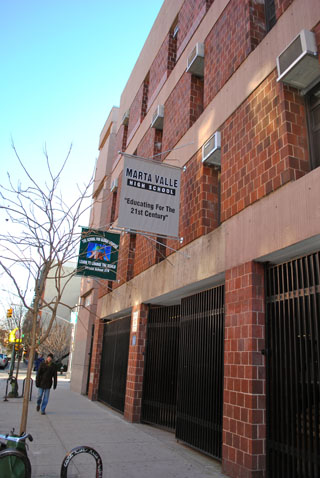
Marta Valle Secondary School in the Lower East Side.
In addition to special attention from teachers, Jennings says that access to school resources and improved facilities help to narrow the achievement gap.
“Educational resources, because they’re not always available at home, need to be equalized for poorer students,” Jennings said. “So far, New York has done a good job at this equalization in many schools.”
According to Susan Klein, the facilities and resources at Marta Valle are still not up to par. When students were required to gather research for an essay, it had to be done during class time because many students do not have computers at home.
“We arrange trips to the school library so that students can get necessary information, but equipment problems delay progress,” Klein said.
During one trip to the computer lab, only one printer erratically worked, and all of the computer paper ran out. Klein and Gardner’s 30 students managed to print out only a few pages of information, and some left with nothing.
Doing research for a paper, a task that can typically be completed for homework in one night, occupies days of valuable class time at Marta Valle and are further delayed by facility issues. This lagging productivity, exacerbated by misguided funding, causes students in schools like Marta Valle to fall behind in academic skills across the board.
Despite the criticisms of Bloomberg’s reform efforts, Kanner is optimistic about the future of New York City public education, especially with President Obama in office. Bloomberg plans to take advantage of Obama’s Race to the Top competition, which rewards states for successful reform advances.
“Over the next four years, we will sustain and build on progress that has already been made,” Kanner said. “Significant funding opportunities made possible by the Obama administration will help to further the mayor’s vision.“
So far, Bloomberg’s vision hasn’t alleviated the challenges faced by public school teachers like Gardner and Klein. They said they struggle each day to stay optimistic and to remind themselves they are making a difference. The key, Gardner says, is to remember that each child has the ability to improve, regardless of the faults in the city’s education system.
“The big idea, that I find myself repeating in my head each day,” Gardner said, “is that every student is capable of being successful, no matter what.”
Sunday, December 20, 2009
Ugly Detroit Teacher Contract: Was Randi the handmaiden
1. The Vote No Prepare to Strike Committee meets today at 4 pm at the Gacious Savior Lutheran Church, 19484 James Couzens (Lodge northbound service drive, just north of Seven Mile)
2. The DFT contract vote was 2031 no, 3578 yes.
3. 14 DFT members filed a formal internal grievance with the DFT Election Committee last night, insisting that the committee not certify the results of the vote until they have heard our evidence about the many, many voting irregularities.
4. The Election Committee said that they will give us a date for the hearing. The Election Committee did not vote to certify the elections or issue any statement contradicting their unanimous December 15th letter, in which they insisted that the vote be suspended due to massive irregularities.
5. An appeal letter has been sent to the AFT national union president. Copies were attached to yesterday's email.
6. We are very close to having the 1000 signatures to recall Keith Johnson. The hearing to vote on his recall will be held at the next DFT General Membership meeting, Thursday January 14th after school.--If you have signed petitions call 313.645.9360 for pick up.
7. Bobb has failed in court and failed in Lansing this week to win the legal power over DPS academics, which immediately raises the question as to what authority he had to bargain this contract in the first place, and why in the world Johnson negotiated with him.
Call 313.645.9360 or email marquette6@hotmail.com for more information about the Vote No Committee
Fight Implementation of this illegitimate contract, in every school and in every classroom!
Recall Johnson! Stop the high-jacking of the DFT!
Defend public education!
Plantora wrote:
Regarding Detroit Teacher's Contract, Thanks for paying attention. I'm a Detroit Teacher, trying to find ways to get our side of the story out. The details of the contract reveal what I heard someone call "the worst contract for teachers every passed by any union". But the last sentence of Weingartartens statement is the most important. "The agreements' education reforms and provisions...are mere words on paper without the continued collaboration between teachers , their union, and the school district". This is one teacher, and there are many more, who will do whatever it takes to prove her right, and keep it no more than words on paper.
Tuesday, December 15, 2009
Do these people have no shame? Ravitch on The Race to Nowhere
The Race to Nowhere
I understand why you were taken aback by that article in the "Style" section of The New York Times last week that described how charter schools have become a must-have among hedge-fund managers, billionaires, and other members of the social elite in New York City. The article bothered me, too. In fact, the more I think about it, the more it worries me. Having written the history of the New York City public schools, I was reminded of the origins of free schooling in certain northeastern cities in the early 19th Century, when wealthy men decided that it was their civic duty to help civilize the children of the poor. In their view and in their day, they were doing good deeds, but their schools were stigmatized as charity schools for children of paupers and were avoided by children of the middle class. Outside of big cities, public education emerged as a community response to a community's need to school its children, not as a charitable venture.
Today, with the proliferation of charter schools, we may be seeing a resurgence of the historic pattern as public schools are privatized and taken over by very rich men (and women) who see themselves as saviors of the children of the poor. Naturally, you find this a repellent portrait because it undermines the democratic foundations of public education. It means that our society will increasingly rely on the good will of wealthy patrons to educate children of color. It means that education is seen as a private charity rather than as a public responsibility. Let's hope that the new owners who have taken over these schools are able to sustain their interest. After all, having 500 children in your care is not the same as having a stable of polo ponies or a vineyard in Napa Valley. If the children don't produce results that make the sponsors proud, they may pick a different hobby.
Though the rise of the hedge-fund managers as charter school operators may distress us, it thrills others because it dovetails so perfectly with the Obama administration's Race to the Top. I don't know about you, but I am getting sick of the rhetoric of the Race to the Top, as it implies the very opposite of "equal educational opportunity." But "equal educational opportunity" is so...yesterday, so now we shall all "race to the top," to see who can get there first. Who can privatize the most schools? Who can close the most public schools? Which district can replace the most public schools with charter schools? Who can compel their teachers to focus intently on those pesky math and reading test scores? Who can boot out the most teachers whose students didn't get higher scores than last year? Who seriously believes that this combination of policies will produce better education?
We try not to be New York City-centric, but so much is happening in this city that it is hard not to see it as a bellwether. After all, NYC not only was a faithful representation of No Child Left Behind, but it is now outfitting itself to be a faithful representation of the Race to the Top. This is not a hard transition because NLCB and the Race to the Top are really the same, except that President Obama and Education Secretary Arne Duncan's "Race" has nearly $5 billion as a lure to persuade states to climb aboard the express train to privatization.
In the past few days, Chancellor Joel Klein has announced that he is closing nearly two dozen public schools. Some of these schools are the anchor in their communities; some have long histories as gateways for immigrant children. In recent years, the Department of Education decided that it does not like large high schools, so it has been closing them down and sending their lowest-performing students to other large high schools, which then have lower scores and more disciplinary incidents. Some of the large high schools were beyond saving, but most could have been improved by a thoughtful plan of action, including smaller classes, better supervision, and the kinds of resources that hedge-fund managers pour into "their" charter schools. Unfortunately the data-driven MBAs at central headquarters know nothing about instruction and curriculum or about any strategies that might improve a school. They have no school-improvement strategy. What they know best is how to shut down schools, and in this they will find funding and encouragement from the Obama administration.
As soon as the central administration decides to close a school, it is a fait accompli. New York City has a rubber-stamp "board" of 13, with a majority appointed by the mayor, serving at his pleasure; it approves every executive decision, with only a single dissenting vote (the heroic Patrick Sullivan, a public school parent). Public hearings are pro forma; no decision is ever reversed. Parents and teachers may protest 'til the cows come home, and they can't change a thing. Their school will be closed, the low-performing students will be dispersed, and either new small schools or charter schools will take over their building. Some of the schools that will close are, funnily enough, small schools that were opened by Bloomberg and Klein only a few years ago.
Does anyone believe that this sorry game of musical chairs will improve education? Does anyone in Washington or at central headquarters grasp the pointlessness of the disruption needlessly inflicted on students, families, teachers, principals, and communities in the name of "reform"? Do these people have no shame?
Diane
Norm Scott
normsco@gmail.com
norscot@aol.com
917-992-3734
Blogs: http://ednotesonline.blogspot.com/
http://normsnotes2.blogspot.com/
UFT Proposed Resolution on School Closings for Dec. 16 DA
WHEREAS Chancellor Klein and the Department of Education have announced the closure of an unprecedented number of twenty-two New York City public schools, disproportionately drawn from the ranks of high schools; and
WHEREAS the decision to close such a large number of schools, especially high schools, is based not on any educational calculus, but on the need to pursue the Chancellor’s political agenda of freeing up space to house new charter schools and new DoE schools; and
WHEREAS since 97% of the elementary and middle schools received grades of ‘A’ and ‘B’ on the School Progress Reports, reflecting the inordinate weight the reports give to state exams, Chancellor Klein and the DoE have attempted to disguise the political character of their space and closure decisions by closing large numbers of high schools; and
WHEREAS among the schools announced for a number which are in good standing with the New York State Education Department and are meeting their Annual Yearly Progress goals under No Child Left Behind, a school which it just opened four years ago and a school which received a school-wide bonus for meeting their progress goals; and
WHEREAS among the schools announced for closure are those which have made academic progress in recent years; and
WHEREAS there are serious and fundamental flaws in the School Progress Reports which are used as a basis for these decisions:
· the inordinate weight [85% of the total grade] given to scores on New York State ELA and Math exams for the elementary and middle school levels;
· the establishment of new cut scores for grades this year at the same time that old ‘peer index’ [the measurements of student need] were maintained, even though many schools with low grades had greater numbers of high needs students;
· the use of scores on the 8th grade New York State ELA and Math exams to establish the ‘peer index’ for high schools, thus failing to give the schools that take in large number of “over the counter” students, some of whom are the highest needs students in our schools [i.e., recent immigrants who are English Language Learners with limited formal education in their native country], full credit for their challenging student populations;
· the failure to distinguish between special needs students in “less restrictive” and “more restrictive” environments in the calculation of ‘peer index’, thus treating schools with large numbers of students with more severe learning disabilities as if those students had less severe disabilities;
· the placement of schools with concentrations of high needs students in ‘peer groups’ with schools which do not share many of the same challenges;
· the failure to provide appropriate credit for academic progress to schools with large numbers of transfers and “over the counter” students who do not have scores on 8th grade ELA and Math exams;
WHEREAS as a consequence of these flaws, the School Progress Report grades for high schools reflect as much the concentration of student need as the actual academic performance of a school -- by the DoE’s own measures the high schools targeted for possible closure because of poor grades have a ‘peer index’ over 20% lower, reflecting far greater need, than high schools receiving a grade of ‘A’;
WHEREAS the Chancellor and the DoE have failed in their basic responsibility to provide schools with concentrations of high needs students the supports and the resources necessary for their education, and are now blaming those schools for their management failures;
WHEREAS the decision of the Chancellor and the DoE to close so many high schools and replace them with charter schools and new schools that do not serve high school grades will result in an overcrowding of the remaining high schools and in the rolls of teachers placed in the Absent Teacher Reserve [ATR];
WHEREAS under the new governance law recently passed, the decision to close a school should not be made unilaterally by the Chancellor, but require an educational impact statement by the DoE and a process of consultation with the Community Educational Council and School Leadership Team that allows for public reaction and comment; therefore be it
RESOLVED that the United Federation of Teachers condemns Chancellor Klein’s decision to close an unprecedented number of New York City public schools in order to create space for new charter schools and new district schools; and be it further
RESOLVED that it is the “persistently failed management” of Chancellor Klein and the DoE -- and in particular, the concentration of students with high needs in a number of existing schools and the failure to provide those schools with the supports and resources necessary for the education of those students -- that needs to be phased out, not schools; and be it further
RESOLVED that the UFT condemns the cavalier decision of Chancellor Klein and the DoE to close schools in a way that will greatly increase school overcrowding and the ranks of teachers in the Absent Teacher Reserve, thus exacerbating problems already created by their “persistently failed management”; and be it further
RESOLVED that when a New York City public school slated for closure determines that they will oppose this decision as without educational merit, the UFT provide full and complete political, logistical and educational support to that school in their efforts to overturn that decision; and be it further
RESOLVED that the UFT support efforts to utilize the process of consultation for closing schools outlined in the new governance law to overturn closure recommendations without educational justification; and be it further
RESOLVED that the UFT mobilize the membership in all schools to provide support for schools fighting educationally unjustified closure decisions.
Monday, December 14, 2009
Move Jan. 26 PEP Out of Staten Island to Central Location
Dear Chancellor Klein:
cc: Michael Best
We urge you to move to a more central location the Panel for Educational Policy meeting that will decide the fate of 36 schools, many of which are slated for closure, as well as a host of critical regulations that relate to parent involvement and the role of parents and teachers in decision-making at the school and district level.
We object because this time and location — January 26 at 6 PM on Staten Island — does not afford stakeholders and members of the community who will be most affected by these momentous decisions a reasonable opportunity to be heard.
The site would take more than an hour and a half to get to for most NYC parents, students, and teachers, making it impossible for those with daytime responsibilities to get to the meeting in time to comment.
To hold such a meeting in a location and time inaccessible to overwhelming majority of NYC students, teachers and parents is wrong and legally suspect.
We ask that you respond to this request as soon as possible.
SIGN HERE: Name, (parent or teacher?), school, district, office or organizational affiliation if any:
Norm Scott, Retired teacher, Education Notes, ICE, GEM
Thank you.
March 4th Strike and Day of Action is now a national call
California has recently seen a massive movement erupt in defense of public education -- but layoffs, fee hikes, cuts, and the re-segregation of public education are attacks taking place throughout the country. A nationwide resistance movement is needed.
We call on all students, workers, teachers, parents, and their organizations and communities across the country to massively mobilize for a Strike and Day of Action in Defense of Public Education on March 4, 2010. Education cuts are attacks against all of us, particularly in working-class communities and communities of color.
The politicians and administrators say there is no money for education and social services. They say that "there is no alternative" to the cuts. But if there's money for wars, bank bailouts, and prisons, why is there no money for public education?
We can beat back the cuts if we unite students, workers, and teachers across all sectors of public education — Pre K-12, adult education, community colleges, and state-funded universities. We appeal to the leaders of the trade union movement to support and organize strikes and/or mass actions on March 4. The weight of workers and students united in strikes and mobilizations would shift the balance of forces entirely against the current agenda of cuts and make victory possible.
Building a powerful movement to defend public education will, in turn, advance the struggle in defense of all public-sector workers and services and will be an inspiration to all those fighting against the wars, for immigrants rights, in defense of jobs, for single-payer health care, and other progressive causes.
Why March 4? On October 24, 2009 more than 800 students, workers, and teachers converged at UC Berkeley at the Mobilizing Conference to Save Public Education. This massive meeting brought together representatives from over 100 different schools, unions, and organizations from all across California and from all sectors of public education. After hours of open collective discussion, the participants voted democratically, as their main decision, to call for a Strike and Day of Action on March 4, 2010. All schools, unions and organizations are free to choose their specific demands and tactics -- such as strikes, rallies, walkouts, occupations, sit-ins, teach-ins, etc. -- as well as the duration of such actions.
Let's make March 4 an historic turning point in the struggle against the cuts, layoffs, fee hikes, and the re-segregation of public education.
- The California Coordinating Committee
(To endorse this call and to receive more information contact march4strikeanddayofaction@gmail.com and check out www.defendcapubliceducation.wordpress.com )
Sunday, December 13, 2009
Columbus HS Letter to NY State Regents
Today is a vital day. It is our last chance to reach the Regents prior to their meeting tomorrow. I sent each of them a detailed 18 page report going through our accountability data point by point, but Regent Rosa lead me to think that they may still be reading emails this weekend, therefore lets make sure they are flooded with material. Additionally - please go to the NYSED website and email Commissioner Steiner.
Garnering support from Bronx Borough President Ruben Diaz is also extremely important - please try to send him an email today also urging him to support our community.
His email address is: webmail@bronxbp.
Again - feel free to tailor the letter below - but remember that the focus must be on urging postponement tomorrow.
Finally -check out the comments following the blog - Karen Sherwood put in another outstanding attack.
Here's the form letter...
Dear Regent ____________
(personal intro)
On the eve of the December Board of Regents meeting I am writing once more to urge you, at the very least, to postpone the decision on Christopher Columbus High School. While you have already received a detailed rationale for this, I would like to make one further point.
The way the accountability is structured presumes that a school receives a fairly constant population guided basically by urban geographic and socioeconomic factors that change extremely slowly over time. This is not the case for Columbus - we have received a major influx of the highest needs students that has left AYP and absolute 4 year graduation rates a virtual impossibility. We are not a failing school - although we can and do always strive for improvement - we have many students who graduate over 5, 6, and 7 years. Our most recent 7 year statistics are a graduation rate of 81.5% (NYC average being 72.2%) and our drop out rate was 18.2% (city average 27.8%). Many of our students, and notably our English Language learners who arrive in their junior or senior years with no English take far longer to pass Regents Exams - particularly English.
Our population is mobile and vulnerable and needs to be supported rather than crushed. The DoE plans to replace Columbus with an existing school (KAPPA) from district 10. The students from this school are much lower need than those at Columbus, in fact they are lower need than the prestige programs already housed on the campus. This is one more step in the segregation of students that has been going on for that last 10 or so years - bringing in a large number of high ability students from this existing school in September and having no place for our special needs students and recent immigrants who will then be sent to a more distant large high school.
We believe that our community will reject this move at our January 7 public hearing. Columbus has projects on two sides of the school and we do need to serve a large number of high needs students from our immediate locality.
Please recognize that education is far more than outcome data and that our most vulnerable students who struggle to achieve ARE important, not only to this school community, but to our State. Allow us to go through the process in New York City without circumventing the outcome with a decision as to our future now. Your placement of Columbus on the RTTT application at this time will effectively make you the ones responsible for the de facto banishment of the highest needs children from this neighborhood in the Bronx. It is a mixed neighborhood and deserves services for all of its students.
Your postponement of this decision would allow for a public process around Columbus, and for the community to have a say in its future.
Sincerely,
Thursday, December 10, 2009
Ravitch: Obama and Duncan Launch NCLB 2.0
Diane asks good questions and doesn't pretend to have the answers. That is refreshing.
by Diane Ravitch
Dear Deborah,
We promised to keep a close watch on what is happening at the federal level, and now it begins to get interesting. And a bit scary, if you care about the future of public education.
The U.S. Department of Education announced its plan to spend at least $3.5 billion to push local officials around the country to close failing schools and reopen them with new teachers and principals. At this time of fiscal crisis and budget cuts, districts are desperate for federal dollars. To qualify for these dollars, districts must do one of four things: 1) fire the principal and at least half the staff and reopen the school with new staff; 2) turn the school over to a charter operator or other private managers; 3) close the school and send the students to higher-achieving schools in the district; or 4) replace only the principal and take other steps to change the school.
Sounds just like the sanctions in NCLB. The Obama-Duncan plan might as well be called "NCLB 2.0."
Arne Duncan is certainly familiar with school turnarounds. He closed down a number of schools in Chicago. Studies done by Chicago think tanks have shown that most of the brand-new, turned-around schools enrolled few of the students who previously attended "failing" schools. The Consortium on Chicago School Research produced a report revealing what happened to students when their "failing" school was closed: 80 percent of the students enrolled in low-performing schools transferred to other low-performing schools. There is no evidence that the turnaround strategy in Chicago has produced positive results. Catalyst, the first-rate independent group that covers education issues in Chicago, reported in September that high school test scores in Chicago were stagnant, even in the highly-touted transformation schools.
Charter school organizers and management companies must be licking their chops, waiting to scoop up the new federal dollars and new opportunities for market expansion. The charter movement began as an effort to strengthen public education, but it has turned into a movement to get rid of public sector unions and to turn public schools into private schools funded by public dollars.
Is the charter movement up to the challenge? According to a thoughtful report by Tom Toch, the best charter management organizations are already overstretched. They don't have the financial resources to grow (but the federal dollars will solve that problem), but more importantly, they have a high rate of turnover among principals and teachers. Not every teacher can sustain that 60-65 hour work week that is expected of charter teachers. Tom wrote the original report (a draft of which was printed on Dean Millot's blog), but defenders of the charter movement at Ed Sector edited the report so heavily that Tom took his name off the report before it was released. Is the charter movement so fragile that it must muzzle the voice of a friendly critic?
For more on the new face of the charter movement, see Scholarly Investments in the Dec. 5 issue of The New York Times. There we learn about the aggressive hedge-fund managers—millionaires and billionaires—who are thrilled to have their own school. One gets the sense that these guys--whose innovative investment strategies helped to bring our economy down—see the public schools as charities, in which they can "leverage" public funding while playing the role of do-gooders. One of the m/billionaires says he likes the cash flow associated with charters. He gets to put his name on a privately managed school paid for with public dollars. Will the entrepreneurs stick with their new investments, or will they dump them like a penny stock if the scores don't rise enough to satisfy their board members? If they get bored with "their" school, will they look for other forms of amusement?
I wonder about the students in the 5,000 schools that Obama and Duncan want to close. Will they be shuffled off to other low-performing schools, as they have been in both Chicago and New York City?
I wonder, too, about who will work in the 5,000 brand-new schools? Are there 5,000 super principals waiting in the wings to lead them? Where will they find the tens of thousands of "great" teachers who will staff them? Or will they play musical chairs with the principals and teachers from the schools that were closed?
What we are witnessing now is the culmination of the plans of the education entrepreneurs who are driving national education policy at the highest levels. They are not educators. They do not understand how to help or support a school, so their first instinct is to close it down and start over. I think that is called creative destruction. Just watch: It will be coming soon to a school near you.
— Diane Ravitch
Education Week blog
2009-12-08
http://tinyurl.com/ykb6avj