Tuesday, September 05, 2023

Melissa Williams, Uncensored: "The game is rigged. It was rigged for two years. We are only now seeing the full force of the abuse of power in a union with one-party rule."


Melissa Williams, Uncensored: "The game is rigged. It was rigged for two years. We are only now seeing the full force of the abuse of power in a union with one-party rule."

Melissa Williams, shares her experience as chapter leader for occupational and physical therapists under Michael Mulgrew's Unity - the partisan patronage caucus machine that controls UFT leadership.

 Note:  I am publishing this outside of UFT email because none of what I say would get through the editing of UFT leadership.
 

When members of OTs and PTs for a Fair Contract ran and won the Chapter Leadership in 2021, we ran without much information provided about what the job would entail because (as I have  learned very well over 2 years) very few union HR policies and procedures are actually in writing.

At my first solo meeting with union leadership in July 2021, I was asked, “Why did you run?”, and was told “the chapter leader job is what you make of it.”

In fact, our Executive Board was not allowed to make the job as we wanted. The first evidence of that is when we were not allowed to place our own elected members into the PM staff positions (the 12 hours a week of  time that was theoretically available to assist the chapter leader). The prior elected chapter  leader and PM staffer were allowed to keep the job, but this was not made clear to me until October 2021. I learned by accident when I was “taken out of the sandbox” of the Salesforce HR  system (the system with all union members’ information) in October 2021 and saw that the prior PM Staffers had been working for weeks without informing me. I was finally informed in my office, in the next breath after I told leadership that my dad was just put in hospice, that “we don’t just fire people.” If our group would have known that we would not have been able to place our own people in PM staff jobs, I don’t think we would have run.

In my mind it is the equivalent of Mayor Adams being forced to keep all of De Blasio’s former staff. They were both Democratic mayors, but they each have their own ideas and priorities. This idea that “we are all one chapter” and should work together, when there was deception right in the beginning and a pattern of steering people to PM staff on social media to bypass the actual elected chapter leadership was the first of many challenges in our tenure.

Following the advice of Barbara Madeloni, former Massachusetts Teacher Association president who mentored me in the early months of my chapter leadership, “don’t make private beef public because the average therapist doesn’t care,” I did not make public the early undermining of our elected leadership.  At the time, I was trying out her philosophy to “stand somewhere while drawing people in at the same time.” Over time, my ideas about this philosophy in the context of the UFT power structure have changed.  

The first three months were a whirlwind made worse by the sudden and horrible way my father died in October 2021 due to medical errors caused by extreme understaffing on his dementia unit. There were times in the first six months of my tenure that I didn’t take lunch because I was answering emails nonstop about COVID policies, pivoting to remote tele-therapy, and the mess of the recovery payment issues. Concurrently, I returned to in-person therapy after 18 months of working remotely and dealt with all the normal stressors of being a clinician in a pandemic. I quickly realized that if I didn’t start erecting some boundaries, that the chapter leader job would take over my life.

At this time, I was also told by numerous male, highly paid, full-time union staffers that “the chapter leader job is 24/7.” I countered that with, “but you said the chapter leader job is what I make of it.” I began setting a 30-minute timer at the union office to hold myself accountable for taking a duty-free lunch. I began placing limits on checking union emails on non-union days. The job still took over my life. 

Our Executive Board’s successes during this time were to have many members of the Executive Board plus members of the rank and file to present the items on our consultation agenda each month. As much as I don’t think consultation made a significant change in our working conditions, I do hope that the practice of giving average therapists “voice” in consultation continues after our leadership. We also conducted remote meetings with 200 plus attendees each month when the expectation is only 6 chapter meetings a year, not twelve.

This year on top of contract negotiations we ran 12 chapter meetings, a new hire orientation, an itinerant PK meetings, a D75 meeting, and a meeting to unpack the racist comments by the former AOTA  president at the AOTA conference this year. The use of remote meetings increased the ability to conduct more meetings and increase access and participation. I also went to numerous Panel of Education Policy meetings, sometimes staying up until 1 AM on a school night to testify about our working conditions.  

The winter of 2021 and spring of 2022, our chapter leadership was consumed by understanding  the parameters of the payment issues and became drafted payroll experts. I began to see that the pattern of dealing with these types of issues one by one, instead of as a systemic issue, was part of a pattern of UFT leadership enabling the DOE to be negligent in their basic duties to pay people in a timely manner.

One union leader framed it to me as a type of “harm reduction,” but I remain convinced that if leadership continues to enable the DOE not to perform the basic functions as an employer, the DOE will have no incentive to do right by us.

The current Summer 2023 paraprofessional pay issue is a perfect example. I learned that our union leadership tends to play defense instead of offense on these payment issues. After all the many months of work our OT/PT Executive Board did gathering data for the UFT Grievance Department, the UFT Grievance Department failed to pursue the Transfer List 2022 issue, the recovery pay  arbitration, or substantively address the months of non-payment some therapists experience  coming off of parental leave. The success we had addressing the SEED Payment issues this year  is because we showed up at Panel of Educational Policy meetings, Citywide Council of Special Education meetings, and leveraged our relationships with parent leaders.

All of that was achieved outside of the union power structure.  

In the Spring of 2022, when I was given the list of therapists who wanted to be on the  negotiation subcommittee, I chose Marilena Marchetti, delegate Jen Clavin, Susan Paul, OT vice-Chair Hannah Fleury, Chapter Secretary Rachel Feinsilver, Regional OT At Large Beth Salzman, and Itinerant PK PT, Peter Romagnuolo. Jen Clavin withdrew so OT delegate Mimi Greenberg was replaced as an alternate. When Marilena left the DOE in the Summer of 2022, we were not allowed to replace her. However, the union leadership, without prior consent or consultation, placed two former chapter leaders and an OT PM staffer on our committee as well. This is yet another example of union leadership organizing around the elected leadership of our chapter.

During our many subcommittee meetings we were told by union leadership to “shoot for the moon,” only to have those demands such as the 7th session later weaponized  against us by the members of the subcommittee that were paced without elected chapter leadership consent by union leadership. During bargaining, it did feel that we had reached consensus as a group after very careful and thoughtful planning of demands.

The fact that the members of the committee that were placed there without consent are now mischaracterizing what happened at the table seems like it was the design all along. Most of the therapists on the OT/PT bargaining subcommittee did not go to their second and third jobs so they could attend  these meetings. Everyone there had a stake in the outcome of our bargaining. Everyone there faced the city when they turned down every single one of our demands. Everyone there could see that the city’s two demands were an attempt to get us to begin servicing charter schools  and to maximize our productivity in a way that could potentially displace therapists with less  seniority who happened to be payrolled in co-located schools.

At the end of the last session with the city, the UFT staffer who was the leader of our subcommittee said to us, “I hate to say this, but this is an example of effective bargaining.” He stated that sometimes the best you can do is avoid future harm. If the leader of our subcommittee stated that we engaged in effective bargaining, one has to ask themselves what the motivation is of the prior OT/PT chapter leadership as well as current union leadership to characterize our bargaining as rigid in our seeking of pay parity as well as a form of “politics and games” by an “extreme group who has  taken over our chapter.”  

Our subcommittee took the negotiation process very seriously. The seriousness and good faith with which we approached the process was assaulted by the information we received with the entire 500-person bargaining committee that an optional 9th session was added at the 11th hour  without our consent. The explanation given was that “you all said you wanted us to get more  money for you and all of this happened quickly.” We were promised that if anything happened  in the governance committee that would directly affect us that we would be consulted. That was a lie.

The majority of our subcommittee would have said no to the 9th session because we  have been fighting any form of the 9th session since at least 2007. We would have said no to the new rate of pay that is not our regular overtime rate. We were not given that option.

For many of us on the committee, it was an affront to the entire integrity of the bargaining process and formulation of demands. It is particularly offensive when our legitimate concerns are dismissed by comments such as, “We are all adults, just don’t take the work”.

(There is a magic word, ‘no’” without a touch of insight into the irony about asserting that we should exercise our right to say NO in this instance but not when voting down the contract).

Many therapists in understaffed D75 schools who are already pressured to “partially serve” students will now be coerced to perform 9th sessions and it is a minimization of our concerns and a lack of understanding of our actual working conditions to state otherwise.  

When this current Executive Board ran, we ran on and were elected on the understanding that we were going to fight for pay parity. There were other members of our bargaining unit who also refused to back down from the idea of pay parity, yet curiously that fact is not being weaponized against them as it is now weaponized against us by union leadership.

In 2018, there was a financial subcommittee where money could be moved around. This time around we were  informed that there was no such subcommittee. We were not informed of the extra money  from the stabilization fund that was used to give the supervisors a raise until after the tentative  agreement was released. Had we known, perhaps the other chapters in our bargaining unit would have also tried to get some of that money which would have resulted in less for supervisors.

I am curious as to why the stabilization fund was not presented to our subcommittee. It fits a pattern of union leadership pitting chapters in our bargaining unit  against each other in a zero-sum game. We did not create our bargaining unit, nor do we have control over the fact that union leadership refused to break up the bargaining unit in 2018 and 2019 when they were asked by the smaller chapters in our bargaining unit, just as we now have no control that union leadership is framing it as an “injustice” to the other members of our unit that we voted “No”.  

When the information came out about us voting down our contract with 56% voter turnout and 2/3 of therapists voting no, it was immediately presented to us by union leadership as if it was a mistake to exercise our right to vote no. The tone was demeaning and paternalistic.

Union leadership made it very clear that they had no intention of fighting the city on our behalf. A meeting was called by union leadership in which the functional chapter leaders in our bargaining unit were not involved. Instead of inoculating us against fear of a prolonged fight and congratulating us about exercising the only leverage we have under the Taylor Law, a NO vote, the wheels of an unprecedented revote were already set in motion.  

It is important to think about what it means in our union to have a “mandate” to lead as elected  leaders. Our current chapter leadership won our positions with a wide margin in an election with low voter turnout. Although 200 therapists routinely logged in to monthly Zoom meetings, that is still only about 7% of our chapter. At our two meetings in June 2023 where over 1,000 therapists logged in, that is still only about 25% of the chapter. 44% of our chapter did not mail in a contract ratification ballot.

Despite the words of our union president who accuses current chapter leadership of “politics and games,” a union is a political organization. Politics exist to address social problems. Our lack of pay parity sits at the intersection of women’s rights, disability rights, civil rights, and racial inequality. Every union decision is inherently political and  the idea that “politics” is weaponized against our elected chapter leadership is deeply disturbing.

Our chapter leadership led with information we gleaned from the therapists who  showed up and engaged in the work of unionism. We lead despite active antipathy, like this post that was written by a caucus whose president is also the Staff Director of the UFT.

The game is rigged. It was rigged for two years. We are only now seeing the full force of the abuse of power in a union with one-party rule.  

In the face of a revote, I am stepping down as chapter leader of occupational and physical therapists. The precedent of our union has always been to run votes through the American Arbitration Association and to accept the results of those votes. These are my bare minimum expectations if I am to continue to give my time to a “democratic” organization.

A revote is undemocratic on its face. If our chapter votes no, I will still be a member of the bargaining subcommittee unless union leadership decides to remove me which at this point seems a strong  possibility. I am deeply sorry to the therapists who exercised their right to vote only to have  union leadership humoring the possibility of a revote, encouraging an email campaign, refusing  to perform their fiduciary responsibility to bargain based on our vote, and using a convenient sample of emails to justify a revote to get the desired outcome of both union leadership and the city.

Many therapists who voted no have told me they are going to throw the new ballot in the garbage, and I understand the sentiment. I encourage everyone to exercise their right to vote again to continue to fight for the pay and working conditions of our students and therapists in the richest city in the history of humanity deserves.  

At the beginning of my tenure, I wrestled with the question, “how do you stand somewhere and welcome people in at the same time?” After two years, the question I began to ask myself was “how do I stand somewhere, with the mandate of the therapists who elected me, and  effectively lead when union leadership exercises their power and control of the mechanisms of communication to undermine me at every turn?” With the current structure of the functional chapter leader job, my answer is that I am unable and unwilling to continue to engage with that question.

It has been posited by the ruling union caucus that I am “taking my ball and going home.” In fact, I am engaging in the regenerative Politics of Refusal.

To paraphrase poet Mira Mattar, this is not a NO, but a YES to “not-this.” Despite my best efforts, to use the language and analysis of my profession, the environmental barriers set up by the ruling union caucus made it  impossible to do the “occupation” of chapter leadership in the way I promised in my original campaign statement. It also required me to neglect other areas of occupation in my life, including the role of parent, grieving daughter, and friend in order to perform a job that was not living up to its promise.

The occupational and physical therapist chapter leader represents 2,963 people on two work release days . It is my opinion that the job will be effective if there is a chapter leader or delegate for each borough with dedicated time and pay to represent each borough.

We also need a dedicated group of therapists organizing and mobilizing outside of  official union positions at the district and D75 levels. A huge barrier to this work is the fact that up to 75% of us still work second jobs, which is why we fight for pay parity. 

Our anger about our pay and working conditions seems to have gotten lost amid this “disorganization” campaign this summer. This conciliatory energy to accept these crumbs is not the energy of the 200 therapists who showed up to monthly meetings the past two years.

I look forward to wrestling with these questions outside of the current chapter leader position after I restore some “occupational  balance” to my life. I will have more energy for actual organizing instead of acting as an unwilling enabler of the DOE HR and payroll department.

Thank you for the support of those who elected me over the past two years.


Healthcare is a human right - Labor Day Parade Sept. 9


The Central Labor Council website, in the issue section on health, states 
"Health care is a basic human right." 
and
"Of course, the most cost-effective and equitable way to provide quality health care is through the social insurance model (“Medicare for All”), as other industrialized countries have shown." 
It's time for New York State and the power of labor to lead the way


 NYC Labor Day Parade 

BCanvass  Sept. 9th *b

*Never canvassed or flyered before? Rusty on the New York Health Act? 
The flyers have our talking points (see below). Also, there will be canvass trainings and NYHA 101's offered evenings Wednesday, Sept. 6 RSVP  and  Thursday Sept.7th . RSVP to get details TBD.


Clickable RSVP Link 


Click here to check out our constantly-updated page for all things M2EFF!


To see more events click here for NYPAN's Calendar
Got anything you want publicized? To get your events in the NYPAN calendar  Email it to the Calendar here!

Support Grassroots Action New York
Follow us on social media!
Grassroots Action New York is a founding chapter of the New York Progressive Action Network (NYPAN) and an affiliate of Our Revolution.

Monday, August 28, 2023

The Buisness of American Healthcare - A Sick System - The American Prospect


https://americanprospect.bluelena.io/index.php

 
Norman,
Where is the money for the most expensive health care system in the world going? The cut of gross national health care expenditures commanded by administrative overhead and waste has ballooned to an estimated 30 percent; the portion that pays doctors and nurses has fallen. Wealth extraction, whether through excessive billing, under-delivery, or the constant buying and selling of hospitals, has become the new normal in American health care.

Once upon a time, doctors and providers were some of the foremost defenders of our for-profit system. But in recent years doctors and nurses have had a disarming sense of clarity about the fundamental conflict between caring for patients and delivering value to shareholders. We think everyone should understand this fundamental disconnect with our system.

That’s why we decided to dedicate our August 2023 print issue to the business of health care—the inner workings of the monopolies and cartels extracting ever-greater sums for ever-lousier outcomes, and the policies and protocols pushing doctors and nurses to the brink—and increasingly into labor unions.

To kick off the series, Maureen Tkacik and I wrote an overview of what’s at stake in our corporatized health care system, both how it has gutten patient care and the ways providers are fighting back. It’s available on our website today.

Today, we also present the story of Stephanie Arnold, a young family physician who, after years of working several precarious jobs owned by private equity, finally started her own direct primary care practice to provide her patients affordable and comprehensive care untouched by corporate greed.

You can read the entire series as it is released here.

It’s thanks to reader support that our newsroom has the resources to pursue stories this, Norman. You can help support this work by becoming a member today. All of the reader support we receive funds our editorial mission: illuminating stories about ideas, politics and power.

Thanks for being a part of this,

David Dayen
Executive Editor,
The American Prospect


The American Prospect, Inc.
1225 I Street NW, Suite 600
Washington, DC 20005
United States


Saturday, August 26, 2023

100 Days In, Brandon Johnson Is Steadily Shifting Chicago’s Political Terrain - In These Times

100 Days In, Brandon Johnson Is Steadily Shifting Chicago’s Political Terrain

Movement organizers and political strategists assess the new mayor’s record as he seeks to make Chicago a progressive beacon—while modeling co-governance.

href="https://inthesetimes.com/article/brandon-johnson-chicago-mayor-100-days-movement-organizers

Taylor Moore

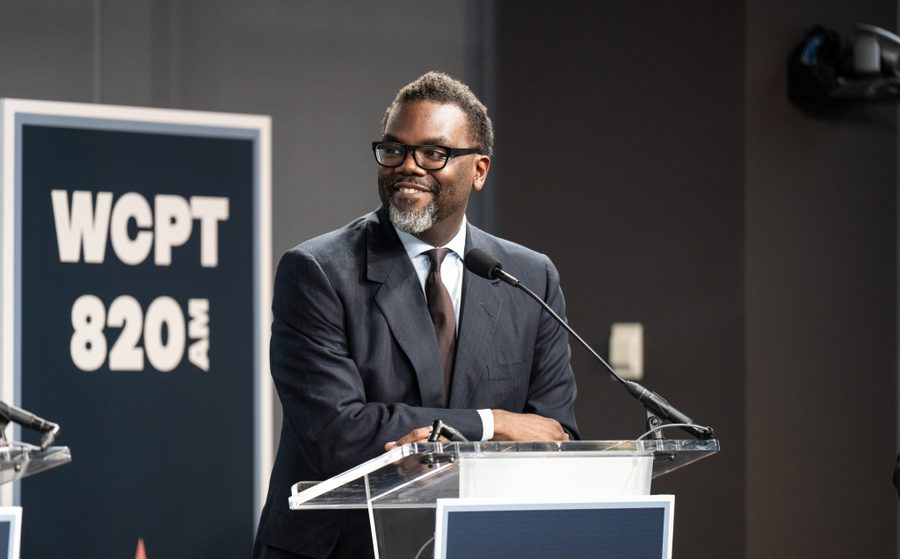
Chicago's 57th Mayor, Brandon Johnson. Paul Goyette
In May, longtime teachers union organizer Brandon Johnson ascended to the Chicago mayor’s office, becoming one of the most progressive leaders of any major city in the United States.

Just months before the election, Johnson was polling at 3%, far behind the frontrunners in the race, and had little name recognition. God bless. Brandon Johnson is not going to be the mayor,” said then-incumbent Mayor Lori Lightfoot on January 21, just over a month before the first round of the election.

Johnson’s win against the city’s most formidable political insiders, including former Chicago Public Schools CEO Paul Vallas who he faced head-to-head in the second round of voting, represented a rejection of the status quo for a city that’s facing crises ranging from the pandemic to police abuse to pay-to-play politics and decades of disinvestment in Black and Latino communities.

We can reject the false choices that have been presented to us for too long,” Johnson, a former Cook County commissioner and middle-school teacher, said during his victory speech on April 4. We get to do it for everyone, Chicago. We don’t have to choose between toughness and compassion, between the care of our neighbors and keeping our people safe. If tonight is proof of anything, it is proof that those old, false choices do not serve this city any longer.”

One hundred days into his term, Johnson has begun to shepherd key progressive policy priorities through the City Council, built relationships with President Joe Biden and Illinois Gov. J.B. Pritzker, and taken steps to ameliorate the city’s migrant crisis that’s been spurred by GOP officials around the country. He has also courted some amount of controversy with some of his staffing decisions, including the hiring of interim police superintendent Fred Waller (and later, into the permanent role, Larry Snelling) and the firing of public health commissioner Allison Arwady.

The 100-day milestone, though arbitrary, has traditionally been a temperature check on the policy priorities and leadership style of a new administration that has moved from campaigning to governing. To better understand Johnson’s first 100 days in office and what it could spell for the next four years — or longer—In These Times spoke to more than a dozen movement leaders, elected officials, researchers and political strategists, including Johnson himself.

We’ve laid a real clear foundation that we’re going to need in order to build a better, stronger, safer Chicago, and we’ve done that in the collaborative spirit which we promised we would do,” Johnson tells In These Times.

In a late August interview, the new mayor recounted some of his biggest accomplishments, including advancing the Treatment Not Trauma proposal and creating new deputy mayor positions related to immigration, community safety and labor rights. Johnson also worked with the business community and the Bring Chicago Home Coalition on a proposed real estate transfer tax that would combat homelessness by lowering the real estate transfer tax for most homebuyers and raising it for properties over $1 million.

Monday, August 21, 2023

From Detroit to Hollywood, New Union Leaders Take a Harder Line Pushed by angry members, unions representing actors, autoworkers and UPS employees are becoming increasingly assertive under new leadership.


GT Zura
Bowling Green, KYAug. 17

NEGOTIATIONS FOOD FOR THOUGHT 1975 to 2022 GM auto worker pay of $6.25/hr adjusted for inflation would be $36.67. BASICALLY THE SAME, except for tiers. GM president Lee Iacocca pay of $292K adjusted for inflation would be $1.7M. Mary Barra yearly compensation $29M SEVENTEEN TIMES HIGHER! According to Barra Math and my calculations the auto worker should be making $600 PER HOUR!

Arguably my two leftmost political opinions are on display in this delightful bit of news: 1) All workplaces should be unionized, and 2) If what it takes to overcome runaway corporate executive compensation is to bring the economy to its knees through labor stoppage, then so be it, let's have more strikes than a bowling tournament.

MikeH
Upstate NYAug. 17

@Jerry Davenport Going bankrupt is a rather extreme way of calling their bluff, wouldn't you say? Yellow went under because of years of poor management, not because of union demands.


Carter

I was involved in my union for decades. Over the years I rose up through the ranks and was elected to a high position and sat on the executive council of our International Union. One of the largest in the country. The higher I rose in the Union, the less it was about the membership. It became almost solely about organizing new members (money) and politics. Whenever I voiced my concern and issues about the members I represented I was quickly shut down. If there was even a whisper of one of my locals going on strike I was immediately pressured to quash it. There was hardly ever any attention or dollars allocated to helping the members unless a local was attempting to decert from the Union. Then that local was flooded with organizers, t -shirts, etc. When I was reassigned to cover a different area the members were shocked to see me at the local meetings or worksites. Most members had never seen a union rep before. Don't get me wrong. Organizing the unorganized and electing politicians who support workers are important. But if a union is not visible to their members and do not represent their concerns than that Union really has no power. The members do not support their Union if they don't see a return on their dues. I don't work for that Union anymore. But I do support unions and believe workers do need representation. This article gives me hope that maybe unions are changing back to listening to their members and representing them. Real power comes from the members


Lydia
PortlandAug. 17

@Carter I spent nearly two decades working as an internal/external organizer at both the National field and state-affiliate level. Half the time at AFSCME, half at an AFT-affiliated nurses union. Agree in large part with what you expressed (and- I wonder if we may have even crossed paths). As a worker in those settings (and as union member myself)- I was often frustrated by the decisions made by out-of-touch, entrenched, trollish leaders at every level of those organizations. From the bargaining unit level- all the way to the top-most brass on the National scene. I spent much of my career trying to push the organizations I worked for to be more progressive, more inclusive, more aggressive, and more directly responsive to the rank and file. I wasn’t alone in trying. Many union members have been frustrated with the movement for a long, long while. And- they’ve been organizing internally to push for something better. This cultural shift we’re seeing now is - in part- a culmination of that.

From Detroit to Hollywood, New Union Leaders Take a Harder Line

Pushed by angry members, unions representing actors, autoworkers and UPS employees are becoming increasingly assertive under new leadership.

https://www.nytimes.com/2023/08/16/business/economy/union-leaders-teamsters-uaw-hollywood.html

Shawn Fain is not a typical president of the United Automobile Workers union.

Mr. Fain recently declined a symbolic handshake with the chief executives of the major Detroit automakers, a gesture that traditionally kicks off contract negotiations. He is seeking an ambitious 40 percent wage increase for rank-and-file members — in line, he says, with the pay gains of those corporate leaders over the past four years. And in a video meeting with members this month, Mr. Fain threw a list of proposals from Stellantis, the maker of Chrysler and Jeep, into a wastebasket, saying it belonged in the trash “because that’s what it is.”

On one level, the circumstances that produced the union’s more aggressive leadership are idiosyncratic. Mr. Fain, who won his position in March, is the first president in the union’s history, dating back nearly 90 years, to be elected directly by its members. The change took place after a major corruption scandal engulfed two of his predecessors and several more union officials.

But on another level, the forces that swept Mr. Fain into power are the same ones that have borne down on unions across a variety of industries: a feeling among members that they have spent years enduring out-of-touch leaders, meager wage growth and concession-filled labor agreements, which forced some to do similar jobs as co-workers for less pay.

“We kept being told, ‘This is a good contract,’” said Shana Shaw, a U.A.W. member who has worked at a General Motors plant in Missouri since 2008. “And our members are saying, ‘It’s not a good contract!’”

The long-simmering rage helps explain why, in addition to Mr. Fain, several prominent unions are now in the hands of outspoken leaders who have taken their membership to the brink of high-stakes labor stoppages — or beyond.

Sean O’Brien, president of the International Brotherhood of Teamsters, has repeatedly referred to corporate leaders as a “white-collar crime syndicate” and warned that a strike of the union’s 300,000-plus United Parcel Service members appeared inevitable. (The union recently reached a tentative agreement that members are voting on.)

Just after a union of more than 150,000 Hollywood actors called a strike in July, Fran Drescher, president of SAG-AFTRA, said that she was “shocked by the way the people that we have been in business with are treating us.” She added: “It is disgusting. Shame on them!”

The companies, including UPS and the automakers, have indicated that they are willing to increase compensation but cannot jeopardize their long-term viability. The large Hollywood studios have offered actors pay increases but say they must be able to adapt to the decline of traditional television.

Some executives have called out the unions’ more confrontational gestures. “The theatrics and personal insults will not help us reach an agreement,” Mark Stewart, a top Stellantis official, said in a letter to employees after Mr. Fain literally discarded the company’s proposals.

And channeling members’ anger is not without risk: It can raise expectations and make it difficult for leaders to finalize contracts. Mr. O’Brien is facing a “vote no” campaign organized largely by UPS part-timers who argue that the union did not secure large enough raises.

The populist approach is not unique to labor unions. The 2008 financial crisis and the grindingly slow recovery produced a more militant style of politics that upended established institutions around the world. The crisis helped lay the groundwork for the unexpected support of Bernie Sanders and Donald Trump in the 2016 presidential race.

If anything, unions were slower to adapt to the rising anger than other institutions, largely because they were less democratic.

In 2018, UPS employees voted down a labor contract negotiated by the Teamsters leadership, which created a new category of lower-paid drivers. The union’s president, James P. Hoffa, who had served in the position for nearly 20 years, used a procedural rule to impose the contract anyway.

But even the change-averse labor movement could not withstand a final blow: Covid-19, and union members’ anger over their perilous working conditions as corporate profits grew at one of the fastest rates in decades.

“There’s a historical memory of all the concessions they made,” said Ruth Milkman, a sociologist of labor at the Graduate Center of the City University of New York, referring to union members. “And they feel shafted. The C.E.O.s are sitting pretty with all this pandemic money that didn’t go into their pockets.”

Many nonunion workers saw their wages rise rapidly thanks to a tight job market, but contracts negotiated before the pandemic often locked union members into smaller wage increases as inflation surged.

Mr. O’Brien has tapped into that resentment.

A vice president and ally of Mr. Hoffa in the mid-2010s, Mr. O’Brien ran to replace him in 2021, deriding his predecessor for foisting concessionary contracts onto members. He vowed to raise pay for part-timers at UPS — an unusual concern for a would-be Teamster president, even though part-timers make up a majority of the union’s members there — and secured a significant wage increase.

Other union leaders have followed a similar arc. In 2021, Ms. Drescher ran for president of SAG-AFTRA, the actors’ union now on strike, on the union’s moderate slate and narrowly won. But she came to channel her members’ anxieties over the rise of streaming, which has led to longer gaps in work for many actors and more limited royalties as shows are reused less often.

“The streaming contracts negotiated back at the beginning of this, when certain individuals thought this would be a fad, set us up for failure,” said Linsay Rousseau, a SAG-AFTRA member who works primarily as a voice actor. She said Ms. Drescher’s outspokenness had won over even members who voted against her.

In some cases, outraged rank-and-filers have taken matters into their own hands. Edward Hall, a rail worker and local union official in Tucson, said he decided to run for the presidency of the more than 25,000-member Brotherhood of Locomotive Engineers and Trainmen in early 2022. The union’s longtime president had arrived to hold a town-hall meeting about labor negotiations that had dragged on for over two years. But, Mr. Hall said, he was unable to provide frustrated members with a timetable for a deal. (Dennis Pierce, the former president, declined to comment.)

Mr. Hall was elected last fall, shortly after Congress intervened to enact a labor agreement that members of several rail unions had voted down. Many workers felt the agreement did not go far enough to rein in a system of railroad operations that sought to minimize equipment and employees.

“It was profitable for them,” Mr. Hall said, referring to rail carriers. “But for lack of a better way to put it, it made life on the railroad hell for regular employees.”

The combination of agitated members and more assertive leaders can sometimes pry loose concessions from employers even without a strike, especially amid a worker shortage. This year, rail carriers began voluntarily addressing one of the workers’ biggest concerns: the lack of paid sick days.

At UPS, Mr. O’Brien spent months preparing his members for a possible strike, even holding training sessions for strike captains and practice pickets. The pressure appeared to yield significant gains in the recent tentative agreement between the two sides, including more than $7 an hour in raises over the five years of the contract.

In an interview last month, Mr. O’Brien said the Teamsters’ actions under his leadership had made the strike threat credible. “We’ve been striking since I took over,” said Mr. O’Brien, pointing to other companies where the union represents workers.

David Pryzbylski, a labor lawyer at Barnes & Thornburg who represents employers, said the strident rhetoric of union leaders often reflected a genuine shift in workers’ attitudes. Still, he added, negotiations more often hinge on fundamentals like a company’s profitability and the union’s ability to disrupt operations through a strike, making it wise for employers to ignore the bluster.

“A lot of times that stuff stops: They go out and say what they wanted to say, they send up a signal flare and move on,” Mr. Pryzbylski said. “If you start responding, it stays in the news cycle.”

The full-throated demands can also backfire in economic terms. Yellow, a trucking company with 30,000 employees, declared bankruptcy several months after talks with the Teamsters broke down. The company’s chief executive said in a statement that the Teamsters’ intransigence drove Yellow out of business, though analysts note that the company showed signs of mismanagement for years.

The risks may be even higher in industries under pressure to embrace a new business model.

The major U.S. automakers have said that they need the ability to team up with nonunion battery manufacturers to secure additional capital and expertise. But Mr. Fain, the new U.A.W. president, has said that the failure to organize more battery workers was a major failure of his predecessors, and that battery workers must receive the same pay and working conditions that union workers enjoy at the Big Three.

Many U.A.W. members say the tension between the automakers’ goals and the union’s indicates that a strike will be hard to avoid when their contract expires in mid-September. But they do not appear to be shrinking from that possibility.

“We have an extremely well-oiled machine,” said Ms. Shaw, who also serves as a co-chair of the organizing committee of Unite All Workers for Democracy, a reform group within the union that assembled the slate of candidates Mr. Fain ran on. “We’ll be ready to go if happens.”

Noam Scheiber is a Chicago-based reporter who covers workers and the workplace. He spent nearly 15 years at The New Republic, where he covered economic policy and three presidential campaigns. He is the author of “The Escape Artists.” More about Noam Scheiber