Sunday, March 12, 2023

Finally NYT Cover Us - More Retiree Health Plans Move Away From Traditional Medicare - NYT


retiring

More Retiree Health Plans Move Away From Traditional Medicare

Retirees whose former employers offer health coverage are being shifted to privately run Medicare Advantage, often against their wishes. The change saves millions for employers.

 https://www.nytimes.com/2023/03/10/business/medicare-advantage-retirement-nyc.html

7 min read

Bob Bentkowski, a retired New York City firefighter, has a rare, painful disease that caused his kidneys to swell almost to the size of basketballs. He needed a transplant, and in the fall of 2021, he found a donor after waiting for years — but he was unsure whether Medicare would cover his surgery.

New York City has long provided its retired employees with comprehensive health benefits that pay for most of their Medicare costs. But with his transplant approaching, the city, and a coalition of its labor unions, had thrown Mr. Bentkowski a curveball. Aiming to save $600 million annually, they were negotiating to shift 250,000 retirees out of traditional fee-for-service Medicare into a privately operated Medicare Advantage plan.

“I was panicking about what might happen if I moved over to this new plan, since I was only a month away from the surgery,” Mr. Bentkowski said. But after hours on the phone with the insurance company, he was told that it couldn’t give him an answer until he enrolled. “They just give you the runaround — how am I going to join the plan when I don’t know what it will cover?”

Ultimately, Mr. Bentkowski’s surgery was covered under traditional Medicare. The city’s plans for Medicare Advantage became bogged down in litigation and political battles, with the opposition led by a group of New York City retirees who organized to fight not only the city but their own unions. Their battle has continued into this year, with a group representing city workers voting Thursday to approve the latest Advantage proposal.

Story continues below advertisement

Continue reading the main story

The fight in New York City is a highly visible example of a nationwide shift in the way some retirees receive health insurance benefits from former employers, both in the public and private sector. It pits the drive to control health care costs against retired workers’ pocketbook and health concerns.

Many employers have dropped these benefits over the past several decades, and those that still offer them are shifting retirees into Medicare Advantage plans at a rapid pace.

  • Did you know you can share 10 gift articles a month, even with nonsubscribers?
Share this article.

Half of large employers offering benefits to Medicare-age retirees have contracts with Medicare Advantage plans, nearly double the share in 2017, according to the Kaiser Family Foundation. And roughly 44 percent don’t give retirees a choice to use traditional Medicare within their programs. Most cited lower cost as the key reason.

The growth is part of a bigger story about Medicare Advantage expansion. Advantage is an alternative to traditional Medicare offered by insurance companies, and it uses managed-care techniques to control costs. Nearly half of Medicare beneficiaries were enrolled in Advantage plans last year, more than double the rate in 2007. And enrollment is projected to cross the 50 percent threshold as soon as this year, according to K.F.F.

Retirees who are shifted into Medicare Advantage plans may not fully understand the major differences from traditional Medicare. These include the requirement to use physicians and hospitals in their plan’s narrower network, and reduced access to care in some instances. A federal investigation concluded last year that tens of thousands of people in Medicare Advantage plans were denied necessary care that should be covered.

Story continues below advertisement

Continue reading the main story

The shift will also mean higher costs for taxpayers and all Medicare beneficiaries, some experts say. Payments by the federal government to Advantage plans average 102 percent of its spending on the fee-for-service traditional program, and that contributes to higher overall Medicare spending. This occurs in part because a bonus system awards extra dollars to plans that achieve high quality ratings from Medicare.

Advantage plans have also been found to submit to Medicare inflated bills that over-diagnose their patients. According to federal audits, the practice of “upcoding” crossed the line into fraud. Excess payments totaled $12 billion in 2020, according to the independent Medicare Payment Advisory Commission, which advises Congress.

The higher costs add financial pressure to Medicare’s hospital insurance (Part A) trust fund, as well as the taxpayers, beneficiaries and state-run Medicaid programs that fund the Part B program. The Part A trust fund is forecast to run dry in 2028, leaving revenue sufficient to meet 90 percent of the program’s obligations.

“On the one hand, Medicare Advantage allows employers to continue to offer retiree health benefits and potentially broaden benefits, and may lower their financial liability for retiree health,” said Tricia Neuman, senior vice president of K.F.F. “It also has the possibility of increasing Medicare spending.”

Insurers argue that Medicare Advantage group plans are simply one choice available to retirees. “Medicare rules require that retirees always have the option to opt out of enrollment in a group Medicare Advantage plan in favor of other forms of coverage that may be available,” said Heather Soule, a spokeswoman for United Healthcare, one of the largest providers of Advantage plans.

But for many retirees, joining an Advantage plan can be a difficult decision to reverse. Traditional Medicare should be paired with supplemental coverage — often a Medigap policy — to protect against potentially high out-of-pocket costs. But the best time to buy a Medigap policy is during the six months after you sign up for Part B (outpatient services), when insurers cannot reject you, or charge a higher premium, because of pre-existing conditions. After that time, you can be rejected or charged more in most states.

What’s more, when employers make this transition, retirees often face a choice: Join an Advantage plan or lose the benefit.

Story continues below advertisement

Continue reading the main story

“It really takes away choice,” said Marilyn Moon, an economist and a former trustee of both Social Security and Medicare. “The whole idea of Medicare Advantage was supposed to be to give people more choice, not less.”

Image
President Biden, in a blue suit, stands at a lectern with an American flag behind him and with signs that read, “Protect and strengthen Medicare.”
President Biden spoke at the University of Tampa last month about fortifying Social Security and Medicare. Credit...Haiyun Jiang/The New York Times
President Biden, in a blue suit, stands at a lectern with an American flag behind him and with signs that read, “Protect and strengthen Medicare.”

Medicare Advantage offers employers an opportunity to reduce costs substantially. They and unions traditionally have provided a retiree health benefit that fills the gaps in traditional Medicare by paying for deductibles and co-pays, and by providing other benefits. When an employer contracts with a Medicare Advantage insurer, retirees get all of their benefits, including their Medicare-covered benefits, from this Medicare Advantage plan.

In New York City, labor unions representing retirees have been working with the city on its planned shift to Advantage. They promoted the projected savings and their ability to use their bargaining clout to negotiate for far more generous features than those in plans available for individual purchase.

“When we looked at this, we saw that we could design our own plan that would get the same benefits and even more for our retirees,” said Michael Mulgrew, president of the United Federation of Teachers, the city teachers’ union. “One of our greatest assets is the ability to use our buying power to get that done and, more importantly, to set up an accountability system and a contract where we’re holding the provider to every single word in our contract.”

As the plan was originally envisioned in 2018, retirees who wanted to stay on traditional Medicare could do so if they paid an estimated $191 per month to cover its higher cost to the city. But a grass-roots group founded in 2021, the NYC Organization of Public Service Retirees, sued over the plan, taking its battle to the City Council and organizing through Facebook, YouTube and email.

On Thursday, the Municipal Labor Committee, which represents the city’s 102 unions, approved the latest plan to offer only Medicare Advantage starting this September.

Story continues below advertisement

Continue reading the main story

In a statement on Thursday, Mayor Eric Adams said the new arrangement “improves upon retirees’ current plans,” and includes a lower deductible, a cap on out-of-pocket expenses, and new benefits. “We also heard the concerns of retirees and worked to significantly limit the number of procedures subject to prior authorization under this plan,” Mr. Adams said. “This Medicare Advantage Plan is in the best interests of retirees and taxpayers.”

The retiree group says it is considering its next steps, possibly including new litigation‌. “Labor should never support privatizing public health care or stripping retirees of vested earned benefits,” the group’s founder, Marianne Pizzitola, a retired city Fire Department Emergency Medical Services employee‌, said in a statement.

“This is a daily anxiety the city and the Municipal Labor Committee are putting us through,” she added in an interview.

Mr. Bentkowski felt that anxiety in 2021 as he tried to learn whether an Advantage plan would cover his kidney transplant. He was among the first firefighters to respond at the World Trade Center on Sept. 11, 2001, and a lung-related disability that developed afterward forced him to retire at age 45. He qualifies for Medicare now, at 53, because he receives Social Security Disability Insurance.

“The Medicare Advantage plan might be good for some people,” Mr. Bentkowski said. “But you just can’t squeeze everyone into one plan and say it’s going to work.”

The protection of labor agreements and the municipal code has given opponents of the New York City plan leverage to fight the Medicare Advantage transition. In the corporate sector, retiree benefits are offered at employers’ discretion — but that hasn’t stopped some retirees from trying to fight these transitions.

IBM introduced two new Medicare Advantage plans this year for its large retired work force, replacing a plan that paid for supplemental Medigap coverage along with prescription drugs, dental and vision.

Story continues below advertisement

Continue reading the main story

IBM retirees were given the option to stick with the old benefit — but they would lose access to balances in their health reimbursement arrangements, an employer-funded plan that reimburses certain medical expenses and insurance premiums. In most cases, employers retain the right to change this type of benefit, says Trevis Parson, chief actuary for individual marketplace business at the benefits consulting firm Willis Towers Watson.

“Most plan sponsors include language in their plan documents explicitly reserving rights to amend the plan,” he said. Some retirees were outraged by that tactic, and by the announcement of the planned transition with relatively short notice in September.

“They sprung it on us — either take Medicare Advantage or forfeit your balance,” said Steve Bergeron, who retired from IBM in 2009 after 29 years.

In a statement, IBM said that for 2023, two Medicare Advantage P.P.O. options have “enhanced design elements above and beyond what participants were previously able to obtain with individual policies.”

Like many group plans, the new IBM offering features co-pays and annual deductibles much lower than those found in individual plans, and wider networks of providers. But it’s not clear how long those features will remain.

“There’s no guarantee of anything from IBM,” Mr. Bergeron said. “What if these terms were just to get people to sign up?”

Dr. Neuman of K.F.F. shares that concern. “The question is, what happens over the longer term for retirees, perhaps five or 10 years from now, when the circumstances may change and it may be more difficult to maintain the favorable terms of a negotiated contract?” she asked.

Story continues below advertisement

Continue reading the main story

Mr. Bergeron has been organizing retirees on social media to fight the change and with an online petition calling on IBM to drop the plan. He has also tried to recruit lawyers to sue the company, but most have advised that the case is not strong, since the retiree benefit is discretionary.

After holding out against the change, Mr. Bergeron reluctantly joined one of the Advantage plans, not wanting to forfeit the $27,000 balance in his health reimbursement arrangement.

“I never dreamed I would join, but I did,” he said. “I waited until the last minute, and signed up on the last day that I could. I really was fighting it in my brain.”

A version of this article appears in print on March 12, 2023, Section BU, Page 7 of the New York edition with the headline: When Health Plans Change, Not Everyone Is Happy. Order Reprints | Today’s Paper | Subscribe


An End to Airline Consolidation? - Matt Stoler


An End to Airline Consolidation?

Antitrust enforcers and Pete Buttigieg step up on the Jetblue-Spirit merger. Plus Silicon Valley Bank falls apart, Google gets spanked, Elon Musk tries to intimidate the FTC, and how to regulate AI.


https://mattstoller.substack.com/p/an-end-to-airline-consolidation?utm_source=substack&utm_medium=email

Since 2001, most flyers can see that the U.S. airline industry has gotten much worse, with bad service, cancelations, and often higher prices through opaque fees. And one key reason, though not the only one, is monopolization.

Over the last twenty years, Delta bought Northwest, United bought Continental, American bought TWA, America West, and U.S. Air. On the low-cost carrier segment, Southwest bought AirTran, Alaska bought Virgin America, and JetBlue engaged in a quasi-merger with American Airlines via its Northeast Alliance. From over a dozen competitors twenty years ago, we are now down to four major airlines - United, Delta, American Air, and Southwest - and these control upwards of 80% of the industry, with a few smaller carriers managing the rest.

As a result, most people can only fly one or two airlines from where they are to where they are trying to go, so airlines don’t have to offer reasonable prices or customer service. Though it’s hard to find good pricing data that includes fees, it seems clear that U.S. airlines are costly and inefficient. In 2017, The Economist noted that the profit per passenger in the U.S. was three times that of Europe. At the time, dropping fuel prices had led to fare wars in Europe as airlines competed for customers, but not in the U.S. Instead, domestic airlines all just took higher profit margins.

Broad national market shares understate the problem. Competition in air travel is also about specific routes. If you need to go from Boston to Orlando, you care about who flies to Orlando, not who has market share in aggregate for all flights within the U.S. As of 2015, in 40 of the largest 100 airports, a single airline controls a majority of the market.

And even having rivals on a route doesn’t always guarantee competition. Firms often raise prices in the hopes that rivals will follow along. Think about how one airline will start charging a certain kind of fee, and then the rest start doing it too, knowing that they can essentially collectively hike prices. That’s a harmful practice called ‘price leadership,’ and it’s how all concentrated industries work.

Despite these problems, the government, though it occasionally raises concerns, hasn’t stopped an airline merger since the 1980s. So last year, during a bidding war over Spirit Airlines, a lot of analysts assumed consolidation would continue. JetBlue CEO Robin Hayes ignored the skepticism from enforcers, perhaps finding it unimaginable the government would block such a merger. I mean, it’s just one more merger piled on top of so many others. And as it would be the sixth biggest airline buying the seventh biggest, it seemed so small.

But Hayes misread the situation, and did not seem to care that the Biden administration has made competition part of its policy agenda. So on Tuesday, Hayes was faced with a complaint from the Antitrust Division, along with the state attorneys general of New York, Massachusetts, and D.C., calling the merger unlawful. A lot of people thought the Antitrust Division would challenge, and presumably JetBlue thought they could win a case. But what was not expected was that Department of Transportation Secretary Pete Buttigieg announced that his department would also use its authority to oppose the merger. The DOT, as I noted last week in my piece on Buttigieg’s “moment of truth,” has a much easier time stopping such combinations, but hasn’t even tried since the 1980s. Upon this set of announcements, Spirit’s stock dropped 8%.

And I have to say, I understand why the stock fell. I’ve read a lot of merger complaints at this point, and this is probably the closest I’ve ever seen to a slam-dunk case. So what is the argument against this merger and why is it so strong? The gist is that Spirit Airlines is an ultra low-cost carrier that tends to engage in price wars to take market share, so removing it from the market will raise prices and cut capacity.

The reason this complaint is so devastating is because it uses Spirit’s own analysis. Last year, there was a bidding war between Frontier and JetBlue over who would get to buy Spirit. At the the time, Spirit wanted to merge with Frontier, and JetBlue’s offer was unsolicited. So Spirit’s Board of Directors commissioned “top-tier aviation and economics consultants” to analyze JetBlue’s offer. What they found is that it would be almost impossible to win an antitrust case if the government chose to challenge, because Jetblue’s “stated plans” would result in higher prices and less capacity. "Spirit estimates,” so goes the complaint, “that when it starts flying a route, average fares fall by 17%; JetBlue estimates that when Spirit stops flying a route, average fares go up by 30%."

Here’s a slide Spirit showed shareholders urging them to reject the deal.


Image


Open in app or online

An End to Airline Consolidation?

Antitrust enforcers and Pete Buttigieg step up on the Jetblue-Spirit merger. Plus Silicon Valley Bank falls apart, Google gets spanked, Elon Musk tries to intimidate the FTC, and how to regulate AI.


Save

▷  Listen
 

Welcome to BIG, a newsletter on the politics of monopoly power. If you’re already signed up, great! If you’d like to sign up and receive issues over email, you can do so here.

This week, I’m writing about how the Biden administration moved to block the JetBlue-Spirit Air merger, and more broadly, airline consolidation. Plus:

  • Silicon Valley Bank fell apart. What happened? Does it matter?

  • The Antitrust Division caused more resignations among private equity controlled corporate boards.

  • Google got spanked in Virginia

  • Elon Musk is quietly trying to face down Lina Khan.

  • Who cleans up the messes that AI-powered chatbots make?


Image
Antitrust enforcer Doha Mekki announces DOJ Action against JetBlue-Spirit merger as an anonymous baby boomer observes.

Since 2001, most flyers can see that the U.S. airline industry has gotten much worse, with bad service, cancelations, and often higher prices through opaque fees. And one key reason, though not the only one, is monopolization.

Over the last twenty years, Delta bought Northwest, United bought Continental, American bought TWA, America West, and U.S. Air. On the low-cost carrier segment, Southwest bought AirTran, Alaska bought Virgin America, and JetBlue engaged in a quasi-merger with American Airlines via its Northeast Alliance. From over a dozen competitors twenty years ago, we are now down to four major airlines - United, Delta, American Air, and Southwest - and these control upwards of 80% of the industry, with a few smaller carriers managing the rest.

As a result, most people can only fly one or two airlines from where they are to where they are trying to go, so airlines don’t have to offer reasonable prices or customer service. Though it’s hard to find good pricing data that includes fees, it seems clear that U.S. airlines are costly and inefficient. In 2017, The Economist noted that the profit per passenger in the U.S. was three times that of Europe. At the time, dropping fuel prices had led to fare wars in Europe as airlines competed for customers, but not in the U.S. Instead, domestic airlines all just took higher profit margins.

Broad national market shares understate the problem. Competition in air travel is also about specific routes. If you need to go from Boston to Orlando, you care about who flies to Orlando, not who has market share in aggregate for all flights within the U.S. As of 2015, in 40 of the largest 100 airports, a single airline controls a majority of the market.

And even having rivals on a route doesn’t always guarantee competition. Firms often raise prices in the hopes that rivals will follow along. Think about how one airline will start charging a certain kind of fee, and then the rest start doing it too, knowing that they can essentially collectively hike prices. That’s a harmful practice called ‘price leadership,’ and it’s how all concentrated industries work.

Despite these problems, the government, though it occasionally raises concerns, hasn’t stopped an airline merger since the 1980s. So last year, during a bidding war over Spirit Airlines, a lot of analysts assumed consolidation would continue. JetBlue CEO Robin Hayes ignored the skepticism from enforcers, perhaps finding it unimaginable the government would block such a merger. I mean, it’s just one more merger piled on top of so many others. And as it would be the sixth biggest airline buying the seventh biggest, it seemed so small.

But Hayes misread the situation, and did not seem to care that the Biden administration has made competition part of its policy agenda. So on Tuesday, Hayes was faced with a complaint from the Antitrust Division, along with the state attorneys general of New York, Massachusetts, and D.C., calling the merger unlawful. A lot of people thought the Antitrust Division would challenge, and presumably JetBlue thought they could win a case. But what was not expected was that Department of Transportation Secretary Pete Buttigieg announced that his department would also use its authority to oppose the merger. The DOT, as I noted last week in my piece on Buttigieg’s “moment of truth,” has a much easier time stopping such combinations, but hasn’t even tried since the 1980s. Upon this set of announcements, Spirit’s stock dropped 8%.

And I have to say, I understand why the stock fell. I’ve read a lot of merger complaints at this point, and this is probably the closest I’ve ever seen to a slam-dunk case. So what is the argument against this merger and why is it so strong? The gist is that Spirit Airlines is an ultra low-cost carrier that tends to engage in price wars to take market share, so removing it from the market will raise prices and cut capacity.

The reason this complaint is so devastating is because it uses Spirit’s own analysis. Last year, there was a bidding war between Frontier and JetBlue over who would get to buy Spirit. At the the time, Spirit wanted to merge with Frontier, and JetBlue’s offer was unsolicited. So Spirit’s Board of Directors commissioned “top-tier aviation and economics consultants” to analyze JetBlue’s offer. What they found is that it would be almost impossible to win an antitrust case if the government chose to challenge, because Jetblue’s “stated plans” would result in higher prices and less capacity. "Spirit estimates,” so goes the complaint, “that when it starts flying a route, average fares fall by 17%; JetBlue estimates that when Spirit stops flying a route, average fares go up by 30%."

Here’s a slide Spirit showed shareholders urging them to reject the deal.


Image

Spirit’s CEO Ted Christie publicly called JetBlue’s acquisition “cynical” and argued the deal was obviously unlawful.

Last year, Spirit was calling this deal illegal. Today, of course, Spirit’s CEO is supporting the deal, but you can’t flip 180 degrees like this and be taken seriously. Indeed, there’s no mystery at all as to what would happen if the deal goes through. JetBlue’s plan upon buying Spirit is to combine fleets, paint Spirit’s airplanes a new color, rip 10-15% of seats from every Spirit plane, and raise prices.

Spirit and JetBlue are direct rivals on hundreds of routes, and the DOJ notes that flights in 150 markets would become much less competitive if the merger went through. The biggest price hikes will happen in Boston, Hartford, NYC, Fort Myers, Miami, Orlando, Tampa, Las Vegas, and Los Angeles.

Spirit is also growing extremely quickly, and as an independent competitor, will bring down prices across the industry for years.


Image

Honestly, reading this complaint makes me wonder, what could JetBlue’s CEO be thinking? DOJ has a quote from a JetBlue manager raising prices after Spirit stopped flying a route, saying “I don’t think we should be selling the [Spirit] fare if [Spirit] is not serving the market." And a JetBlue executive noted that the ‘efficiencies’ from combining the two firms come from raising prices and removing seats. I just can’t see a reasonable way to make the case for this merger.

Now, even though I think it’s highly likely the government wins, there are some elements here to take into account. Florida Governor Ron DeSantis essentially cut a deal to back the merger through the attorney general’s office, and Florida is a big player since it will suffer the most if the deal goes through. Also, Jetblue says it will divest a few airport slots, and will argue the route overlaps are not as severe as presented. Finally, the airlines caught a lucky break by having the case assigned to Judge William Young, an 82 year-old Reagan-appointee named to the bench in 1985.

Still, I can’t see the Antitrust Division losing this one. But even if they do, the Department of Transportation has an even easier time stopping it, since their standard to refuse the transfer of international routes is even lower. So this merger strikes me as the end of airline consolidation, at least until the end of the Biden administration.


Silicon Valley Bank Collapse

There’s a lot of news about the collapse of Silicon Valley Bank (SVB) on Friday. I tend to stay away from banking, but this collapse does have implications for competition policy because a lot of small firms that might one day compete with big tech use its services and are on the hook. Lots of bigwig Silicon Valley types are panicking and demanding a bailout - my suggestion is don’t listen to them. This situation is not a crisis.

Here’s my understanding of what happened and what it means. SBV is a moderately large bank with roughly $200 billion of assets. It lends to rich people, private equity and Silicon Valley firms, and is pretty weird as banks go, with a $1B+ loan book outstanding on premium wineries alone. 95% of its deposits are above the Federal Deposit Insurance Corporation limit of $250,000, which means many accounts with funds exceeding that amount are uninsured. That’s highly atypical, and makes SVB vulnerable to a bank run.

In 2018 banks under $700 billion of assets succeeded in lobbying Trump and a Republican Congress to get out from bank rules, like needing to have enough cash on hand to pay back depositors easily, known as a liquidity requirement. The Fed then implemented those rules in a bank-friendly way, contra the wishes of then-Vice Chair Lael Brainard, who warned of potential bank problems like SVB in 2019. That’s likely one reason SVB got into trouble, because it used its political power to eliminate the regulations that would have forced it to have enough cash on hand to stop a bank run. (SVB CEO Greg Becker sold his bank stock just before the collapse, so the sleaziness hasn’t stopped.)

Anyway, in 2019, SVB started piling into bonds, accumulating a portfolio of $100 billion such securities. These bonds go down in value when interest rates go up suddenly, so this was essentially a giant bet on interest rates, made with depositor cash. In 2022, the Fed jacked up interest rates, and ultimately, SVB lost a lot of money. Uninsured depositors started to panic, and the FDIC shut the bank down and is beginning liquidation. Thousands of small firms were locked out of their accounts, and couldn’t meet payroll.

Because nearly all deposits are uninsured, and the FDIC has to resolve the bank in a manner that is least costly to the FDIC insurance fund, it doesn’t make sense to sell SVB to another bank. It will be wound down. That said, the FDIC knows what it is doing, this isn’t 2008 and this is more a temporary inconvenience than anything else. These assets are solid if slightly lower in value, and the losses probably aren’t going to wipe out very much of the depositor money. I could be wrong about that, there might be some fraud, but so far I haven’t seen indications of it.

What’s going to happen is that on Monday, depositors will have access to $250,000 of cash. Over the next few days, depending on how bad the losses are, the FDIC will give customers access to most of their uninsured deposits. The rest will be available, minus losses, over the next two to six months. And there are indications that even among firms holding funds at SVB far in excess of the $250k limit, the situation is annoying but manageable.

The lesson here is that banks should face more stringent regulations, and that we need a central bank digital currency so small businesses, nonprofits, and municipalities can keep cash risk-free at the Fed if they want to do that. There’s no reason to force them to give their cash for safekeeping to gamblers.

Saturday, March 11, 2023

America's Best Allies Against ISIS Are Inspired By A Bronx-Born Libertarian Socialist - Huffpost


America's Best Allies Against ISIS Are Inspired By A Bronx-Born Libertarian Socialist

Syrian Kurds have launched an unlikely radical experiment in governance without hierarchy, patriarchy or capitalism.
|


ISTANBUL -- Last fall, Islamic State fighters launched a coordinated, large-scale assault on the Kurdish town of Kobani on Syria's northern border with Turkey. Fresh from victories that granted them an aura of invincibility, the extremists were about to remove the single irritant on a wide swath of the border they otherwise controlled.

The world watched in resignation. The lone superpower said it would not help. U.S. officials grimly predicted the city would fall. Yet the small band of Kurds held on for days, then weeks. The U.S.-led coalition against the self-described Islamic State began to help, first with a smattering of airstrikes then with daily assaults. And by January, in a stunning turnabout that has been called a contemporary Stalingrad, the Kurds won.

In succeeding, the Syrian Kurds defended not just a strategic outpost in the Middle East, but also a utopian idea of government they're putting into practice -- what they talk about as a space where decisions are made at the neighborhood level, where gender equity and ethnic inclusion are legally mandated, and where barter is becoming more important than currency.

The Kurds' inspiration? Survival, sure. But also the ideas of one specific Bronx-born, Vermont-based philosopher. Their leaders developed their guiding philosophy out of a long engagement with Murray Bookchin, who fused Marxist and anarchist ideals into a vision of a world where citizens' assemblies supplant state bureaucracy and environmentalism is king. A contemporary of Democratic presidential hopeful Sen. Bernie Sanders, Bookchin considered the socialist politician far too conservative.

Bookchin, who described himself as a libertarian socialist, died nearly a decade ago. His passing sparked a celebration of his life in the Kurdish regions. And now, Syrian Kurds have -- at the urging of Abdullah Ocalan, an imprisoned Kurdish icon -- built a Bookchin-inspired society that is the antithesis of the Islamic State.

The territory where the 1.5 million or so Syrian Kurds have launched this social experiment, carved out of the wreck of Bashar Assad's police state, includes Kobani and two other small "cantons," or regions. They call it all Rojava -- "Western Kurdistan" in Kurdish, the language the Syrian Kurds have only been able to use freely since Assad's control loosened a handful of years ago.

Washington sees the Syrian Kurds' success defending Kobani -- and other parts of Rojava -- as the chief example of how U.S.-led air power and partnerships with forces on the ground can effectively defeat the Islamic State.

But this is an especially odd partnership. The Syrian Kurds' ties to Ocalan and the PKK, the designated terrorist organization he leads, enrage Turkey, the most important U.S. ally in the region. And the Rojava vision is dramatically at odds with the more feudal nationalism of another group of Kurds who are used to being Washington's favorites -- those in Iraq. The Syrian Kurds' growing autonomy and unwillingness to launch an all-out offensive against Assad has also upset the Syrian Arab nationalist rebels that the U.S. has courted for years.

A quarter century after the fall of the Berlin Wall suggested the taming of the left, the U.S. is providing air cover for radical Marxist-inspired militants its closest allies can't stand.

Welcome to Rojava.

[This story is part of a series exploring the U.S.'s relationship with the Syrian Kurds. Go here for the other story, which chronicles how Washington's other alliances in the region make the most important relationship in the Islamic State fight also the most precarious.]

Bookchin, who died in Burlington, Vermont, in 2006, grew up speaking Russian. His parents were Russian Jews who were active in the movement against the Tsar -- "Russian revolutionaries," he called them in a 2001 interview. "I learned English in the streets" of a multi-ethnic New York, Bookchin said.

Bookchin was a young communist, but he knew early that he would not be following any party line. He left the Young Communist League in his teens because he was worried that his fellow leftists were collaborating with the bourgeoisie and becoming less militant. Bookchin remained involved in the U.S. Communist Party through the end of the Spanish Civil War, which he later said he would have participated in personally had he been older. But he left the party again before he graduated from high school, adopting Leon Trotsky's view that the Soviets had the right idea but were implementing it wrong, and got a job as a foundryman in New Jersey.

After 10 years as a labor organizer, Bookchin ditched orthodox Marxism altogether after the World War II -- disappointed, he explained in the 2001 interview, that "the war ended without a revolution." Bookchin set out to "rethink everything," he said, as he watched fellow workers in the auto industry become too passively middle class for his taste and labor's role in post-war America shift rapidly.

Bookchin began to dream of a future in which machines could replace most human effort and free individuals could develop themselves as they saw fit. But he believed that in the interim, social problems -- the biggest among them the struggle between amoral corporate power and humanity's best interests -- would lay waste to the natural world. "The notion of progress, once regarded as faith in the evolution of greater human cooperation and care, is now identified with ever greater competition and reckless economic growth," Bookchin argued.

So he began to pioneer a brand of thinking called social ecology that advocated using human innovation to serve populations and the planet rather than capital.

"I wrote about alternative technology, arguing that technology should be as humanly scaled as possible," Bookchin recalled in the later interview.

In Bookchin's view, "utopia was no longer just an idle dream, but something that could happen," according to his biographer and longtime companion, Janet Biehl.

"Murray's contribution to that was to figure what is going to be the institution," she said.

Bookchin proposed reshaping a capitalist world by setting up micro-level systems of local popular assemblies. Such a political structure would, he believed, marry the best of both the intellectual traditions he valued. "We have to go beyond the economism of Marx and beyond the individualism that is sometimes latent, sometimes explicit in anarchism," Bookchin said in 2001. He argued that true freedom and economic equity could only exist as products of democratically run, self-governing and non-hierarchical communities. Bookchin highlighted societies that he said enabled both freedom for the individual and social cooperation without relying on hierarchy.

"He's trying to do with hierarchy what Marx did with class," Biehl said. "It's no mistake that he ended up living here in Vermont, the land of the New England town meeting."

Debbie Bookchin, his daughter, told HuffPost her father insisted "we could only heal our relationship with the natural world when all forms of hierarchy were abolished."

The political structure Bookchin foresaw -- his approach to the revolutionary dream of establishing communalism or a "commune of communes" -- had little to do with the nation-state.

Perhaps that's what made it so appealing to the Syrian Kurds -- a people who have never had their own country.

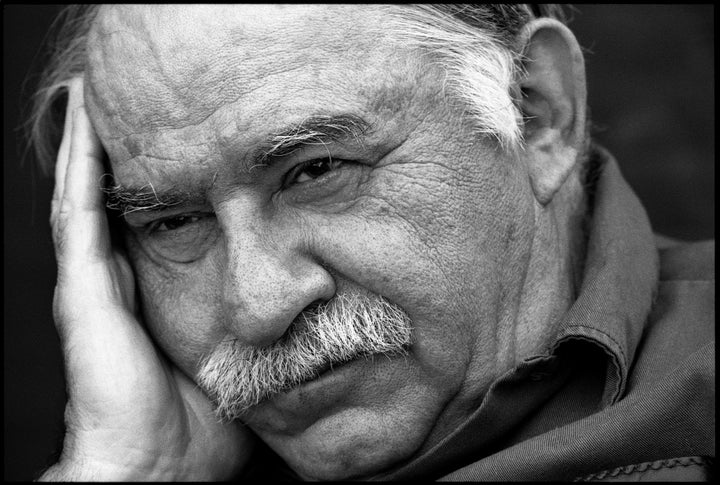
Murray Bookchin, photographed in 1992 by Ludwig Rauch. Image used with permission from the Murray Bookchin Trust.

The Syrian Kurds owe their Bookchin obsession to their chief guide: Abdullah Ocalan, the imprisoned leader of the PKK, a Kurdish revolutionary group in Turkey that has fought the Turkish government on and off since the early 1980s.

The European Union and the U.S. consider the PKK, which has killed thousands of Turkish security personnel and civilians, a terrorist organization. They support their NATO ally Turkey in its anti-PKK actions.

Unlike Iraqi Kurds ― partners of the West since 1991 who are skeptical of the PKK and are content for now with an autonomous region inside the nation-state of Iraq ―Syrian and Turkish Kurds take their ideological cues from Ocalan. So when he argued that longstanding Kurdish aspirations for political structures and societies of their own would be best fulfilled if Kurds adopted the philosophy of a mustachioed Russian-American Jew from the Bronx in New York City, they listened.

Ocalan was once a Marxist-Leninist true believer. But by 1999, when the U.S. and Syria helped Turkey capture him, he was signaling his doubts about the continued viability of orthodox communist thought. The PKK had abandoned the goal of establishing a Kurdish nation-state by 1995, according to Reimar Heider of Freedom for Abdullah Ocalan, a Germany-based nonprofit. By the time of what Ocalan supporters call the “abduction,” the Kurdish movement was trying to identify its next steps.

Turkey imprisoned Ocalan in 1999 on an island 35 miles south of Istanbul, the same T-shaped speck where soldiers who took over in a 1960 coup executed the prime minister they replaced. It built a courthouse for the express purpose of hosting Ocalan’s trial. It arrested fisherfolk who it believed got dangerously close. And then it left Ocalan alone for years in a 140-square-foot cell as the only inmate in a jail that once housed the American author of Midnight Express. A military base loomed nearby.

In prison, Ocalan dove into radical, post-communist literature, looking for a new way forward. A famously voracious reader whose book selections were regularly leaked in the Turkish and Kurdish press, he began to devour Murray Bookchin. By 2004, Heider and others advocating for Ocalan’s cause felt the time had come to connect him with the aging Vermonter. Establishing some form of dialogue was critical to them, Heider told HuffPost, because conservatives in Kurdish circles were pushing for the movement to completely abandon leftist thought.

They wrote to Biehl.

On April 11, five days after he received Ocalan’s missive, Bookchin wrote back with Biehl’s help.

Then 83, Bookchin had long been curious about the Kurds and written about their struggle in his personal journals, his daughter said. He told Ocalan he wasn’t familiar with all aspects of the PKK’s fight ― he blamed the U.S.’s “parochial press” ― and he was so old that writing was a struggle, but he was happy to be in touch.

“I am a walking history of the twentieth century in my own way and have always tried to look beyond ideas that people freeze into dogmas,” Bookchin wrote to Ocalan. “I ask you to please be patient with an old radical.”

The existence of Bookchin’s correspondence with Ocalan has been previously reported, but HuffPost obtained the full cache of preserved documents and is publishing them for the first time with permission from the Murray Bookchin Trust, Biehl and Heider.

Heider passed Bookchin’s message to Ocalan’s lawyers. The jailed Kurdish leader sent a response on May 5. In the new missive, Ocalan’s intermediaries mentioned that “he spoke of himself as a good student of yours.”

Ocalan conveyed that he disagreed with Bookchin on a few points and wanted non-Western philosophy to shape his vision as well. But he told his intermediary to tell Bookchin that “the Kurdish freedom movement was determined to successfully implement your ideas.”

Bookchin wrote back on May 9. “I am not in a position to carry on an extensive theoretical dialogue with Mr. Ocalan,” he told the intermediary. But the Kurds were “fortunate indeed” to have Ocalan as a leader, Bookchin wrote.

Ocalan became, Biehl later wrote to the intermediary, “a beacon for [Bookchin] in his declining years.”

"I can't believe how much [Ocalan] thinks like Murray," she told HuffPost recently as she re-read their letters to one another.

From jail, Ocalan moved quickly to implement the new ideas he developed as he read Bookchin. In 2005, he shaped a PKK declaration that Kurdish liberation would not be achieved by setting up a new nation-state along ethnic lines. The nation-state itself entailed oppression, the declaration argued -- there had to be another, less centralized way for the Kurds to eventually govern themselves. It was a stunning indictment of socialism's past coming from one of the 20th century's most hardcore Marxists.

The announcement enshrined Ocalan's central idea for the Kurds and other communities living in Kurdish majority areas: "democratic confederalism," a major devolution of power intended to resemble Bookchin's communalism.

Kurdish areas in southeastern Turkey took advantage of a period of relative peace between the PKK and the state to put the Ocalan-Bookchin philosophy into practice, setting up "assembly democracy" at the neighborhood and village level. Because women had long been active fighters in the left-wing PKK and because Ocalan extended Bookchin's talk of abolishing hierarchies to smashing the patriarchy, these assemblies took the even more radical step of making women's inclusion a non-negotiable requirement.

When Bookchin died in 2006, a PKK assembly lauded him in a resolution Biehl shared with HuffPost. "We undertake to make Bookchin live in our struggle" the assembly vowed.

But it took the actual collapse of one of the most centralized nation-states in the region -- Assad's Syria -- for Ocalan and Bookchin's anti-state vision to fully manifest.

The Assad regime had banned Kurds from speaking their language, arbitrarily stripped thousands of them of Syrian citizenship and changed Kurdish names to their Arabic equivalents. Syria was (and it remains) an Arab Republic.

But in the summer of 2012, Assad pulled his forces from three Kurdish-majority areas near the border of Turkey to focus on fighting Arab rebels elsewhere. The Syrian Kurds' chief political party, an Ocalan-inspired organization called the PYD that is a Syrian affiliate of the PKK, filled the power vacuum.

Today, four years into Syria's civil war, the Islamic State uses eastern Syria as the core of its caliphate. Western-backed nationalist rebels maintain holdouts in the northwest and southwest of the country. Assad controls Damascus and the western Mediterranean coast.

But in northern Syria, in the three Kurdish enclaves that make up Rojava, the PYD holds sway.

There, Syrian Kurds have achieved Ocalan's goals with unexpected speed.

"The nation-state proved that it is bankrupt," Senem Mohammed, a Syrian Kurdish leader in Rojava, told HuffPost earlier this year. "We witnessed that ... there will always be problems, conflict between people in the nation-state." 

Rojava supports the effort to free Syria from Assad, Mohammed said, but it wants to be sure that any replacement for the dictator does not simply end up resembling him. "The point is to change the system, not just to change the person," she added. "This is what we want."

"The Kurds already have made major strides in their quest for greater rights by being masters of their own areas for the first time in the history of modern Syria," the nonprofit International Crisis Group wrote in a report on Rojava published one year after the territory's establishment.

Rojava is now Ocalan's chief focus, according to Bejan Matur, a Kurdish poet and author in Turkey who has written about the PKK for years.

"He finds Rojava as his dream land," Matur told HuffPost in January. "All his dreams are coming true."

Rojava is among the most diverse regions of the Middle East. Mohammed, the PYD leader who serves as the Rojava emissary in Europe, served on a Kurdish commission that reached out to Arabs, Christian Assyrians, Armenians, Chechens and other residents of the areas newly free of Assad to work out a new form of government.

Non-Kurds were willing to work with the dominant Kurds and embrace their ideas, Mohammed argued. It didn't hurt, she noted, that all of them faced the existential threat of extremist militants tied to the Islamic State and the al-Qaeda affiliate in Syria, Jabhat al-Nusra.

"Everybody threatened in the area asked, 'Who will protect us?'" Mohammed said. "When they realize that only [Kurdish] forces would protect them and defend the area, they joined our administration."

Mohammed and other politicians in Rojava, among them non-PYD activists and non-Kurds, declared their democratic self-administration in January 2014. Its central principles are outlined in a document that is described not as a constitution -- given that concept's connection to the institution of the state -- but as the "Social Contract." It prioritizes "ecological balance," Bookchin-style, and equality, and explicitly rejects state, religious or military nationalism.

Today, Rojava has evolved its own understanding of Bookchin's face-to-face democracy. Each of its neighborhood communes selects delegates to send to higher assemblies -- three layers of smaller and smaller councils that each cover wider regions. Those neighborhoods can recall their assembly representatives at any time. Each assembly must include Arabs, Kurds and members of other minority groups, like the Christian Syriac community, Mohammed told HuffPost. At the highest level of governance, each of the three cantons is led by two co-presidents, a man and a woman. Elected by these popular assemblies, the co-presidents are meant to be accountable through them to each Rojava resident in the neighborhood communes.

"They are living the ideals of human freedom and democratic decision-making that exemplify the highest aspirations of democracy-loving people, a feat all the more remarkable because they are doing it in the middle of a war," Debbie Bookchin wrote of the Syrian Kurds last year in The Huffington Post. She told HuffPost recently that Rojava's determination to establish a society like this was especially striking to her because her father thought of such change being implemented gradually during peacetime.

The task facing the PYD's decision-makers -- women and men, Kurds and Arabs -- is a staggering one. Rojava has lost thousands of residents as refugees and victims of war, and it is effectively cut off from the rest of the world. Only limited supplies enter through the borders with Turkey and Iraqi Kurdistan. And trade with the rest of the country is nearly impossible because of Western embargoes on Syria and the Islamic State's grip on the areas surrounding the cantons. So devising a radical new economy isn't only ideologically necessary -- it's the only way the region can survive.

Rojava's economy relies on agricultural cooperatives, industrialists who fled from the besieged Syrian industrial capital of Aleppo, and the portion of Syria's oil reserves that the Kurds now control -- which they cannot sell abroad but can use for necessities like diesel generators. The local councils direct farms in their areas to be sustainable and socially conscious, providing what the Rojava residents around them need rather than focusing on cash crops. It's a Syrian Kurdish version of what high-end restaurants in the U.S. call "farm-to-table."

"We will develop an economy based on agriculture, that is to say production. We will base this mode of production on a foundation by which all the peoples of the region will be included and benefit from it," one Rojava official from the Afrin canton, Dr. Ahmet Yusuf, told the PKK-linked Kurdish outlet ANF News last December. "We will encourage everyone to work their own lands based on the needs of the community."

Rojava's economy should be based on small cooperatives that mirror Ocalan's descriptions of ideal societies of the past, Yusuf said. Wealthy investors are welcome to contribute by putting capital into various citizens' efforts to live off the land, he added, since private enterprise is still part of the economy. But he wants them to know that "we will not allow them the opportunity to exploit the community and people or monopolize."

"We will succeed in this," Yusuf said. "Because there is no other model left to try on Earth. Because this model is the model by which the history of humanity will be brought back to life."

Much day-to-day business is done using a barter system. It's a necessity, given the fact that Syria's currency is now largely worthless.

Shaky as Rojava's economy and political system are, they have a key advantage. Unlike most social structures around the world, they take full advantage of their entire population rather than largely excluding half of it. Gender equity is central to how Rojava works, in large part because Ocalan's ideology has convinced the PYD of its importance.

To the PKK offshoot, "Kurds are oppressed, but Kurdish women are oppressed twice. And without empowering women ... society will not be free," said Mutlu Civiroglu, a Kurdish affairs analyst who closely monitors the PYD and YPG, the PYD's armed counterpart

Rojava mandates that women comprise at least 40 percent of all governing bodies, multiple observers of the region said. The senior leader in the Afrin canton is a woman, and 35 percent of the Syrian Kurdish forces battling the Islamic State on Rojava's behalf are women, Civiroglu told HuffPost earlier this year.

The radical experiment has a built-in safety valve to ensure that centuries-old misogyny won't prevent the spread of the new ideas: It has set up parallel women's bodies at every level of political organization. These structures are composed entirely of women and have the final say on issues regarding women, Biehl reported after talking to Rojava politicians. The final say on any of those issues -- among them still-prevalent problems like domestic violence -- is that of the women's council.

Utopian or no, revolutions are often not pretty up close. Rojava is no exception. Asked about the Syrian Kurds last year, just as the U.S. began to support Kobani, an Obama administration official hesitated before gingerly mentioning their militia's use of child soldiers.

"Hopefully all that stuff's in the past," he said.

It doesn't look like it, Human Rights Watch warned this summer. The organization said the YPG demobilized 149 fighters younger than 18 in July 2014 after promising to do so, but then accepted child recruits over the next year -- including some who apparently died in combat in June 2015. "The Kurdish forces are fighting groups like the Islamic State that flout the laws of war, but that’s no excuse to tolerate abuses by its own forces," said Human Rights Watch's Fred Abrahams. The YPG's response: It would work on the problem.

Nor does direct democracy necessarily mean that competing political parties, with competing ideologies, are welcome. The Syrian Kurdish area is "the best place you as a journalist can be today in Syria," according to Sirwan Berko, the head of a U.S.-supported independent radio station called ARTA FM. But that's relative, he noted -- this is a country where 86 journalists have been killed since the revolution began in 2011, according to the Committee to Protect Journalists.

Berko's outlet broadcasts in Kurdish and in the languages of the main minority communities that live in Rojava: Assyrians and Arabs. "We are not a Kurdish radio station," he told HuffPost. "We are the radio station of the components of society in Rojava. That means everybody: supporters of the [Assad] regime, Muslims, Christians, Yazidis ... we don't believe in a Kurdish region or an Arab region, and we don't think it's useful to say 'majority' or 'minority.'"

Rojava's rulers underestimate the value of an independent media, Berko argued. The YPG raided one of his stations in March 2014. In August of this year, the PYD suspended the licenses of Rudaw, a leading Kurdish network that broadcasts around the region, and Orient TV, a station associated with the anti-Assad Arab media.

Meanwhile, political opponents of the PYD have disappeared or been killed as the party has solidified its control, Human Rights Watch reported in the summer of 2014. The group cast doubt on the investigations into those cases and also highlighted arbitrary detentions and a 2013 instance in which YPG forces shot at and beat anti-PYD protesters. (Rojava officials said the responsible fighters had been disciplined for their excesses.)

Many activists and journalists have left Rojava out of fear since the PYD takeover, Berko said. And even international allies of the Kurdish party's radical ideology have turned skeptical: In December 2014, the U.K.-based Anarchist Federation criticized the PYD's dominance in its representative assemblies and the power of the personality cult around Abdullah Ocalan, the PYD's icon.

"The dilemma is that Syrian Kurds don't have an alternative to the PYD," Berko argued. The Islamic State's rise has ensured the PYD's dominance, he said -- other parties in the region lost the faith of locals once the PYD and the YPG took the lead in defending Rojava against extremists.

Daryus al-Darwish, an independent activist and journalist from Rojava's capital of Qamishli, said one-party rule undercuts the PYD's rhetoric about building the most radically open society in the Middle East through what they call direct democracy.

"Their control over the administrative authorities, over the parliaments and the executive authorities and the judicial authorities, that's not any kind of democracy -- not direct or indirect democracy," Darwish told HuffPost this fall from Paris, where he lives now, writing about Kurdish issues for U.S. and Arab outlets.

These accusations, largely ignored in the West, could mean trouble for Washington because of how closely it's now linked with the PYD.

An October Amnesty International report on the brutal treatment some Arabs faced after the Kurdish militia retook their areas from the Islamic State was released under the headline "U.S. Ally's Razing Of Villages Amounts To War Crimes." Among Amnesty's findings was the discovery that some Kurdish fighters had told Arab civilians that if they did not move when they were commanded to, they would be hit by U.S. airstrikes.

Lama Fakih, a researcher involved with the report, told HuffPost her group had raised its allegations with the State Department. She indicated that the U.S. would be the primary point of contact -- other than PYD officials themselves -- about the potential war crimes because of its role in supporting the Kurds.

"I'd be lying if I said I'm not worried about the U.S. empowering the PYD," Darwish said. "I cannot stand against my people's interest in the American support. What I think, with the Americans and any other international actor who wants to support the PYD and the YPG, is that after saying thank you to them, I want them to know that this support must be accompanied with pressure to achieve democracy -- otherwise their support will be meaningless."

When Mohammed, the Rojava leader, came to Washington in March, she won her party its first high-level meetings at the State Department and with key analysts here who help shape strategic thinking.

But despite Rojava's importance to the U.S.-led campaign against the Islamic State, the visit didn't make headlines. In fact, even as she met with top U.S. officials, Mohammed did so knowing that her party's top leader's visa application had been rejected just weeks earlier. To the U.S. government, many of Rojava's leading lights could be considered terrorists because of their ties to the PKK.

Those ties partly explain why Washington has been loathe to fully embrace the Syrian Kurds. That move risks alienating Turkey, which has only just agreed to ramp up efforts against the Islamic State group -- with an apparent green light to hit the Kurds as well. Support for the group is also unpopular among Arabs fighting the Islamic State in Syria and Iraqi Kurds, who are not eager to share their favored status as U.S. partners with their pinko cousins to their West. (Iraqi Kurds are represented by three political parties, of which two -- those that are not in charge -- strongly support Rojava).

But the Kurds say they won't surrender their ideology just to please Washington."They call us terrorists. It's because the United States knows we won't follow their orders," one PKK fighter calling herself Tamara told HuffPost contributor Khazar Fatemi. "If they say something, we won't simply obey."

The State Department's terror designation and regional politics have not stopped some Americans from making up their minds about the Syrian Kurds and traveling to fight alongside them -- even if they are sometimes doing so without fully understanding what Rojava stands for. One American volunteer said he left after he realized the Syrian Kurds are "damn reds," Middle East Eye reported this spring. He got it wrong, according to Dean Parker, another American who journeyed to the region and trained with PYD-linked militants. Parker told HuffPost this summer that he didn't want the U.S. public to fear supporting the Syrian Kurds because of worries about Rojava's ideology. "They're not a bunch of communists, they're not a bunch of socialists," Parker said. "It's a different type of democracy, a new concept."

Some Europeans, like the leftist intellectuals associated with the New World Summit who inaugurated a Rojava parliament this October and the fighters who've followed the same path as some Americans, share a respect for the Kurds' thinking. Recently returned Swedish volunteer Jesper Söder and a Dutchman who asked to remain anonymous because of worries that his family in the Netherlands might be targeted by Islamic State cells told HuffPost in November they would like NATO to delist the PKK and be tougher on Turkey. "Get Turkey out of NATO," the Dutchman said.

Ultimately, persistent doubt over how much the U.S. is willing to support a group its other allies hate cannot diminish what the Kurds have already accomplished. Henri Barkey, a Woodrow Wilson International Center scholar and former State Department official who has written extensively on the Kurds, told HuffPost that while it was difficult to expect a fully democratic, liberal administration to be established in the midst of a civil war, the Syrian Kurds appear to have "put their money where their mouth is."

Rojava's defense of Kobani against the Islamic State was "a larger-than-life moment," Barkey added. The radical experiment has secured its place in Middle Eastern history -- and shown the viability of a different way for Kurds and others in the region to live.

"The hard way, the old-fashioned way, they have won," Barkey told HuffPost.

Last December, Biehl saw Rojava for herself for the first time. She flew to Erbil, the capital of the autonomous Kurdish region in Iraq. Unimpressed with the oil-rich city’sapparent aspirations to emulate Dubai,” she and the group of academics and activists she was traveling with soon journeyed to the Tigris River, at the western edge of Iraqi Kurdistan, to cross into Rojava. One day, the delegation visited an academy for security officers to get a grasp of the education the democratic self-administration was providing. Minutes into what she described as an initially awkward encounter, she asked her translator to tell the students and their teacher that she had a friend called Murray back in the U.S. who would have been very pleased to hear about the ideas they were putting into practice. Biehl knew about his influence on Ocalan and other top activists, but had no idea that it had gone much further.

“I just threw it out there,” Biehl said. “And it turned out they had been reading Bookchin that morning.”

UPDATED 1/12/17: This story has been updated to include the original message from Reimar Heidar of Freedom for Abdullah Ocalan to Murray Bookchin.