Wednesday, March 20, 2013

Queens Courier: PEP OK’s closure of two Campus Magnet schools, collocations at Flushing, Newtown

Collocations at Flushing, Newtown also approved at raucous meeting


Posted: Thursday, March 14, 2013 10:30 am | Updated: 11:13 am, Thu Mar 14, 2013.
The police officers and bodies in suits standing guard at the end of the auditorium aisles have become a familiar staple of late winter and early spring meetings of the Panel for Educational Policy in recent years.
The policy-making arm of the city Department of Education decided the fates of dozens of city schools, including two high schools in Queens — Business, Computer Applications and Entrepreneurship; and Law, Government and Community Service — and voted on a slew of other new collocated schools, including new ones that will be placed in Flushing and Newtown high schools at a meeting Monday night at Brooklyn Technical High School.
By a vote of 8-4, the PEP approved all of the changes. Seven of the votes came from mayoral appointees — the eighth member was absent — and one vote came from Staten Island representative Diane Peruggia.
The two closing schools — both located at Campus Magnet Complex in Cambria Heights — will be phased out starting next year. A new high school focusing on English language learners will open in Newtown High School’s building and two new high schools, including one dedicated to Chinese-speaking students, will open in Flushing High School’s building next year, which will allow the DOE to decrease enrollment at Newtown and Flushing. The DOE had attempted to phase out both schools last year, but a lawsuit prevented it from moving forward with the plan.
The four schools were the only ones in the borough out of more than 50 citywide whose futures were decided Monday night. Most of the phaseouts and collocations were in Brooklyn and the Bronx.
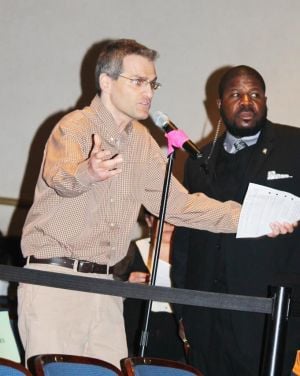
The six-and-a-half-hour meeting was calmer than many in past years, but did have a number of vociferous moments. Parents, teachers and union officials were not coy about their frustrations and disapproval of the body’s decisions, not only those made Monday, but Mayor Bloomberg’s entire education policy.
“You’ve had 12 years to fix our schools and you’ve failed!” scolded Michael Mendel, the United Federation of Teachers’ secretary.
The real anger toward the board was less about its decision to close or collocate dozens of schools citywide this year specifically. Most were already resigned to that happening. At issue was the frustration with the Bloomberg administration’s policies on schools period, especially in his third term.
“You don’t listen to us!” screamed one teacher repeatedly as Schools Chancellor Dennis Walcott and Deputy Chancellor Marc Sternberg explained the DOE’s phaseout and collocation policies.
Walcott said the department had done everything it could for the problem schools and that new collocated schools provide another option for students at failing institutions. He acknowledged there is strong opposition to the DOE’s idea, but defended it.
“We know we can’t please all the people all of the time and that leads to the reaction we see in the audience tonight,” the chancellor said.
Sternberg struggled to speak over the boos and hisses and chants of “Liar!” and “Fraud!” from the crowd when he outlined steps the city took toward saving failing schools. At times seemingly affected personally by the catcalls from the crowd, Sternberg said closing schools is a “last resort” and he wasn’t happy to be doing it.
“There is no joy for me or my colleagues in having to bring these proposals to you this evening,” he said. “But we have a responsibility to act.”
James Eterno, UFT chapter leader at Jamaica High School — which was approved for phaseout in 2011 — said the city did nothing to help Jamaica in the years before the DOE decided to close it and has done nothing for the school since. He also questioned the policy of collocations and phaseouts, noting the situation at the Campus Magnet — formerly Andrew Jackson High School — which was closed in the 1990s and replaced with four schools.
“If phaseouts were such a success, why are we here discussing closing two of the four schools located there?” he asked.
The PEP also debated a resolution drafted by Queens member Dmytro Fedkowskyj that would place a moratorium on school closures and collocations, but discussions about the proposal turned to criticism of mayoral control, which allows the mayor to appoint a majority of the members of the PEP.
“In 10 years, no one’s raised a hand against the mayor, because you know you’ll get fired if you do,” Patrick Sullivan, Manhattan representative on the PEP, said to the members appointed by the mayor. He accused them of not being involved in policy discussion, amidst chants of “Puppets!” from members of the audience.
“Did it ever occur to you that we’re here because we believe in what’s being done?” responded Judy Bergtraum, one of Bloomberg’s appointees.
Fedkowskyj responded by suggesting the DOE should have gotten involved in the troubled schools earlier.
“If these policies were put in place before phaseout, we wouldn’t have to phase these schools out,” he said to thunderous applause from the audience.
The resolution was supported by a number of mayoral candidates, but only former Comptroller Bill Thompson was at the meeting to speak in favor of it. However, one teacher yelling across the room at Thompson called for the mayoral candidate to support ending mayoral control.
“No to mayoral control, for you too Thompson!” she screamed, letting him know that she did not support having him in control of schools as mayor, even if he was opposed to Bloomberg’s policies.
The board voted down Fedkowskyj’s proposal by a tally of 8-3-1, with the lone abstention coming from Brooklyn’s representative, Kelvin Diamond. A contingent of teachers from Brooklyn booed Diamond’s vote, accusing him and Brooklyn Borough President Marty Markowitz, who appointed him, of being sellouts.
The PEP will meet again next Wednesday night, March 20, in the same location to vote on another list of closures and collocations, including collocations of new schools in August Martin High School; PS 156 in Laurelton, which is also proposed to be truncated from a K-8 to a K-5; IS 8 in South Jamaica, IS 204 in Long Island City and JHS 226 in South Ozone Park.

Sunday, March 17, 2013

Janine Sopp: Listen to Our Voices


https://www.indypendent.org/2013/02/21/listen-our-voices

Issue #184
 
As a parent of a child in a New York City public school, I had no idea my 7-year-old daughter would be subjected to high stakes standardized testing. After Kya came home in a panic after being informed about “The Test,” I immediately confronted her teacher and asked how and why my daughter was even remotely aware of this unreliable test. I was told this was a way to begin to prepare second graders for what they would face in third grade. What they would face? I asked. Why was her education being treated like a sentence with consequences for being a child in public school?

This was the beginning of my activism as a public school parent.
Later that year, in the spring of 2011, I helped lead parent opposition at my daughter’s school to Mayor Michael Bloomberg’s threats to implement budget cuts that would cause the layoffs of thousands of teachers citywide. All the parents I spoke with agreed this was a damaging proposal. Over time we began to understand how budget cuts, high stakes testing, Annual Yearly Progress reports that slap a grade on our schools, school closures and charter school co-locations inside public school buildings were all part of an accelerating drive by corporate elites to dismantle and privatize public education.

SCANDALOUS
The amount of time and money spent on test prep while average class sizes grow and classroom resources dwindle is scandalous. During third grade parent orientation, there was mention of a “test prep class” on Friday mornings which sent me into a rage. With budget cuts forcing us to lose teachers across the city, limited amounts of the arts, sciences and gym, the loss of the library and the constant PTA fundraising for anything that would enrich the curriculum, why would we dedicate an entire period each week over the next eight months to test prep?
The thought of my dyslexia-diagnosed daughter sitting through an annual battery of tests that lasts for six days made me squirm with unease. I knew how she was doing in school. Every teacher she had was able to assess her strengths and weaknesses and was more than happy to discuss ways to take on the challenges she was facing. So why should I place her in a situation that I felt was not healthy or supportive of her education?

During the second month of third grade, Kya transferred to a more progressive public school — one that did not “teach to the test” but focused on teaching to the whole child. Kya’s self confidence soared; her daily sharing was alive with enthusiasm and her desire to go back for more each day was delightful. She grew both intellectually and socially, and I watched her flourish as a human being. How she performed was not as important as how she experienced the information. I could see actual learning taking place because she was intrinsically involved with the process and not just learning how to take a test. This assessment of learning cannot be gathered on a bubble test or through a reading passage.

ACT OF CONSCIENCE
Kya’s school was still required to administer standardized Math and English Language Arts exams even if they did minimal test prep for them. I refused to have Kya participate in this and instead arranged with the school for her to have a portfolio review and a pair of 45-minute exams which would be used to assess her for promotion. We found a wonderful and enriching way for her to spend the testing hours in the school and she rejoined her class each day after the testing period, feeling a bit like a celebrity. She assisted in one of the kindergarten classrooms where her hands-on skills and desire to read aloud to the younger children proved to be a much more valuable experience. She did not come home feeling afraid or stressed and did not question her abilities or intelligence. We agreed that if these tests required an “Opt In” rather than an “Opt Out,” a whole lot more children would have been with her during those six days of testing.

Now in fourth grade, Kya faces an additional high stake as this year’s test scores will be used to place children in the city’s best middle schools. I plan to contact any of the schools we are considering applying to before the testing season to find out how they will handle her application if it does not include these scores. My hope is they would recognize the value of a portfolio review over the use of these tests, which would actually tell them much more about Kya’s true qualities. It’s a hard decision but when the tests are conducted in April she will likely sit them out as well.

The solution to the pervasive misuse of high stakes tests lies not just in individual acts of conscience but in the collective organizing and action of educators, parents and students. That is why there has been an outpouring of support for the Seattle teachers (see page 8) and why parent-led groups like Change the Stakes in New York and United Opt Out nationally have formed in the past few years to provide information and support for parents who wish to withdraw their children from high stakes standardized testing.
The corporate school “reformers” who have stoked the mania for high stakes standardized testing in the past decade have failed (and manipulated) us. In New York, where Mayor Bloomberg has been given dictatorial control over our school system since 2002, only 21 percent of high school graduates are college ready, including only 13 percent of graduates of color, according to the City University of New York.

These self-styled reformers still have tremendous resources at their disposal. But now they are up against growing ranks of outraged parents. To turn the tide against high stakes standardized testing would save the millions of dollars handed over annually to test prep companies and reclaim the possibility of a curriculum that meets the needs of the whole child. Instead of being test prep factories, our public schools can be places where we support the love of learning, socialize children and welcome differences as we prepare our children for ever-changing, expanding realities of life in a diverse and interconnected world.

For more, see changethestakes.wordpress.com or unitedoptout.com.

Friday, March 15, 2013

Who Killed John Dewey High?

Gail Robinson won a journalism award for this piece.

http://www.bkbureau.org/who-killed-john-dewey-high#.UT9y-xnFzoh

Pearl Gabel/City Limits Documentary >> View Slideshow >> Photos by Pearl Gabel

Who Killed John Dewey High?

In the '60s it was an ambitious experiment in progressive education. Today John Dewey High graduates its final class after being closed as a failing high school. What led the Gravesend facility from success to shut-down?Printer-friendly version
By Gail Robinson | Monday, Jun 25, 2012
On April 26, 1963, a dozen New York City principals went into seclusion in Hershey, Pennsylvania. They emerged 10 days later with a plan for what was to be one of the boldest experiments undertaken by the city's public schools, a blueprint for a high school that would foster independent study, replace the letter grade system, extend the school day and encourage students to take charge of their own educations.
On June 26, that experiment—tattered and eroded over more than 40 years—will come to an end as John Dewey High School in Gravesend graduates its final class. Earlier this month, all Dewey teachers received letters telling them their jobs no longer exist. Barring action by an arbitrator, when school reopens in September, the building on Avenue X will house a new school dubbed Shorefront High School of Arts and Sciences at John Dewey Campus.
Few in Dewey's early days would have expected this denouement. For years, Dewey's program attracted press coverage and visitors from across the country. "It is looked upon by school officials as a model for the future and by others as an island of hope in a sea of trouble," Paul Montgomery wrote in The Times in 1971. As recently as 2000, the U.S. Department of Education selected Dewey as a showcase high school, and in 2008 US News and World Report awarded Dewey a silver medal in its ranking of American high schools.
"Dewey should go down as the greatest experiment on the secondary level in the 20th century," says Bob DeSena, founder of the Council for Unity, a group started at Dewey that works to reduce violence in schools and communities.
So what happened? Who killed John Dewey High School?
Shut and open
John Dewey High School, of course, is not alone. Since 2002, the Bloomberg administration has shut or begun phasing out about 140 schools, many of them, like Dewey, large high schools. The administration says that as of September, it will have opened 589 new schools. About 200 are high schools, most of them small.
Mayor Michael Bloomberg and officials at the Department of Education (DOE) staunchly defend the policy. The mayor crowed about the openings of new schools at a press conference in April, calling the results "really amazing," and adding, "It is an achievement that nobody, nobody, would have thought possible.”
There's little doubt that many of the shuttered schools deserved to close, and that some of the new schools have excelled. But the school closings have proved wrenching for many New Yorkers, sparking passionate protests from students, parents and teachers. Critics have charged that the DOE is so eager to close schools that it has ignored other, less-draconian solutions. "They are using schools closings totally inappropriately. School closings should be a last resort," says Pedro Noguera, a professor of education at NYU.
In some cases, critics say, the DOE has--under the banner of improving a facility—actually abetted a school's decline. "DOE has a list of schools they think are not going to make it … and they insure that their predictions come true," says Norm Fruchter, senior scholar at the Annenberg Institute for School Reform. The department may place more troubled students, students with special needs and English language learners at the shaky school—moves that can further bring down its graduation rate and test results.
The closings have become an annual ritual. This February, the city approved closing all or part of 23 schools. In addition, when the administration and the United Federation of Teachers failed to reach agreement on a plan to evaluate teachers, Bloomberg announced he would designate 33 struggling schools as "turnaround" schools. Under a federal program, this meant DOE would shut the schools and replace up to half their staffs.
Initially, many saw Bloomberg's move as a bluff designed to win concessions from the teachers union and sharply criticized it. "There's a fight going on here that has nothing to do with what's going on at the school," state Board of Regents chancellor Merryl Tisch, usually a Bloomberg ally, said last winter of the mayor's closure plans. “It’s a labor dispute between labor and management.”
Bloomberg eventually spared several "turnaround" schools. But on April 26, the Panel for Education Policy, a body controlled by the mayor, voted to close 24 schools on the original list of 33 and reopen them in new guises and with many new teachers in September. One of those schools was Dewey.
Education reform, '60s style
In the 1960s city officials saw Dewey not as a problem but as a solution. "There has been an increasing dissatisfaction with the goals, methods and results of high school education,'" the group of principals wrote after the Hershey meeting. "How can our high schools do an even better job? What changes must be made in philosophy, organization, curriculum and teaching methods if they are to meet the imperatives of our times."
The school that opened with 1,000 students in September 1969 tried to answer those questions. Named for the American philosopher whose theories form the basis for much of progressive education, it featured a longer day, with students spending 25 percent of their time in independent study or other activities. Resource centers, equipped with books and other materials, were set up as places where students could work on their own or get extra help. The school also had science labs, music practice rooms and art studios as well as a large outside campus that students could use freely. Dewey became home to theatrical productions, various publications and a marine biology program whose students took samples from Jamaica Bay and then pressed the federal government for stricter regulation of discharges into the wetland's waters.
The school offered a plethora of novel courses--on such subjects as the crime and punishment, the emerging city, the Holocaust and the American Dream --and independent study allowed students an even broader selection. Underscoring it all was a belief, as a 1982 documentary on Dewey put it, that youngsters should "be responsible for their education and approach it with zest and concern."
Dewey upended the standard building blocks of high school. Instead of semesters it offered courses in seven-week cycles. Students could graduate after two to six years. Letter grades did not exist. Dewey, an early teacher recalled in the documentary, "freed me to let go of every shibboleth … I had about public education"
Because the school's approach might not suit all teenagers, students had to apply. The school selected students through a process aimed at guaranteeing those accepted would have a range of abilities and reflect the diversity of Brooklyn.
Today many look back fondly on those early days. Naomi Berger graduated in 1975 and some 30 years later helped form the John Dewey Alumni Association to keep the Dewey model alive. "The opportunities were endless," she recalled. "By virtue of getting a rich experience you were prepared for college or the workforce or beyond when you went to Dewey."
Decline and fall
Dewey's descent was slow.
"There wasn't any one thing that brought Dewey down. There was a multiplicity of things," DeSena says.
Even in the early days, he added, there was "a dark side … There were a lot of kids bringing conflict from the neighborhood into the school." And of course there were budget cuts as the fiscal crisis hit in the 1970s.
By most accounts, though, the major changes came during the 1990s, a decade not kind to the city's schools as Mayor Rudolph Giuliani clashed with chancellors, lashed out at teachers and cut spending.
Marianne Stephan, who is active in the Dewey alumni association, attended Dewey at that time. "When I went to Dewey, I met people who brought me out into the type of person I became," says Stephan, who went on to get a master's degree in public administration. "I would not have done that without people at Dewey who care."
When she started high school, many key elements of the Dewey program remained. But she says, "The late '90s were when things started to change for the worse and they continued to go downhill." According to Stephan, "new teachers came in, new administrators came in that didn’t necessarily understand the ideas of the old administration, the old teachers, even the students … Things just weren't the same and it was very depressing being there."
Indeed, the leadership of the school changed several times, with at least eight principals (one acting) in 35 years. Michael Drillinger, who graduated in 1974, now heads the Dewey alumni association. If an innovative school like Dewey is to succeed, he believes, it must have "the energy of a single person or small group of people." For the first couple of decades, he says, Dewey had that "very strong leadership from the top."
Meanwhile, one strong leader, former assistant principal Saul Bruckner, had replicated much of Dewey at Edward R. Murrow High School in Midwood, an arguably safer and, for many prospective students more convenient neighborhood. Many students who once would have gone to Dewey opted for Murrow instead, says Clara Hemphill, founder and senior editor of Inside Schools
The final decade
Bloomberg came to office promising to be the education mayor. But the renewed interest in city schools did nothing to help Dewey and many other large high schools. The dismantling of the Dewey experiment continued.
As Bloomberg instituted his choice system for high schools—requiring most students in the city to apply to high school rather than being able to attend a neighborhood school— 100 or 200 students a year who were not matched with any of their chosen schools" were dumped into Dewey." according to a former teacher, now retired. Multiply that by four grades, and that left Dewey with "800 kids who could not handle the concept," she says.
The culinary and dance programs ceased to exist, reportedly victims of budget cuts. Publications stopped publishing. "It became like a Jenga game," says Berger. "Their answer to every problem is to remove another piece until the tower falls down."
Some thought the principal at the time, Barry Fried, was not up to the challenge. "He did not have a strong, solid commitment to the Dewey model," Drillinger says, and was "not the person to wage battles with the Board of Ed or the Department of Ed."
By most accounts, problems increased at Dewey as the city started closing large high schools in Brooklyn in 2003. The demise of nearby Lafayette High School, sent more students with little interest in Dewey to Dewey. Overcrowding and discipline problems followed, Samuel Freedman reported in The Times. "Since Lafayette began to close down, we've had an influx of students who are unprepared. It's destroying our entire school," Chung Chan, a social studies teacher, told Freedman.
The longtime teacher agrees. There were problems in the cafeteria, she says, and it became difficult to determine who was cutting class and who was on independent study. "It was very hard. It was very sad," she says.
In 2007-2008, the first year of the Lafayette phase out, Dewey had 78 more ninth graders—more than two classes worth --than it had the previous September. Also in 2007, the number of suspensions at Dewey rose sharply—from 153 to 250 Attendance dipped from 87 percent to 84 percent. Both numbers, though, improved the following year.
The graduation rate declined from 71 percent in 2003 to 63 percent in 2007-08, according to a 2009 report by the Center for New York City Affairs. It found that after Lafayette closed, Dewey attracted fewer high-achieving students and more "poorly prepared for high school," including recent immigrants with little formal education.
In 2008, a student brought a gun to Dewey, sparking a lockdown at the school. Later the school installed scanners. Students had to spend the school day inside the building, leaving the surrounding campus largely unused.
Eventually fewer students opted to attend Dewey. Between 2003-04 and 2010, enrollment dropped by 19 percent.
Dewey's woes mirrored those that have afflicted many other large schools during the Bloomberg era—in the Bronx where a succession of closings led to the shutting of Lehman High School this year and along the Brooklyn/Queens shore, where Rockaway, South Shore, Beach Channel High School and now Sheepshead Bay and John Adams have all tumbled.
"The prevailing philosophy under 10 years of Bloomberg is small schools are the answer to high school problems," says Hemphill, an author of the center's report. "What DOE hasn't come up with is a strategy for big schools, which still serve many thousands of New York City teens.”
As big schools close and small ones open, many of the remaining large schools find themselves unable to attract the top applicants a school needs to succeed. And so, Hemphill says, "the stronger schools get stronger, the weaker schools get weaker."
Meanwhile, Dewey, like all schools, grappled with cuts in funding. "When you cut somebody's budget and then dump a lot of kids there that no one wants to deal with, they're setting you up to fail," DeSena says. (Spending for school rose sharply during the first years of the Bloomberg administration. Since the recession, spending continued to increase to cover pension costs and debt service, but classroom programs were cut across the city. At Dewey, per pupil spending has inched up slightly, but an analyst with the Independent Budget Office, said that rise has been more than offset by an increase in teacher salaries.)
By all accounts, Dewey began to show signs of stress. The state targeted it as a persistently low achieving school.
In 2010, the United Federation of Teacher found that 135 classes at Dewey had more students than the number allowed by the teacher contract—the third highest of any school on the city.
Students lagged behind their counterparts in similar schools in accumulating credits. In 2008-09, 32 percent of students responding to a DOE survey said they did not feel safe in Dewey's halls and bathrooms. (This number declined to 23 percent in 2010-11.)
Visitors to the campus saw little evidence of the original Dewey program. "For an ostensibly progressive institution, Dewey has many classrooms that are traditional," Inside Schools reported in 2007. "Most rooms were near-barren of student-made work or art, and hallways, lined by disused lockers, had bulletin boards filled largely by generic or pre-fab graphics."
"There was a lot of room for improvement," says Noguera, who met with faculty and alumni. "The data showed it, and the teachers were aware of it."
Alumni, faculty and others tried to turn things around. City Councilmember Domenic Recchia, who graduated from Dewey in 1977, tried repeatedly—and without success—to get DOE to replace the principal. In November 2010, Friends of Dewey, including Berger and DeSena, issued a plan calling for curriculum changes, revitalization of the Resource Centers, restoration of the dance program and the development of new programs in a number of areas.
There was, though, only so much the group could do, says Noguera. "No one was providing leadership," he says.
The state education department identified Dewey as a persistently-low achieving school and, in 2011, put it on a list of schools the state believed should be replaced. In May 2011, the city announced it would seek a management change for Dewey and 21 other schools and a federal grant to help fund the process. In September, that money was approved. But then, in January 2012, Bloomberg announced his plan to shut the 33 struggling schools. Two months later, DOE did what many Dewey advocates had sought for years. It removed Fried, replacing him with Kathleen Elvin.
Elvin's work at Dewey has garnered considerable praise, but many wonder why it took the department so long to act. For years, the department "fiddled as Rome burned," says Tom Bennett, a Brooklyn representative for the UFT, "Why wouldn't you have taken the obvious first step to replace the principal?" Bennett continued. "I resist conspiracy theories, [but] it does appear that they did not want the school to improve."
(The department in its written response to questions about Dewey did not answer questions regarding Fried. It also did not respond to similar questions from Recchia and others at an April hearing. An attempt to reach Fried was not successful.)
With Dewey's days apparently numbered, student, staff and other in the community took the steps that have become hallmarks of school closing season in New York. They staged protests and spoke out at hearings, arguing that whatever shortcomings Dewey had, DOE should fix the school rather than shut it.
The school still has fans. Deion Harrington, who is graduating from Dewey this year, says, "It's breathtaking being at Dewey." Dewey let him explore his interests. Teachers provided extra help and if that wasn't enough, he says, they called in another faculty member: "No matter where you were sent, it was like family."
Christopher Reyes, then a 10th grader, told of similar experiences when he spoke at the April hearing on Dewey's future. "I walked into this school and became interested in a subject which I actually hated before, and that was history, and now I love history, I can't get enough of it. I walked into my math class and I actually liked it, because in ninth grade I had a teacher who would spend his entire lunch break with me just talking about math, history and math … because he just cared that much."
Dewey's supporters say the efforts to fix the school had already begun to bear fruit. The four-year graduation increased from 51.2 percent for the class of 2009 to 66.0 percent for the class of 2011. The percentage of Dewey graduates deemed "college" ready—23.3 in 2011—exceeded the city average of 20.7 percent, although that number represented a decline from 2010.
Responding to arguments from Dewey supporters at the hearing, deputy chancellor Marc Sternberg said Dewey's graduation rate still lagged when the school was compared to schools with similar student populations. Sternberg also noted the sharp declines in enrollment at Dewey "suggest a decline in parent and student satisfaction with the services rendered here."
The new Dewey
Shorefront High School will open as a single large high school with eight so-called small learning communities—clusters of 400 or so students with 25 teachers. Five will be based on current programs at Dewey. The school will have three new communities: visual and media arts, theater arts and dance and robotic and space science.
Counselors will be assigned to each learning community. The new school, DOE has said, will build upon "elements of the existing school that support rigorous learning and help students attain higher levels of confidence and achievement."
The resource centers seem all but certain to fade into history, although Vincent Brevetti of the Institute for Student Achievement, Dewey's educational partnership organization, says the small learning communities may provide the kind of support for students that the resource centers once did.
The scanners, though, will remain in place for the time being. And, unlike in the past when people had to apply to Dewey, the new school will take “over-the-counter” students, the often challenging teenagers who show up midyear, many having had trouble in their previous schools.
The biggest question-marks concern who will attend Shorefront and who will teach there. While the department did not provide figures on applications to Dewey, many ninth graders do not apply to schools with uncertain futures. Brevetti says he hopes any shortfall in students will be temporary. "If we do well by the school, it will be a very attractive option," he says.
The school, he says, should be able to meet the needs of even low-performing students. "If you engage a student you can bring out the best in them," he says. "It's the responsibility of the school to spark that kind of engagement if the student doesn't come in with it."
All teachers at Dewey have lost their jobs. Those wishing to remain must apply and face interviews. By all accounts, this has been stressful and upsetting for almost all faculty. Senior teachers in particular worry the process will hurt them. "Principals have a vested interest in hiring the least experienced teachers because they're the least expensive," Bennett says. (The UFT filed suit to stop the personnel changes, and an arbitrator is expected to rule soon.)
Teachers not finding work at Shorefront would enter the Absent Teacher Reserve pool. Many would probably eventually find jobs at other schools.
Despite the upheaval, DeSena, for one, sees some hope in the plan. "There are very positive things in it that will be attractive to kids," he says. "They've tried to diversify it, and I think it might work."
Drillnger also expressed optimism. "What they're planning to offer in the fall is, in fact, better than the program as it exists today and as it has existed for the last five years," he says.
There are, of course, no guarantees. In the past few years, DOE has shut down some small schools that once opened to much fanfare. Some buildings, such as John Jay in Park Slope and Erasmus in Flatbush, have gone through many permutations.
The department, though, remains strongly committed to its program of closings and openings. Officials cite a report by MDRC, which concluded, "It is possible, in a relatively short span of time, to replace a large number of underperforming public high schools in a poor urban community and, in the process, achieve significant gains in students’ academic achievement and attainment."
A policy brief released by MRDC this year seems to back this up. It found that all groups of students—black, Hispanic, low performing, male, female, low income—in one of the small schools was more likely to graduate from high school than similar students not attending one of the small schools.
Critics, though, charge that while many small schools have had good results, their student bodies do not reflect the complexity of the city's student population. A study by the Annenberg Institute concluded that, when compared to the schools they replaced, the new small schools were likely to have more students who were proficient in reading and math and less likely to have over-age or special education students and English language learners.
And earlier this year, the Coalition for Education Justice found that the new small schools at many campuses had fewer special education students in self-contained classes than the big schools that formerly occupied the same buildings. (Students in these self-contained classes are far less likely to graduate than other students.) While 10 percent of those attending South Shore High School were in self-contained classes, for example, only 1 percent of the schools now on the site are.
DOE denies the small schools have cherry-picked their students. "Our new small schools on the whole are serving more black, Hispanic, and students with disabilities than the schools they replaced, and than the citywide average. We feel very strongly about this because people often claim otherwise, and it’s absolutely not true," a spokesman wrote in an email.
As each side cites numbers to bolster its case, the puzzle remains whether a high school with many very challenging high school students—people who enter over-age, those not speaking English, those emerging from the criminal justice system—can meet DOE's standards for success and survival.
If more than 40 percent of students entering a high school have low test scores, Fruchter says, "you substantially reduce the graduation rates of the total school. … You have to control your school composition so you don't concentrate kids with low skills"
Whatever happens at Dewey, parts of this story seem certain to be repeated next school year. Bloomberg has dismissed a rumor that he would close 75 schools during his last year in office, but he told reporters he certainly would shut some. How many? ”Pick a number," he says. "It's less than the total number of schools that are in this city and greater than zero."

Friday, March 08, 2013

David Sirota on Demise of Democracy in Education

Michelle Rhee: Wrong again

Her education "reform" movement sends the lovely message that communities should stay out of their schools


http://www.salon.com/2013/02/26/teaching_kids_to_hate_democracy/

Michelle Rhee: Wrong againFormer DC schools chancellor Michelle Rhee
Most who are reading these words will probably agree that our country is facing a democracy crisis, thanks, in part, to the dominance of money in our political process. Many who read these words will also probably insist that our country is facing an education crisis (though many try to deny the actual cause of that crisis).
Getting past the denial stage and acknowledging both of these problems is certainly a step toward one day fixing them. However, there’s another more subtle and self-reinforcing form of denial that makes getting to those solutions more difficult. That denial — or perhaps cognitive dissonance — evinces itself in an American psyche that tends to perceive the democracy and education emergencies as separate and distinct.
Essentially, we see the cause of voting-rights activists, get-out-the-vote pushes and same-day registration crusades (among others) as divorced from the concurrent education policy fight between public school advocates, teachers’ unions and corporate education “reformers.” We see them as disconnected from one another even though the two battles are fundamentally fused by a simple truism: Basically, you can never hope to have a functioning democracy over the long haul if your education system is trying to convince students and parents to abhor democracy.
That, of course, is exactly what is happening right now thanks to a scorched-earth campaign by the corporate interests that see big potential profits in privatizing public schools.
Like so many other industries currently waging a war on democratic institutions that get in the way of bottom-line concerns, this Wall Street-backed education industry sees democratic forces — elections, collective bargaining, local control, etc.— as obstacles to private profit. Thus, the industry, through financing the crusades of education “reform” advocates, is trying to maximize its bottom line by reducing democratic control of the most local of local institutions: the schoolhouse. In the process, the “reform” movement is forwarding an extremist message to kids and parents that runs counter to the most foundational ideals of American democracy and self-governance.
You can see that message in myriad actions over the last few years.
For instance, at the behest of corporate education “reformers,” more and more cities are moving to eliminate the democratic process of electing school boards, effectively telling students, parents and the larger community that republican democracy cannot be trusted to manage fundamentally public institutions. Similarly, corporate “reformers” are constantly demonizing teachers’ unions, effectively telling students and parents that the major vestige of workplace democracy in schools must be crushed.
Then there is corporate “reformers’” push to replace publicly run schools with privately run charter schools, even though the charter schools typically perform worse than the public ones. That tells students that a public institution with some modicum of democratic control is inherently less ideal than a private, undemocratic tyranny.
Likewise, as shown most recently in this recent Reuters investigation, those charter schools often “screen student applicants, assessing their academic records, parental support, disciplinary history, motivation, special needs and even their citizenship” — and then hand-pick only the students the school administrators want. That tells students and the community at large that the core democratic notion of equal opportunity for all shouldn’t be honored even in public education. Just as problematic, as Andrew Hartman noted in his incisive Jacobin magazine report on Teach for America, many of the most hyped charter schools force families to “sign contracts committing (their children) to a rigorous program of surveillance,” thus sending the additional message to low-income kids that to succeed in America, they must be willing to submit to “institutionalization” and give up their most personal democratic freedoms.
Taken together, the education “reform” movement is waging a comprehensive war on the most basic notions of democracy — and not a secret war, either. It is quite explicit, as evidenced by the comments of the most famous and politically renowned leader of that movement, Michelle Rhee.
During her tenure as the head of the Washington, D.C., public schools, Rhee engaged in mass firings and school closings; helped private testing companies impose a strict standardized testing regime on students; did nothing about a massive cheating scandal in her midst; and, as PBS Frontline notes, produced an academic achievement record that leaves “Washington still among the worst in the nation and D.C.’s high school graduation rate dead last.”
That’s where Rhee’s little-noticed but incredibly revealing comments come in. As grass-roots opposition in the local community understandably rose up to oppose her destructive policies, Rhee made quite clear what she and her movement thinks of the notion of local control of schools and community involvement in education policy:
MICHELLE RHEE: People said, “Well, you didn’t listen to us.” And I said, “No, I listened to you. I’m not running this district by consensus or by committee. We’re not running this school district through the democratic process.”
FRONTLINE: [on camera] It’s not a democracy.
MICHELLE RHEE: No, it’s not a democracy.
If a statement like that about public schools isn’t offensive enough unto itself, remember that Rhee made it not as some outside observer. She made it while she was holding public office. Yes, that’s right: A person who held a democratically accountable office was making clear that the national “reform” movement she leads believes that schools are no longer and should no longer be controlled by any kind of democracy.
In one sense, Rhee subsequently became an encouraging lesson in the resilience of democracy: In a 2011 election that became a direct referendum on Rhee’s policies, D.C. voters took the extraordinary step of tossing her and her boss, Mayor Adrian Fenty, out of office after just one term.
However, in another sense, Rhee has also become a discouraging lesson in the persistence of the corporate crusade against democracy. Rather than being ostracized for her obvious failure she has been rewarded. Indeed, for coupling both education policy failure with such a brazen assault on democratic ideals, Rhee has been employed as an education expert by political leaders of both parties, seen the coffers of her book-hawking political front group expand and been rewarded with fawning coverage from the political and media elite.
That’s, in part, because that elite genuflects to the same corporate forces that see profit potential both specifically in education “reform” and generally in the larger effort to curtail democratic power. It is an elite that openly praises the “great advantages” of China’s dictatorial government and derides the concept of local control if it gets in the way of profit. In similar fashion, that same elite so loyally supports ever more extreme efforts to corporatize schools that it is willing to try to portray a failed extremist like Rhee as a national hero.
Considering the breadth and scope of this whole education “reform” propaganda campaign, it is a good bet that at both the media and the local schoolhouse level, parents are being stealthily influenced to see democracy as at least unnecessary and more likely altogether negative. Even worse, so are kids.
As anyone with a child well knows, young people — and especially teenagers — absorb what’s happening around them, and that obviously goes for the schools in which they are spending much of their days. They may not know the granular details of education policy, but they absorb the meta messages in which we are all immersed. And right now, that means that at some level, many are no doubt absorbing the education agitprop’s anti-democratic messages. Sure, they may be taught in civics class about the supposed supremacy of democracy in the Greatest Country on Earth, but increasingly, those civics lessons are being contradicted by far more powerful messages they see emanating from the concrete actions of the adults running their schools.
In a perverse way, that means our education system is actually starting to live up to the dream of so many American politicians, business leaders and pundits who want America’s schools to emulate China’s.
In that Asian nation, a dictatorial government — motivated by obvious self-interest — has rigged its education system to downplay the whole concept of democratic control and democratic freedom so as to create a culture that disdains the very notion of self determination. While more subtle in its tactics, America’s education system is working to create much the same thing. In doing so, the plutocrats and apparatchiks who run the education “reform” movement understand exactly what the Chinese dictators understand: that school policy and democratic ideals cannot be separated, and that the best way for a cadre of elites to squelch those ideals in the future is to eliminate them from the schoolhouse as quickly as possible.
David Sirota David Sirota is a nationally syndicated newspaper columnist, magazine journalist and the best-selling author of the books "Hostile Takeover," "The Uprising" and "Back to Our Future." E-mail him at ds@davidsirota.com, follow him on Twitter @davidsirota or visit his website at www.davidsirota.com.

Tuesday, February 19, 2013

Ohanian Rams the Common Core


/ Daily Journal (Opinion) /

Whoo-Hoo! Occupy the Schools

http://www.dailycensored.com/woo-hoo/

In response to a poverty rate that tops 90% in many urban and rural schools –and 1.6 million homeless children—many in schools with no libraries–education reformers at the White House, the Bill and Melinda Gates Foundation, and the National Governors Association call for a radical, untried curriculum overhaul and two versions of nonstop national testing to measure whether teachers are producing workers for the Global Economy.
They call this upheaval the Common Core State (sic) Standards (CCSS) and there are two things to remember: The Common Core did not originate with the states and it is speculative and experimental–in a word, cuckoo. I use the (sic) in its title because putting the word “state” in there is a political move, a public relations ploy. Learning from President Bill Clinton’s failure to get the national test he wanted, corporate leaders and their political allies try to keep this school remake as distant from the White House as possible, insisting over and over that it’s a “grassroots initiative” –what the people asked for. Every time they say this, the press repeats it. The Common Core reality is about as far from Mom and apple pie as a zombie invasion.

Writing in Bloomberg Businessweek, Pulitzer Prize winner Daniel Golden was one of the few journalists to acknowledge the closeness of the White House to the Common Core: “Today, the Gates Foundation and Education Secretary Duncan move in apparent lockstep.”

School reform rhetoric about the “failure” of public schools draws on the notoriously deceptive and fear-mongering A Nation at Risk–pushed by entities ranging from the Business Roundtable and the U. S. Chamber of Commerce to the Bill and Melinda Gates Foundation and the U. S. Department of Education. This rhetoric is bi-partisan. Both Republicans and Democrats like to bash schools—as a diversionary tactic to avoid accepting responsibility for the Wall Street and banking debacles. School reform solutions are also bi-partisan–exponentially increasing the number of standardized tests children take, tying teacher salaries to those test scores, dismissing whole school staffs, and shutting down neighborhood schools.
This latest corporate reform plan, the Common Core State (sic) Standards (CCSS), eliminates community-based planning, destroys personal response to literature, and, instead of fostering education for individual need and the common good, puts children on a treadmill to becoming scared, obedient workers for the global economy. The constant exhortation to teachers and students is “You’re not good enough for the market economy!” When the ruling class screams about people not measuring up, over time the besieged are trained to blame themselves for the lack of jobs, lack of benefits, lack of a safety net. Blame themselves and not the politicos, hedgefunders, bankers, and cronies whose own greed has put our entire system in peril. According to an Associated Press 2012 analysis, the typical CEO took home $9.6 million.

The Common Core State (sic) Standards are the result of hundreds of millions of dollars disbursed in carefully distributed grants from the Bill and Melinda Gates Foundation accompanied by the threat from U. S. Secretary Arne Duncan to withhold federal funds if individual states did not sign on the dotted line. I looked at two months worth of press citations praising the CCSS –August and September, 2012–and then looked up the Gates money given to those who come to praise CCSS. The list ranges from the American Federation of Teachers ($1,000,000) to the Wisconsin Department of Public Instruction ($823,637), from the neo-liberal Center for American Progress ($2,998,809) to the neo-conservative Thomas B. Fordham Institute ($5,711,462). The PTA got money ($2,005,000); so did the National Writing Project ($2,645,593). And so on and so on. He who pays the piper calls the tune, and with money in their pockets, many are eager to sing the Common Core song and eat the funeral meats.

Although these groups all play a cheerleading role, here are the significant players in deforming school curriculum and testing and their Gates haul.

• Achieve, Inc.: $25,787,051
• The Council of Chief State School Officers: $71,302,833
• National Governors Association Center for Best Practices: $30,679,116
Chief architects of the literacy content for the Common Core content are a lawyer and David Coleman, an education entrepreneur. Coleman gained the most notoriety as he barnstormed the country preaching the importance of nonfiction and a bastardized form of New Criticism, a literary theory abandoned long ago by just about everybody except Mr. Coleman. In his presentation at the New York State Education Building in April 2011, Coleman declared that teachers must tell students: “When you grow up in this world you realize people don’t give a shit about what you feel or what you think.” Student Achievement Partners, an outfit Coleman co-founded is now churning out Common Core curriculum. They’re bankrolled by $6,533,350 from the Bill and Melinda Gates Foundation and $18,000,000 from the General Electric Foundation. Coleman has moved on to head the College Board ($31,178,497 in Gates funds).

My state education department in Vermont urged every teacher to watch a video produced by the Council of Great City Schools ($8,496,854 from Gates) in which Coleman offers advice to the student who reads several grade levels below the complex text assigned to his class: “You’re going to practice it again and again and again and again. . . so there’s a chance you can finally do that level of work.” It sounds like a very bizarre application of Gladwell’s 10,000-Hour Rule. Coleman decries offering students with learning problems alternate resources, insisting that repetition will clear up difficulties with the mandatory complex text. And teachers are told kids must start early with complexity. The New York Post ran a piece–Playtime’s Over, Kindergartners: Standards stressing kids out–explaining that the New York City Department of Education wants 4- and 5-year-olds to forgo building blocks and crayons and get busy writing “informative/explanatory reports.” This includes writing a topic sentence. Teachers report such complexity makes kids cry, but the corporate imperative doesn’t stop for tears. In rebuttal, Kurt Schwengel, a 15-year Santa Monica kindergarten teacher, insists, “They’re going to have to pry the crayons out of my cold, dead hands.”

A February 2013 New York Times story reads like satire–third graders doing one-arm pushups while performing mathematics tasks with Legos while the teacher recites an important vocabulary word for them to learn (and switch arms when they hear it). I wrote the reporter that I predict a big lawsuit when an 8-year-old engaged in a one-arm pushup while doing Legos gets distracted by vocabulary study, falls, and breaks off his front teeth. I wonder why the people pushing this integrated curriculum leave out The Arts. They could have those third graders singing “Dixie” as they do their one-arm pushups, et al. A teacher friend suggested they could put math facts and vocabulary drill on the toilet paper, and I’d be willing to bet some schools are already doing that. Teachers are feeling the pressure of getting in all the skills, and a lot of readers praised this “integration of mind and body” as a way for kids to learn all they have to learn in our brave new Common Core world. Bad things happen to scared people–and the children in their care.

When I received a note from a desperate Oregon mom telling me the only school available to her family wanted to make her son repeat kindergarten because he didn’t measure up on the federally-required DIBELS phonics test, I asked, “Is there any way you can homeschool?” When I tried to tell this story as an invited speaker at the Chicago AFT Progressive Caucus, I was hooted off the podium as soon as I mentioned the homeschool recommendation. I’ve spent my life working for public school for the common good–and I’m not about to stop–but if I wouldn’t allow a school to destroy a six-year-old I loved, then I can’t allow it to happen to anybody else’s child either. In Finland, lauded for its lead on international tests, they don’t even start teaching reading skills until the kids are 7, and then, children in grade school have a play break every 45 minutes, and don’t take any standardized tests until they’re ready to graduate from high school. I just bought a T-Shirt: Occupy Kindergarten!

I scream about the topic sentence requirement in kindergarten and assigning As I Lay Dying, with its 15 narrators, in 11th grade; I mock the notion of such “informational text” as “Invasive Plant Inventory” and Euclid’s Elements (listed in Common Core State Standards for English Language Arts, Appendix B) supplanting To Kill a Mockingbird and “Macbeth” as vehicles for conveying to students the world knowledge Common Core thugs insist is necessary to compete as workers in the Global Economy. And I’d scream just as loudly if every required text was a book I loved. All this arguing about the percentage of fiction allowed and what that fiction should be is a deliberate distraction thrown up by the power brokers. They do it with school reform; they do it with social issues. They want us to wage battle with each other–over the content of national standards–so we’ll have no breath left over to ask Who decides? Who’s in charge of public schools? And for whose benefit do they operate?

Make no mistake about it: current school reform is destroying the lives of children. Here in Vermont, my so-called progressive governor, Peter Shumlin, eager to show his chops to the National Governors Association, cheerfully laps up their Kool-Aid. He’s pushing algebra and geometry as requirements for a high school diploma. Longtime public school superintendent and now managing director of the National Education Policy Center, William Mathis calls the STEM (Science, Technology, Engineering and Math) crisis the new urban legend. In reality, for some Vermont kids, lumberjack skills are much more important than algebra and before we proclaim algebra more important than music and the arts, we must again ask, Important for whom? Mathis points out that there are more STEM-qualified workers than jobs available and of the nation’s nine million people with STEM degrees, only about three million work in STEM fields.
In his second inaugural address Governor Shumlin put Vermont’s economic future on the backs of teachers and children, saying that “to ensure our success, we must embrace change in the way we both view and deliver education. The rapid change that is required of us is not optional; it will define our success or deliver our failure.” No options. Note how the governor defines education as a delivery system. His emphasis on “rapid change” is both disingenuous and dangerous. Teaching is much more like watching what Whitman called the “trickling sap of maple,” which matures and intensifies slowly, than about delivering rigor to kindergartners—or high schoolers. As Wendell Berry points out, “Good teaching is an investment in the minds of the young, as obscure in result, as remote from immediate proof as planting a chestnut seedling.” One of my third grade students, a deaf child in public school for the first time, recently found me on FaceBook to tell me what Amelia Bedelia meant to her thirty years ago. I think of this as teacher wait time.

Lots of school watchers believe the sole purpose of the Common Core State (sic) Standards is to drive the national test which has been on the corporate agenda for more than two decades. Although the Bill and Melinda Gates Foundation paid for the CCSS, the new, super-duper assessments traveling with those standards are funded by you and me. The U. S. Department of Education gave $335 million to the Partnership for Assessment of Readiness for College and Careers (PARCC)and the SMARTER Balanced Assessment Consortium to develop computer-based tests for grades 3-12. They both plan a lot of testing, and costs of hardware and software requirements, of rewiring school buildings and buying computers that meet the specifications are on the backs of local taxpayers. The Florida state department of education recently announced an infusion of nearly half a billion dollars to develop the necessary technology infrastructure capable of delivering the tests. New York City estimates the same amount.

Although hubris seems to drive Bill Gates’ education reform ideology, it is no surprise that his foundation would find the Common Core’s huge reliance on technology attractive. Technology and the desire to put schools under the oversight and domination of a national test also motivated education reformers in September 1989, when President George H.W. Bush convened a meeting in Charlottesville, Va., for the first-ever National Education Summit. Teachers were also absent from that meeting, Instead, IBM CEO Lou Gerstner joined hands with Arkansas governor Bill Clinton to lead the effort. Gerstner and his Business Roundtable cronies got to name the problem and define the solution, which was a relabeled Business Roundtable plan calling for school choice, competition, and a massive infusion of technology. It was signed into federal law as America 2000. When it morphed into Goals 2000, President Clinton was foiled in his attempt to add a national test. Then came No Child Left Behind under President Bush the Younger and Race to the Top and the Common Core under President Obama. With each residency change at the White House, the name of ed reform has changed and the content has become more destructive to the needs of public schools and the children in them.

Resistance
There is resistance. A national movement of parents opting their children out of standardized testing started when Professor Tim Slekar and his wife went with their son Luke to a school conference to learn why Luke’s grades were slipping. The teacher showed them a sample paper, with a test-prep writing prompt: Write about the two most exciting times you have had with your family. Luke’s response, started, “Whoo-hoo! Let me tell you about my great family vacation trip to the Adirondacks.”

The teacher stopped Luke and asked him to explain to his parents why this opening was unacceptable. “Whoo-hoo! isn’t a sentence,” he acknowledged, adding that the first sentence to a writing prompt must begin by restating the prompt. The teacher said that according to standards, Luke’s response would have been scored a zero, and her obligation was to prepare children to pass the state test. Feeling that education shouldn’t be about preparing students to write answers in a format low-paid temp workers can score, the Slekars decided to opt Luke out of future standardized testing. “We would not allow our son to provide data to a system that was designed to prove that he, the teacher, the system, and the community were failing.” Tim found people of like mind– Peggy Robertson, Morna McDermmott, Ceresta Smith, Shaun Johnson and Laurie Murphy–and together they founded United Opt Out, a national movement to opt students out of standardized testing. Its endorsers include John Kuhn, an outspoken Texas school superintendent, who says, “Parents and students have the power to say when enough is enough.”

Teachers at Garfield High School in Seattle recently demonstrated that teachers also have this power. Despite intense administrative pressure, the whole faculty refused to administer a standardized test there. When a retired Florida kindergarten teacher heard about Garfield High, she called a Seattle pizza shop and ordered five large pizzas with two toppings to be sent to the school. Other expressions of support have poured in from across the country. School watchers are now hopeful that a revolution may be at hand.

Whoo-hoo! Occupy the schools!

Monday, February 18, 2013

Yale Freshman: Say no to charter schools

Looking Left
The News reported three weeks ago on plans to open new charter schools in New Haven (“State may get new charter schools,” Jan. 23). Over the past several years, charters have been expanding in the Elm City, as well as across the country. My hometown of Chicago has already opened 59 charter schools and has plans to open many more over the next few years. But these paradoxically publicly funded, yet privately operated, institutions need to be critically examined.
Charter schools, freed from the regulation of the public school system, were supposed to fix public education through innovation. Instead, lack of regulation has led to a variety of problems, including hiring inexperienced teachers, failing to serve difficult-to-educate students and using taxpayer dollars corruptly. What charters haven’t created, though, are better-educated students.
In Chicago, charter school operators claimed for years that their schools produced better performing students. In late 2011, however, state standardized achievement tests showed that only one of the nine charter school networks in the city had outperformed district averages. Six of the networks fell below average at all or a majority of their schools.
And just last week, Chicago’s United Neighborhood Organization Charter School Network was revealed to be using a $98 million state grant to dole out contracts to the close family and friends of UNO administrators. UNO claims to be a nonprofit community organization, but CEO Juan Rangel makes over $250,000 a year. And as a Sun-Times investigation showed, Rangel’s schools seem to be a nice place for his buddies to make easy cash. Public schools are required to contract only with whatever companies can perform jobs at the lowest cost, but privately operated charter schools, freed from regulation, can contract wherever they would like.
Moreover, Rangel is a political ally of Mayor Rahm Emanuel, and served as co-chair of his 2011 campaign. The Sun-Times investigation revealed that profiteers from the UNO network donated large amounts of time and money last year to Silvana Tabares, a state representative candidate allied with Emanuel, who ran on a platform that would give more state dollars to the UNO network.
UNO is shady and possibly participating in illegal activities, but gets away with it because its charter school network status allows it to avoid following the same financial standards that public schools do.
Beyond the corruption, the advantages that charter schools claim to provide don’t appear to actually exist in many cases. Many charters across the country do not outperform public schools, and to the extent that they do, much of their success can be attributed to their selective admissions. Many charters avoid serving special education students and non-native English speakers — two groups that tend to score lower on standardized tests.
Other charters create the illusion of greater success by discouraging low-income students from enrolling. In Chicago, some charters charge students $5 for minor rule-breaking, including not tying their shoes properly.
Politicians like Emanuel and much of the mainstream press have done a good job of demonizing teachers unions. This rhetoric makes charter schools look comparatively better, as they rarely allow teachers to unionize. But teachers at charters rarely stay for more than a few years at a time, and are often overworked and underpaid, leading to inevitable lower student performance.
Were charter school teachers to unionize, they would work under better conditions, which would in turn allow them to do their jobs better. But charter schools remain strongly anti-union in most places. When teachers at Chicago’s Youth Connection Leadership Academy decided to unionize, the school fired every single teacher, even though many of them had been issued employment renewal letters.
A high correlation exists between family income level and success in school — many of the current problems with our public education system are a direction reflection of our country’s economic problems. We can’t blame teachers, or their unions, for the inevitable problems caused by this excessive wealth disparity. Given the current state of public education, our time and money would be much better spent on fixing that system instead of diverting resources to charter schools. If we want real progress for public education, we need to focus on eliminating the high concentration of wealth in this country.
Not only are charter schools not a solution; they are a problem themselves. New Haven ought to reconsider its charter school plans and instead look at putting the necessary resources into existing public schools while also making sure to support policies that reduce poverty.
Diana Rosen is a freshman in Pierson College. She is a staff blogger for the News. Contact her at diana.rosen@yale.edu .

Wednesday, February 13, 2013

You Should Be Outraged By What Is Being Done To Our Postal Service

http://seeingtheforest.com/you-should-be-outraged-by-what-is-being-done-to-our-postal-service/

You are probably hearing that the Post Office is “in crisis” and is cutting back Saturday delivery, laying people off, closing offices, etc. Like so many other “crises” imposed on us lately, there is a lot to the story that you are not hearing from the “mainstream” media. (Please click that link.) The story of the intentional destruction of the US Postal Service is one more piece of the story of crisis-after-crisis, all manufactured to advance the strategic dismantling of our government and handing over the pieces to billionaires.
Here are a few things you need to know about the Postal Service “crisis”:

  • The Postal Service is the second largest employer in the United States after Walmart. But unlike Walmart, which gets away with paying so little that employees qualify for government assistance, the Postal Services is unionized, pays reasonable wages and benefits and receives no government subsidies. (Good for them!)
  • Republicans have been pushing schemes to privatize the Postal Service since at least 1996. In 2006 Republicans in the Congress pushed through a requirement that the Postal Service pre-fund 75 years of retiree costs. The Postal Service has to pay now for employees who are not even born yet. No other government agency — and certainly no company — has to do this.
  • Unlike other government agencies (like the military) since 1970 the Postal Service is required to break even. Once more: the Department of Defense is not required to break even.
  • While required to break even the Postal Service has to deliver mail to areas that are unprofitable for private companies to operate in. A letter sent from a small town in Alaska is picked up and transported across the country to a farm in Maine for 46 cents. While the internet and recession have eaten into some of the Postal Services letter business, magazines, books, newsletters, prescriptions, advertising, DVD services like Netflix and many other services still depend on the Postal Service for delivery. And many people for one reason or another still send letters. In a democracy these people are supposed to count, too.
  • But along with require the Postal Service to break even, Congress has restricted the Service’s ability to raise rates, enter new lines of business or take other steps to help it raise revenue. In fact, while detractors complain that the Postal Service is antiquated, inefficient and burdened by bureaucracy the rules blocking the Postal Service from entering new lines of business do so because the Postal Service would have advantages over private companies. For example, Republicans in Congress forced the Postal Service to remove public-use copiers from Post Offices and even blocked the Postal Service from setting up a secure online system that allowed Americans to make monthly bill payments.
The Postal Service is a public service for We, the People, not a business. The Service is hamstrung by people who pretend it is supposed to compete and then won’t let it. They won’t help with taxpayer dollars and say it has to compete in the marketplace (again: the Department of Defense is not required to break even.) Then they give it rules that no private company could survive. Then when it gets into trouble, say that government doesn’t work, start laying people off, selling off the public assets, and saying it has to be “privatized” (so all the gains will go to a few already-wealthy people instead of to the public).
Manufacturing A Crisis
So Republicans have hamstrung the Postal Service, forcing it into “crisis” and are now “solving” the crisis by working towards dismantling and privatizing it. Here is how it works:
  1. Require the Postal Service to “break even.” (Again: the Department of Defense is not required to break even.
  2. Require them to serve all areas of the country. (Which is a service to democracy and should continue.)
  3. Keep them from raising or lowering rates as needed.
  4. Keep them from using their competitive advantages to compete with private businesses.
  5. Require them to pre-fund 75 years of health benefits.
  6. When the Postal Service has the inevitable resulting financial “crisis” complain about government and unions and demand their buildings be sold, employees laid off and the service be dismantled and given to private companies.
If you don’t see the pattern yet, try this:
  1. Cut taxes,
  2. Double military spending,
  3. Obstruct all efforts to fix things,
  4. Wait a few years, then scream loudly about a “deficit crisis” and say we have to severely cut back on government — the things we do to make our lives better.
This is not the way an informed democracy is supposed to operate.
Part Of Bigger Assault On Government
The postal service “crisis” is just one more instance of the ongoing pattern of government by lies, hostage-taking and manufactured crises. This is one more assault on a government service.
The “fiscal cliff” was a manufactured crisis, engineered to force cutbacks in the things We, the People do to make our lives better. The “debt ceiling” was a manufactured crisis, engineered to force cutbacks in the things We, the People do to make our lives better. The 2010 “tax deal” was a manufactured crisis, engineered to force cutbacks in the things We, the People do to make our lives better. Etc., etc., on and on…
And the Postal Service “crisis” is one more manufactured crisis.
Not Governing, But Destroying Government
Republicans don’t talk about governing, they talk about killing government, and when they get power they don’t govern, they destroy government. They appoint industry lobbyists to agencies that are supposed to oversee their own industries — and they don’t oversee their industries. They appoint polluters to the agencies that are supposed to protect us from pollution — and they let the companies pollute. And they appoint people who have called for getting government out of areas like education, medical care, etc. to head up and dismantle those departments for the benefit of the companies they came from.
This is not the way our government is supposed to operate. This does not serve We, the People and does not help us make our lives better.
The Push To Privatize Public Assets
Privatization means dismantling government and public assets and turning them over to private companies. It involves “contracting out” or even ending the services that were performed by We, the People (government) to make our lives better. Instead these services are operated for profit, which the citizens (and certainly not the employees) share none of the gains.
To be clear about this: contracting out government services “saves money” by laying off people who have good wages with benefits, and rehiring them at minimum wage with no benefits, while removing the accountability that goes along with a government service. For example, when a city “contracts out” its garbage collection what happens is all the city employees who had government jobs doing this work are laid off. The private company that contracts to do the service “saves money” by hiring employees at a much lower wage with no benefits, doesn’t have to meet the standards of government agencies, doesn’t have to be transparent, doesn’t have to use well-maintained equipment, etc. Obviously the city employees and the places they used to shop are worse off, but their lower wages mean everyone else’s wages come under pressure, too. So the “money saved” comes at a great cost to the public.
This same process occurs in all instances of privatizing or “downsizing” government. The public receives less service, wages generally are lowered, but a few people make a bundle at the expense of the rest of us.
Cato Institute Push To Privatize The Postal Service
The Koch brothers’ Cato Institute has been pushing to privatize the Postal Service (and the rest of government) for many years. (Note: Frederick W. Smith, Chairman & CEO, FedEx Corporation was on the Board of Directors of Cato Institute. FedEx is also a funder of the Cato Institute.) In 1996, for example, Cato’s Edward L. Hudgins testified before Congress on Postal Service Privatization.
Today Cato employees write about “freeing the mail from the government’s grip” and ” getting the government out of the mail business.” (from Cato’s Stamp Out the Postal Service.)
While part of Cato’s motivation for privatizing the Postal Service is their efforts to transfer all public assets to private hands, Their website Privatizing the U.S. Postal Service explains their reasoning,
The USPS is in deep financial trouble as a result of declining mail volume, bloated operating expenses, a costly and inflexible unionized workforce, and constant congressional meddling. At the same time, electronic communications and other technological advances are making physical mail delivery less relevant.

America’s postal system needs a radical overhaul. This essay … concludes that taxpayers, consumers, and the broader economy would stand to gain with reforms to privatize the USPS and open U.S. mail delivery up to competition.
Cato’s funders also oppose unions because they enable working people to bargain for a larger share of the pie, and the Postal Service is unionized — the largest remaining union. In The Postal Service Can’t Afford Unions Cato’s Tad DeHaven writes, “A big drag on the USPS’s bottom line is the pesky postal unions.” DeHaven continues,
The USPS has been able to eliminate thousands of positions through attrition, but it still possesses the second-largest civilian workforce in the country, behind only Wal-Mart. With 85 percent of that workforce protected by collective bargaining agreement, the unions have become a giant anchor on an already sinking ship.
The Postal Service is a PUBLIC service, serving We, the People and our democracy. It is our second-largest employer. Like Social Security it demonstrates that government can and does serve We, the People. You should be outraged by what is being done to our Postal Service! It is time to step up and defend all of our democratic institutions.
Other Voices
Here are a few other voices on this issue:
John Nichols writes in The Nation, Postal Cuts Are Austerity on Steroids,
The austerity agenda that would cut services for working Americans in order to maintain tax breaks for the wealthy—and promote the privatization of public services—has many faces.

Most Americans recognize the threats to Social Security, Medicare and Medicaid as pieces of the austerity plan advanced by House Budget Committee chairman Paul Ryan (R-WI), and the rest of the Ayn Rand–reading wrecking crew that has taken over the Republican Party. But it is important to recognize that the austerity agenda extends in every direction: from threats to Food Stamps and Pell Grants, to education cuts, to the squeezing of transportation funding.

But the current frontline of the austerity agenda is the assault on the US Postal Service, a vital public service that is older than the country. And it is advancing rapidly.
Dean Baker at CEPR: Killing the Messenger: The Downsizing and Death of the Postal Service
Congress also has to be prepared to allow the Postal Service to win. About a decade ago, the Postal Service had an extremely effective ad campaign highlighting the fact that its express mail service was just a fraction of the price charged for overnight delivery by UPS and FedEx.

The two companies actually went to court to try to stop the ad campaign. When the court told them to get lost, they went to Congress. Their friends in Congress then leaned on the Postal Service and got it to end the ads.
Sen. Tom Carper of Deleware has a good information page: Postal Reform Myths vs. Facts, (click through for the details)
With all the information floating around about the U.S. Postal Service’s financial crisis and the possible Postal Service default at the end of September, it can be difficult to wade through what is fact and what is fiction. Below are 8 Myths about the current crisis and 8 facts explaining what can and must be done to reform this vital American institution and ensure its services remain for generations to come.

MYTH #1: The U.S. Postal Service is bankrolled by taxpayers.
MYTH #2: The U.S. Postal Service will inevitably see a total financial collapse in the coming months.
MYTH #3: Congressional action to save the U.S. Postal Service amounts to yet another government bailout of a failing industry.
MYTH #4: Allowing the U.S. Postal Service to default will simply force much-needed restructuring and reform.
MYTH #5: A new government control board could better take the dramatic steps necessary to fix the U.S. Postal Service.
MYTH #6: A new government commission – similar to the Base Realignment and Closure (BRAC) Commission – could help the U.S. Postal Service close or consolidate unnecessary processing and retail facilities free from political pressure.
MYTH #7: The U.S. Postal Service must raise rates on certain postal products to help cover its losses.
MYTH #8: Sen. Carper’s bill – the POST Act – wants to end Saturday mail delivery.
Think Progress: Thanks To Congressional Incompetence, Saturday Mail Delivery Is History,
Postal access is, ultimately, a rights issue for rural Americans; since they live in areas where internet coverage is inconsistent, post office closures and slowed-down delivery can mean big limitations on communication. A lack of access to postal services can lead to a growth in economic inequality. The new rules for Saturday delivery, set to take effect on August 1, 2013, will continue delivery of packages, but discontinue basic first-class mail.
From Sept 2011, Brigid OFarrell, writing at the Roosevelt Institute’s Next New Deal blog, Ten Reasons That the U.S. Postal Service is Not a Failure — and is Vital to Our Country,
There is a crisis, but it is not because the Postal Service is inefficient and its workers overpaid. It is because the Postal Service:
1. Receives no taxpayer dollars
2. Is funded by the products and services it sells
3. Working with its unions, has already reduced its workforce by 110,000 employees, improved efficiency, and introduced new products and services
4. Handles more than 40 percent of the world’s mail more efficiently and at lower cost than other services
5. Despite the growth of the digital world, continues to support a $1 trillion mailing industry with more than 8 million jobs
6. Has a workforce that is made up of 40 percent women, 40 percent minorities, and 22 percent veterans, many disabled
There is a crisis, but it is not because the Postal Service is inefficient and its workers overpaid. It is because the Postal Service:
7. Is the only federal agency or private company required to pre-fund retiree health benefits for 75 years
8. Is therefore required to pay $5.5 billion annually to the Treasury, an amount not required of any other agency or company
Without these unique requirements, it would have earned a surplus of over $600 million during the last four years. In addition, the USPS:
9. Has over-paid its obligations to the Civil Service Retirement System (CSRS) by an estimated $50 billion (and this money should be returned)
10. Has overfunded the Federal Employees Retirement System (FERS) by approximately $6.9 billion (and would be profitable if these funds were returned)
David Morris at AlterNet takes a good look at the history of the Postal Service and the current problems, in Why We Must Rescue the U.S. Postal Service From the Brink of Death, and concludes,
The Postal Service can still be saved. But the grave has been dug. The coffin has been built. And funeral music is in the air. Only the most aggressive effort by AARP, the NAACP, Consumers Union and other affected constituencies can save this most public of all public institutions.

This post originally appeared at Campaign for America’s Future (CAF) at their Blog for OurFuture. I am a Fellow with CAF.
Sign up here for the CAF daily summary