Thursday, May 10, 2012

Hacking Away at the Pearson Octopus

Alan’s Latest Huffington Post - Hacking Away at the Pearson Octopus
 
In many ways the for-profit edu-corporations and their not-for-profit allies resemble a giant octopus with tentacles reaching into every facet of public education in the United States. I am reminded of the book The Octopus (1901) by Frank Norris that detailed the way railroads at the start of the 19th century controlled every facet of business and individual life. There is also a famous political cartoon from 1904 that portrays the Standard Oil monopoly as a giant octopus controlling state and national governments.
 
This giant octopus is strangling public education in both blatant and subtle ways. For example, on the surface the 2000 and 2003 editions of the popular middle school United States history book The American Nation barely differ. Both editions list the publisher as Prentice-Hall in association with American Heritage magazine. However, in the 2003 edition Prentice-Hall was listed as a sub-division of Pearson.
What does it mean that Prentice-Hall is now a sub-division of Pearson and that The American Nation is now a Pearson publication?
 
The 2000 edition of The American Nation was reviewed by a committee of eleven middle school teachers including one from New York State and two, or 18%, from Texas. For the 2003 Pearson edition, the review committee was expanded to twenty-two classroom teachers, seven, or 32%, from Texas. In addition, there was one representative each from Virginia, Arkansas, Georgia, Tennessee, Alabama, and Idaho and still only one from New York State.
 
Anyone familiar with coverage of the 2008 and 2012 presidential elections knows that this review committee leans heavily toward teachers from the most conservative "Red" or Republican states. What Pearson is doing is tilting the coverage of U.S. history to win approval by school boards in these states, and in doing this, allowing the most conservative school boards in the nation to determine what gets taught in New York State schools.
 
The seven Texas teachers on the review board teach in a state where the ideologically-driven state curriculum requires them to teach about Judeo-Christian influences of the nation's Founding Fathers, but not the reasons they supported the principle of separation of church and state. It describes the U.S. government as a "constitutional republic" instead of a "democratic" system. The standards promote the idea that the United States is somehow different from all other countries, a point of view known as of "American exceptionalism," and champions unregulated free enterprise without what it considers excessive government interference.
 
A New York Times editorial charged that the "social conservatives who dominate the Texas Board of Education" had created an ideologically driven curriculum.
 
Teachers and parents could recommend that their school district use a different middle school United States history textbook. However Pearson has been expanding voraciously and now controls what used to be the independent school textbook publishing companies Scotts Foreman, Longman, Addison-Wesley, Allyn & Bacon, Silver, Burdette & Ginn, and the Macmillian Company, all in partnership with Colonial Williamsburg, the Smithsonian Institute, the Discovery Channel, Mapquest, and Inspiration Software. Partnership in these cases generally means the other organizations get paid or donations to let Pearson use their names.
 
Pearson's influence over American education goes much deeper and it empowers right-wing forces in other ways as well. In the New York Times, columnist Gail Collins reported that Pearson, "the world's largest for-profit education business, which has a $32 million five-year contract to produce New York standardized tests," also has "a five-year testing contract with Texas that's costing the state taxpayers nearly half-a-billion dollars." Because Pearson uses the same questions on different state exams and because Pearson's contract with Texas is so much larger than its contract with New York, that means New York State assessments are designed to satisfy requirements established by the very conservative Texas Education Agency. That may be why the latest eighth grade reading test had questions about a race between a pineapple and a hare, rather than real issues such as race or the arms race.
 
Pearson's contract with New York State requires it provide 20-25 nationally-normed multiple-choice questions per grade. This permits State Education to compare the performance of children from New York with children from other states. According to a column that appeared on the Washington Post website, "the pineapple passage was part of this stipulation. The material was drawn from Pearson's item bank -- material that had been seen in several other states handled by the vendor." Pearson is obligated to provide New York State with "120-150 nationally-normed ELA and math items" on future exams, which means it will be double-booking, making "money re-using previously developed items and selling them to Albany. Afterward, the vendor can sell them to other states, having banked a wealth of data showing how over one million more kids fared on its questions."
 
Pearson is also a key partner of the National Governors Association (NGA) and Council of Chief State School Officers. In this capacity, it has been promoting the common core standards, pushing Singapore as a model for education in the United States and promoting conferences for educational officials where they have "the opportunity to explore emerging international methods, best practices, and policies with an eye to the ways in which they may apply to their local education contexts." A number of state governments, including Illinois, are now investigating whether trips to exotic locations paid for by Pearson were actually attempts to buy influence. Pearson has $130 million worth of contracts with the state of Illinois alone. The NGA also partnered with the Pearson Foundation to create study guides that promote the organizations role and " gubernatorial history" in the classroom.
The boundary between Pearson the foundation and Pearson the company can be difficult to identify. The Pearson Foundation promotes the common core standards.
 
The Pearson the company markets material to implement them. Pearson, it is not clear which one, and Kentucky are collaborating to create the "first digital learning repository aligned to the Common Core State Standards. Kentucky, the first state to adopt the standards, uses Pearson's EQUELLA software to embed the standards in the Kentucky Learning Depot, the state's digital library and learning community. The EQUELLA software currently powers the Depot."
 
In Twenty Thousand Leagues Under the Sea by Jules Verne (1870), Captain Nemo and the Nautilus are attacked by what is either a giant squid or octopus (depending on how you translate from the original French). Nemo and the crew have to chop off its tentacles with axes and harpoon the beast to escape. If our public schools are going to survive the current attack by the for-profit edu-corporations and their not-for-profit allies onslaught, we need a new Nemo with a bold crew of parents, teachers, and students to hack away at the corporate octopus.
 
Alan Singer, Director, Secondary Education Social Studies
Department of Teaching, Literacy and Leadership
128 Hagedorn Hall / 119 Hofstra University / Hempstead, NY 11549
(P) 516-463-5853 (F) 516-463-6196

Jim Callaghan on Gay Marriage - Dec. 2003


I wrote this for the NY Observer  in December, 2003: please post.

WHERE ARE Are Liberals On Gay Marriage?

By Jim Callaghan 12/01/03 12:00am
Two news events that broke on the same day in mid-November summarized what we as Americans and New Yorkers feel about discrimination.
On Nov. 18, the Massachusetts Supreme Court ruled in favor of two lesbians who wish to be married. On the same day, an executive with the New York Mets was fired for ridiculing a Chinese-American colleague. The Mets’ owners moved swiftly: The offender was given his unconditional release within days of his verbal abuse.
“As a matter of policy our organization will not tolerate any comment or conduct that suggests insensitivity or intolerance to any racial, ethnic or religious group,” the Mets said.
Reading the two stories led to an interesting question: When was the last time an elected official was fired for making “insensitive” remarks about the rights of gays and lesbian couples to marry? And what is the reluctance of progressive New Yorkers to properly label the rabid opposition to gay marriages for what it truly is?
We used to call it bigotry around these parts.
It didn’t take long for the anti-gay crowd to gear up the “Armageddon is coming” hysteria. Wrapping themselves in the flag and some ancient religious shibboleths, they marched to the cameras to spew the usual poison about the impending “destruction of the family structure.”
Missing from the debate were allegedly progressive Democratic candidates and elected officials who are forever asserting their support for gays and lesbians, but who never seem to add that it’s morally wrong to deny them the right to marry.
The phrase “morally wrong” was used 40 years ago by a President from the same state that issued the gay-marriage decree. Just a few days after the court ruling, on Nov. 22, we honored his life. John F. Kennedy gave one of the strongest civil-rights speeches of his era in June 1963, and there was no equivocation on his part about how America should treat its black citizens.
New York passed an anti-discrimination law based on race in 1946. So here we are, 57 years later, and we still talk of gay and lesbian “civil unions” and “domestic partnerships,” but not the unspoken civil right. Who is saying publicly that a gay marriage is nobody’s business? Where are the small-c conservatives who like to prattle about getting government off our backs? Which Presidential candidate will challenge Dick Cheney by asking him why he would deny his lesbian daughter the pursuit of happiness in a marriage? Where is Mayor Bloomberg? He marches in the Gay Pride parade but won’t say if he would officiate over a gay marriage.
According to the Empire State Pride Agenda, a gay-rights advocacy group, the only citywide official who supports gay marriage is Comptroller William Thompson. Are you surprised that Senators Hillary Clinton and Charles Schumer weren’t heard from last week? Are you surprised that in the hip, modern, sophisticated, “live and let live” city of New York, we have yet to settle this issue?
The gay-marriage folderol resembles the tap dance on abortion that some liberals perform: They say they “personally oppose abortion,” but they promise to uphold abortion rights. That was the standard line of, among others, former Governor Mario Cuomo, . He said he would not impose his morality on others.
For this, he and others were hailed as heroic figures. No, a heroic figure would have said: “I oppose abortion and I will work to change the law.” Mr. Cuomo, after all, was not so reluctant about imposing his morality when he annually vetoed a death-penalty bill because he personally opposed capital punishment. Try, if you will, to imagine Martin Luther King saying he did not want to “impose” his moral views on others.
The homophobia that underlies the gay-marriage issue is cleverly covered with a veneer of religion. But some. like another Republican moral leader of our country, Gen. Colin Powell from the Bronx, occasionally let the cat out of the bag: He told Ted Koppel in 1993 that the real issue with gays in the military was that we have to shower together.” Uh-huh. Mr. Koppel gave General Powell a pass by not asking the obvious question: “So which is it, General: Are you afraid of them or are you afraid of yourself?”
On that promising summer day so long ago, President Kennedy pulled no punches: “We are confronted primarily with a moral issue. It is as old as the Scriptures and is as clear as the American Constitution.”
And that should be our answer to the zealots who seek to impose their values for no other reason than that they find the concept of gay marriage personally repulsive.
Too bad for them. They’ll have to get over it.

Wednesday, May 09, 2012

Winerip on Pearson and Teacher Licensing


Move to Outsource Teacher Licensing Process Draws Protest

http://www.nytimes.com/2012/05/07/education/new-procedure-for-teaching-license-draws-protest.html?_r=1&ref=michaelwinerip&pagewanted=all&pagewanted=print

 The idea that a handful of college instructors and student teachers in the school of education at the University of Massachusetts could slow the corporatization of public education in America is both quaint and ridiculous.
Sixty-seven of the 68 students studying to be teachers at the middle and high school levels at the Amherst campus are protesting a new national licensure procedure being developed by Stanford University with the education company Pearson.
The UMass students say that their professors and the classroom teachers who observe them for six months in real school settings can do a better job judging their skills than a corporation that has never seen them.
They have refused to send Pearson two 10-minute videos of themselves teaching, as well as a 40-page take-home test, requirements of an assessment that will soon be necessary for licensure in several states.
“This is something complex and we don’t like seeing it taken out of human hands,” said Barbara Madeloni, who runs the university’s high school teacher training program. “We are putting a stick in the gears.”
Lily Waites, 25, who is getting a master’s degree to teach biology, found that the process of reducing 270 minutes of recorded classroom teaching to 20 minutes of video was demeaning and frustrating, made worse because she had never edited video before. “I don’t think it showed in any way who I am as a teacher,” she said. “It felt so stilted.”
Pearson advertises that it is paying scorers $75 per assessment, with work “available seven days a week” for current or retired licensed teachers or administrators. This makes Amy Lanham wonder how thorough the grading will be. “I don’t think you can have a genuine reflective process from a calibrated scorer,” said Ms. Lanham, 28, who plans to teach English.
At this point the Teacher Performance Assessment that Pearson and Stanford are developing is still in the pilot stage, being tested by 200 universities in more than two dozen states. While it is meant to supplement traditional assessment methods like classroom observation, in reality it would be the final word for states that adopt it. Student teachers who do not pass would not be licensed.
Stanford officials say that, to the best of their knowledge, the UMass program is the only case of resistance.
The student teachers at UMass complain that they were being told to take part in the pilot program by university officials without their consent and that there were inadequate confidentiality protections for the schoolchildren appearing in the videos being sent to Pearson.
“As a parent, I wouldn’t give my permission to videotape my child and send it off into the twilight,” said Kristin Sanzone, 33, who is getting a master’s degree.
In previous years, parents had given permission to have their children videotaped for use by UMass instructors. But Ms. Madeloni said student teachers and principals had told her that they felt differently about sending videos off to a big company.
“If there are concerns about UMass, there’s someone nearby they can go to,” she said. “How do you complain to a corporation?”
Four local school districts that train student teachers declined to participate when they learned how the video would be used.
This year, when Ms. Madeloni questioned UMass administrators, they played down the need for consent from the student teachers and school districts. One dean wrote in February that Pearson was doing a “field test,” and “not a field research study,” and so no special consent was required.
In March, university officials reversed themselves, acknowledging that special consent forms were needed.
An associate dean offered books of Post-its as prizes for the first six student teachers who turned in consent forms.
The Post-its did not turn the tide.
Jerri Willett, the chairwoman of the department of teacher education and curriculum studies, said because it was a pilot program, it had taken time to develop procedures. She said officials were meeting to develop a statewide policy for confidentiality and consent.
Asked why so many students had refused to take part, Ms. Willett said they may have felt “forced” by faculty members. (None of those who posed for a photograph or were interviewed by this reporter said they had felt pressured.)
While Massachusetts has not made a decision about whether to require the Teacher Performance Assessment, six states — New York, Illinois, Minnesota, Ohio, Tennessee and Washington — have committed to adopting it in the next few years.
Ms. Willett said the education reform movement had been highly critical of teacher education programs, complaining that not enough weak candidates were being eliminated. An independent measure should reassure the public, she said.
She is one of hundreds of educators who have been consulted by Stanford to develop the new assessment. The 40-page test requires student teachers to submit several lesson plans and explain how they measure learning and adapt lessons to their special-needs students. “Until now we’ve assessed what students know about teaching,” she said. “This assesses teaching.”
Raymond Pecheone, a Stanford professor, said he had worked closely with Pearson to ensure extensive confidentiality protections. He said the student videos can’t be downloaded or duplicated by scorers, nor used for marketing and promotion or training teachers.
Pearson plans to hold onto the videos for up to two years in case there are legal challenges, he said.
Mr. Pecheone said Pearson, which describes itself as the biggest education company in North America, was one of six to bid to work with Stanford. Pearson was chosen in part because it was the only company willing to provide enough seed money for a nationwide pilot program. “We needed an operating partner,” he said.
In states that choose Pearson-Stanford to manage the licensing, student teachers are expected to pay the company up to $300 apiece.
Washington State will require teaching candidates to pass the assessment next year. Wayne Au, a University of Washington professor, said based on the pilot, this approach was a considerably more sophisticated measure than traditional standardized tests. But because it is a mass-produced assessment, he said, students have already learned to manipulate it. “Their answers are shaped by what the test requires,” he said. “They’re not expressing who they are as teachers. It will do bad things.”
In New York, Pearson will be able to test a teacher’s worth from start to finish. The company currently administers the test students must pass to be admitted to a teaching program and is developing the testing system that will be used to calculate each teacher’s annual performance score.
How much impact any of this will have on teacher quality is debatable. California has had a performance assessment program in place for 10 years. According to Mr. Pecheone, 10 to 15 percent fail to get their license on the first try. When students retake the test, he said, only 1 to 2 percent fail to get a license.
At UMass, 1 to 2 percent of student teachers are weeded out of the program each year, according to Ms. Willett.
As for the idea that having an independent licensing test like California’s will improve the public’s opinion of teachers — no way. Politicians and businesspeople bash teachers in sunny California as much as they do in cloudy states. There is a whole education industry that is flourishing because it is built on the denigration of public schoolteachers.
E-mail: oneducation@
nytimes.com

Saturday, May 05, 2012

Selling Schools Out


    • MICROSOFTBill Gates and Rupert Murdoch, two of the tycoons who stand to benefit from a wave of school privatization laws, at a Microsoft CEO Summit in 2009.
If the national movement to "reform" public education through vouchers, charters and privatization has a laboratory, it is Florida. It was one of the first states to undertake a program of "virtual schools" — charters operated online, with teachers instructing students over the Internet — as well as one of the first to use vouchers to channel taxpayer money to charter schools run by for-profits.

But as recently as last year, the radical change envisioned by school reformers still seemed far off, even there. With some of the movement's cherished ideas on the table, Florida Republicans, once known for championing extreme education laws, seemed to recoil from the fight. SB 2262, a bill to allow the creation of private virtual charters, vastly expanding the Florida Virtual School program, languished and died in committee. Charlie Crist, then the Republican governor, vetoed a bill to eliminate teacher tenure. The move, seen as a political offering to the teachers unions, disheartened privatization reform advocates. At one point, the GOP's budget proposal even suggested a cut for state aid going to virtual school programs.

Lamenting this series of defeats, Patricia Levesque, a top adviser to former Governor Jeb Bush, spoke to fellow reformers at a retreat in October 2010. Levesque noted that reform efforts had failed because the opposition had time to organize. Next year, Levesque advised, reformers should "spread" the unions thin "by playing offense" with decoy legislation. Levesque said she planned to sponsor a series of statewide reforms, like allowing taxpayer dollars to go to religious schools by overturning the so-called Blaine Amendment, "even if it doesn't pass…to keep them busy on that front." She also advised paycheck protection, a unionbusting scheme, as well as a state-provided insurance program to encourage teachers to leave the union and a transparency law to force teachers unions to show additional information to the public. Needling the labor unions with all these bills, Levesque said, allows certain charter bills to fly "under the radar."
If Levesque's blunt advice sounds like that of a veteran lobbyist, that's because she is one. Levesque runs a Tallahassee-based firm called Meridian Strategies LLC, which lobbies on behalf of a number of education-technology companies. She is a leader of a coalition of government officials, academics and virtual school sector companies pushing new education laws that could benefit them.
But Levesque wasn't delivering her hardball advice to her lobbying clients. She was giving it to a group of education philanthropists at a conference sponsored by notable charities like the Bill and Melinda Gates Foundation and the Michael and Susan Dell Foundation. Indeed, Levesque serves at the helm of two education charities, the Foundation for Excellence in Education, a national organization, and the Foundation for Florida's Future, a state-specific nonprofit, both of which are chaired by Jeb Bush. A press release from her national group says that it fights to "advance policies that will create a high quality digital learning environment."
Despite the clear conflict of interest between her lobbying clients and her philanthropic goals, Levesque and her team have led a quiet but astonishing national transformation. Lobbyists like Levesque have made 2011 the year of virtual education reform, at last achieving sweeping legislative success by combining the financial firepower of their corporate clients with the seeming legitimacy of privatization-minded school-reform think tanks and foundations. Thanks to this synergistic pairing, policies designed to boost the bottom lines of education-technology companies are cast as mere attempts to improve education through technological enhancements, prompting little public debate or opposition. In addition to Florida, twelve states have expanded virtual school programs or online course requirements this year. This legislative juggernaut has coincided with a gold rush of investors clamoring to get a piece of the K-12 education market. It's big business, and getting bigger: One study estimated that revenues from the K-12 online learning industry will grow by 43 percent between 2010 and 2015, with revenues reaching $24.4 billion.
map
Click here for an interactive map.
In Florida, only fourteen months after Crist handed a major victory to teachers unions, a new governor, Rick Scott, signed a radical bill that could have the effect of replacing hundreds of teachers with computer avatars. Scott, a favorite of the Tea Party, appointed Levesque as one of his education advisers. His education law expanded the Florida Virtual School to grades K-5, authorized the spending of public funds on new for-profit virtual schools and created a requirement that all high school students take at least one online course before graduation.
"I've never seen it like this in ten years," remarked Ron Packard, CEO of virtual education powerhouse K12 Inc., on a conference call in February. "It's almost like someone flipped a switch overnight and so many states now are considering either allowing us to open private virtual schools" or lifting the cap on the number of students who can use vouchers to attend K12 Inc.'s schools. Listening to a K12 Inc. investor call, one could mistake it for a presidential campaign strategy session, as excited analysts read down a list of states and predict future victories.

Good for Business; Kids Not So Much
While most education reform advocates cloak their goals in the rhetoric of "putting children first," the conceit was less evident at a conference in Scottsdale, Arizona, earlier this year.
Standing at the lectern of Arizona State University's SkySong conference center in April, investment banker Michael Moe exuded confidence as he kicked off his second annual confab of education startup companies and venture capitalists. A press packet cited reports that rapid changes in education could unlock "immense potential for entrepreneurs." "This education issue," Moe declared, "there's not a bigger problem or bigger opportunity in my estimation."
Moe has worked for almost fifteen years at converting the K-12 education system into a cash cow for Wall Street. A veteran of Lehman Brothers and Merrill Lynch, he now leads an investment group that specializes in raising money for businesses looking to tap into more than $1 trillion in taxpayer money spent annually on primary education. His consortium of wealth management and consulting firms, called Global Silicon Valley Partners, helped K12 Inc. go public and has advised a number of other education companies in finding capital.
Moe's conference marked a watershed moment in school privatization. His first "Education Innovation Summit," held last year, attracted about 370 people and fifty-five presenting companies. This year, his conference hosted more than 560 people and 100 companies, and featured luminaries like former DC Mayor Adrian Fenty and former New York City schools chancellor Joel Klein, now an education executive at News Corporation, a recent high-powered entrant into the for-profit education field. Klein is just one of many former school officials to cash out. Fenty now consults for Rosetta Stone, a language company seeking to expand into the growing K-12 market.
As Moe ticked through the various reasons education is the next big "undercapitalized" sector of the economy, like healthcare in the 1990s, he also read through a list of notable venture investment firms that recently completed deals relating to the education-technology sector, including Sequoia and Benchmark Capital. Kleiner Perkins, a major venture capital firm and one of the first to back Amazon.com and Google, is now investing in education technology, Moe noted.
The press release for Moe's education summit promised attendees a chance to meet a set of experts who have "cracked the code" in overcoming "systemic resistance to change." Fenty, still recovering from his loss in the DC Democratic primary, urged attendees to stand up to the teachers union "bully." Jonathan Hage, CEO of Charter Schools USA, likened the conflict to war, according to a summary posted on the conference website. "There's an air game," said Hage, "but there's also a ground game going on." "Investors are going to have to support" candidates and "push back against the pushback." Carlos Watson, a former cable news host now working as an investment banker for Goldman Sachs specializing in for-profit education, guided a conversation dedicated simply to the politics of reform.
Sponsors of the event ranged from various education reform groups funded by hedge-fund managers, like the nonprofit Education Reform Now, to ABS Capital, a private equity firm with a stake in education-technology companies like Teachscape. At smaller breakout sessions, education enterprises made their pitches to potential investors.
Another sponsor, a group called School Choice Week, was launched last year as a public relations gimmick to take advantage of the opportunity for rapid education reforms. Although it is billed as a network of students and parents, School Choice Week is one of the many corporate-funded tactics to press virtual school reforms. The first School Choice Week campaign push earlier this year featured highly produced press packets, sample letters to the editor, a sign in Times Square and rallies for virtual and charter schools organized with help from the Koch brothers' Americans for Prosperity. The blitz got positive press coverage, providing "grassroots" cover for newly elected politicians who made school privatization their first priority.
A combination of factors has made this year what Moe calls an "inflection point" in the march toward public school privatization. For one thing, recession-induced fiscal crises and austerity have pressured states to cut spending. In some cases, as in Florida, where educating students at the Florida Virtual School costs nearly $2,500 less than at traditional schools, such reform has been sold as a budget fix. At the same time, the privatization push has gone hand in hand with the ratcheting up of attacks on teachers unions by partisan groups, like Karl Rove's American Crossroads and Americans for Prosperity, seeking to weaken the union-backed Democrats in the 2012 election. All of this has set the stage for education industry lobbyists to achieve an unprecedented expansion in for-profit elementary through high school education.
From Idaho to Indiana to Florida, recently passed laws will radically reshape the face of education in America, shifting the responsibility of teaching generations of Americans to online education businesses, many of which have poor or nonexistent track records. The rush to privatize education will also turn tens of thousands of students into guinea pigs in a national experiment in virtual learning — a relatively new idea that allows for-profit companies to administer public schools completely online, with no brick-and-mortar classrooms or traditional teachers.
Like many "education entrepreneurs," Moe remains a player in the education reform movement, pushing policies that have the potential to benefit his clients. In addition to advising prominent politicians like Senator John McCain, Moe is a board member of the Center for Education Reform, a pro-privatization think tank that issues policy papers and ads to influence the debate. Earlier this year, the group dropped $70,000 on an ad campaign in Pennsylvania comparing those who oppose a new measure to expand vouchers to segregationist Alabama Governor George Wallace, who blocked African-American children from entering white schools.
Moe isn't the only member of the Center for Education Reform with a profound conflict of interest. CER president Jeanne Allen doubles as the head of TAC Public Affairs, a government relations firm that has represented several top education for-profits. Allen, whose clients have included Kaplan Education and Charter Schools USA, served as transition adviser to Pennsylvania Governor Tom Corbett on education reform.
Corbett, a Republican who rode the Tea Party election wave in 2010, supports a major voucher expansion that is working its way through the state legislature. The expansion would be a windfall for companies like K12 Inc., which currently operates one Pennsylvania school under the limited charter law on the books. According to disclosures reported in Business Week, Pennsylvania's Agora Cyber Charter School — K12 Inc.'s online school, which allows students to take all their courses at home using a computer — generated $31.6 million for K12 Inc. in the past academic year.
Thirteen other states have enacted laws to expand or initiate so-called school choice programs this year. Indiana Governor Mitch Daniels has pushed the hardest, enacting a law that removes the cap on the number of charter schools in his state, authorizes all universities to register charters and expands an existing voucher program in the state for students to attend private and charter schools (in some cases managed by for-profit companies). Critics note that Daniels's law allows public money to flow to religious institutions as well. Twenty-seven other states, in addition to Pennsylvania, have voucher expansion laws pending. And states like Florida are embracing tech-friendly education reform to require that students take online courses to graduate. In Idaho this November, the state board of education approved a controversial plan to require at least two online courses for graduation.
"We think that's so important because every student, regardless of what they do after high school, they'll be learning online," said Tom Vander Ark, a prominent online education advocate, on a recently distributed video urging the adoption of online course requirements. Vander Ark, a former executive director of education at the influential Bill and Melinda Gates Foundation, now lobbies all over the country for the online course requirement. Like Moe, he keeps one foot in the philanthropic world and another in business. He sits on the board of advisors of Democrats for Education Reform and is partner to an education-tech venture capital company, Learn Capital. Learn Capital counts AdvancePath Academics, which offers online coursework for students at risk of dropping out, as part of its investment portfolio. When Vander Ark touts online course requirements, it is difficult to discern whether he is selling a product that could benefit his investments or genuinely believes in the virtue of the idea.
To be sure, some online programs have potential and are necessary in areas where traditional resources aren't available. For instance, online AP classes serve rural communities without access to qualified teachers, and there are promising efforts to create programs that adapt to the needs of students with special learning requirements. But by and large, there is no evidence that these technological innovations merit the public resources flowing their way. Indeed, many such programs appear to be failing the students they serve.
A recent study of virtual schools in Pennsylvania conducted by the Center for Research on Education Outcomes at Stanford University revealed that students in online schools performed significantly worse than their traditional counterparts. Another study, from the University of Colorado in December 2010, found that only 30 percent of virtual schools run by for-profit organizations met the minimum progress standards outlined by No Child Left Behind, compared with 54.9 percent of brick-and-mortar schools. For White Hat Management, the politically connected Ohio for-profit operating both traditional and virtual charter schools, the success rate under NCLB was a mere 2 percent, while for schools run by K12 Inc., it was 25 percent. A major review by the Education Department found that policy reforms embracing online courses "lack scientific evidence" of their effectiveness.
"Why are our legislators rushing to jump off the cliff of cyber charter schools when the best available evidence produced by independent analysts show that such schools will be unsuccessful?" asked Ed Fuller, an education researcher at Pennsylvania State University, on his blog.
The frenzy to privatize America's K-12 education system, under the banner of high-tech progress and cost-saving efficiency, speaks to the stunning success of a public relations and lobbying campaign by industry, particularly tech companies. Because of their campaign spending, education-tech interests are major players in elections. In 2010, K12 Inc. spent lavishly in key races across the country, including a last-minute donation of $25,000 to Idahoans for Choice in Education, a political action committee supporting Tom Luna, a self-styled Tea Party school superintendent running for re-election. Since 2004, K12 Inc. alone has spent nearly $500,000 in state-level direct campaign contributions, according to the National Institute on Money in State Politics. David Brennan, Chairman of White Hat Management, became the second-biggest Ohio GOP donor, with more than $4.2 million in contributions in the past decade.
The Alliance for School Choice, a national education reform group, set up PACs in several states to elect state lawmakers. According to Wisconsin Democracy Campaign, American Federation for Children spent $500,000 in media in the lead-up to Wisconsin's recall elections. AFC shares leaders, donors, and a street address with ASC. Bill Oberndorf, one of the main donors to the group, had been associated with Voyager Learning, an online education company, for years. A few months ago, Cambium Learning, the parent company of Voyager, paid Oberndorf's investment firm $4.9 million to buy back Oberndorf's stock. Cambium currently offers a fleet of supplemental education tools for school districts. With the recent acquisition of Class.com, a smaller online learning business, the company announced its entry into the virtual charter school and online course market.
Allies of the Right
Lobbyists for virtual school companies have also embedded themselves in the conservative infrastructure. The International Association for Online Learning (iNACOL), the trade association for EdisonLearning, Connections Academy, K12 Inc., American Virtual Academy, Apex Learning and other leading virtual education companies, is a case in point. A former Bush appointee at the Education Department, iNACOL president Susan Patrick traverses right-leaning think tanks spreading the gospel of virtual schools. In the past year, she has addressed the Atlas Economic Research Foundation, a group dedicated to setting up laissez-faire nonprofits all over the world, as well as the American Enterprise Institute in Washington.
Two pivotal conservative organizations have helped Patrick in her campaigns for virtual schools: the American Legislative Exchange Council and the State Policy Network. SPN nurtures and establishes state-based policy and communication nonprofits with a right-wing bent. ALEC, the thirty-eight-year-old conservative nonprofit, similarly coordinates a fifty-state strategy for right-wing policy. Special task forces composed of corporate lobbyists and state lawmakers write "template" legislation [see John Nichols, "ALEC Exposed," August 1/8]. Since 2005, ALEC has offered a template law called "The Virtual Public Schools Act" to introduce online education. Mickey Revenaugh, an executive at virtual-school powerhouse Connections Learning, co-chairs the education policy–writing department of ALEC.
At SPN's annual conference in Cleveland last year, held two months before the midterm elections, the think tank network adopted a new push for education reform, specifically embracing online technology and expanding vouchers. Patrick opened the event and led a session about virtual schools with Anthony Kim, president of the virtual-school business Education Elements.
SPN has faced accusations before that it is little more than a coin-operated front for corporations. For instance, SPN and its affiliates receive money from polluters, including infamous petrochemical giant Koch Industries, allegedly in exchange for aggressive promotion of climate denial theories. But SPN's conference had less to do with policy than with tactics. Kyle Olson, a Republican operative infamous in Michigan and other states for his confrontational attacks on unionized teachers, gave a presentation on labor reform in K-12 education. Stanford Swim, heir to a Utah-based investment fortune and head of a traditional-values foundation, ran a workshop at the conference on creating viral videos to advance the cause. He said policy papers wouldn't work. Tell your scholars, "Sorry, this isn't a white paper," Swim advised. "You gotta go there," he continued, "and it's because that's where the audience is." "If it's vulgar, so what?" he added.
Since the conference, SPN's state affiliates have taken a lead role in pushing virtual schools. Several of its state-based affiliates, like the Buckeye Institute in Ohio, set up websites claiming that unions — the only real opposition to ending collective bargaining and the expansion of charter school reforms — led to overpaid teachers and budget deficits. In Wisconsin, the MacIver Institute's "news crew" laid the groundwork for Governor Walker's assault on collective bargaining by creating news reports denouncing protesters and promoting the governor. In March, while busting the teachers unions in his state, Walker lifted the cap on virtual schools and removed the program's income requirements.
State Representative Robin Vos, the Wisconsin state chair for ALEC, sponsored the bill codifying Walker's radical expansion of online, for-profit schools. Vos's bill not only lifts the cap but also makes new, for-profit virtual charters easier to establish. As the Center for Media and Democracy, a Madison-based liberal watchdog, notes, the bill closely resembles legislative templates put forward by ALEC.
Although SPN's unique contribution to the debate has been clever web videos and online smear sites, the group's affiliates have also continued the traditional approach of policy papers. In Washington State, the Freedom Foundation published "Online Learning 101: A Guide to Virtual Public Education in Washington"; Nebraska's Platte Institute released "The Vital Need for Virtual Schools in Nebraska"; and the Sutherland Institute, a Utah-based SPN affiliate, equipped lawmakers with a guide called "Thinking Outside the Building: Online Education." SPN think tanks in Maine, Maryland and other states have pressed virtual school reforms. Patrick visited SPN state groups and gave pep talks about how to sell the issue to lawmakers.
Meanwhile, ALEC has continued to slip laws written by education-tech lobbyists onto the books. In Tennessee, Republican State Representative Harry Brooks didn't even bother changing the name of ALEC's Virtual Public Schools Act before introducing it as his own legislation. Asked by the Knoxville News Sentinel's Tom Humphrey where he got the idea for the bill, Brooks readily admitted that a K12 Inc. lobbyist helped him draft it. Governor Bill Haslam signed Brooks's bill into law in May. The statute allows parents to apply nearly every dollar the state typically spends per pupil, almost $6,000 in most areas, to virtual charter schools, as long as they are authorized by the state.
SPN's fall 2010 conference featured the man perhaps happiest with the explosion in virtual education: Jeb Bush. "I have a confession to make," he said with grin. "I am a real policy geek, and this is like the epicenter of geekdom." Bush shared his experiences initiating some of the nation's first for-profit and virtual charter school reforms as the governor of Florida, acknowledging his policy ideas came from some in the room. (The local SPN affiliate in Tallahassee is the James Madison Institute.)
Bush: Man Behind the Virtual Curtain
Jeb Bush campaigned vigorously in 2010 to expand such reforms, with tremendous success. About a month after the election, he unveiled his road map for implementing a far-reaching ten-point agenda for virtual schools and online coursework. Former West Virginia Governor Bob Wise, a Democrat, has barnstormed the country to encourage lawmakers to adopt Bush's plan, which calls for the permanent financing of education-technology reforms, among other changes. In one promotional video, Wise says it is "not only about the content" of the online courses but the "process" of students becoming acquainted with learning on the Internet.
The key pillar of Bush's plan is to make sure virtual education isn't just a new option for taxpayer money but a requirement. And several states, like Florida, have already adopted online course requirements. As Idaho Republicans faced a public referendum on their online course requirement rule last summer, Bush arrived in the state to show his support. "Implemented right, you're going to see rising student achievement," said Bush, praising Idaho Governor Butch Otter and school superintendent Tom Luna, who was elected with campaign donations from the online-education industry. Bush also claimed that making high school students take online classes would "put Idaho on the map" as a "digital revolution takes hold." Bush was in Michigan in June to testify for Governor Rick Snyder's suite of education reform ideas, which include uncapped expansion of virtual schools, and he was back in the state in July to continue to press for reforms.
In August, at ALEC's annual conference in New Orleans, the education task force officially adopted Bush's ten elements agenda. Mickey Revenaugh, the virtual school executive overseeing the committee, presided over the vote endorsing the measure. But when does Bush's advocacy, typically reported in the press as the work of a former governor with education experience advising the new crop of Republicans, cross the threshold into corporate lobbying?
The nonprofit behind this digital push, Bush's Foundation for Excellence in Education, is funded by online learning companies: K12 Inc., Pearson (which recently bought Connections Education), Apex Learning (a for-profit online education company launched by Microsoft co-founder Paul Allen), Microsoft and McGraw-Hill Education among others. The advisory board for Bush's ten digital elements agenda reads like a Who's Who of education-technology executives, reformers, bureaucrats and lobbyists, including Michael Stanton, senior vice president for corporate affairs at Blackboard; Karen Cator, director of technology for the Education Department; Jaime Casap, a Google executive in charge of business development for the company's K-12 division; Shafeen Charania, who until recently served as marketing director of Microsoft's education products department; and Bob Moore, a Dell executive in charge of "facilitating growth" of the computer company's K-12 education practice.
Like other digital reform advocates, the Bush nonprofit is also supported by Microsoft founder Bill Gates's foundation. The fact that a nonprofit that receives funding from both the Gates Foundation and Microsoft pressures states to adopt for-profit education reforms may raise red flags with some in the philanthropy community, as Microsoft, too, has moved into the education field. The company has tapped into the K-12 privatization expansion by supplying a range of products, from traditional Windows programs to servers and online coursework platforms. It also contracts with Florida Virtual School to provide cloud computer solutions. Similarly, Dell is seeking new opportunities in the K-12 market for its range of desktop products, while the Michael and Susan Dell Foundation, the charitable nonprofit founded by Dell's CEO, promotes neoliberal education reforms.
Through Bush, education-technology companies have found a shortcut to encourage states to adopt e-learning reforms. Take his yearly National Summit on Education Reform, sponsored by the Foundation for Excellence in Education.
At the most recent summit, held in San Francisco in mid-October, a group of more than 200 state legislators and state education department officials huddled in a ballroom over education-technology strategy. Rich Crandall, a state senator from Arizona, said to hearty applause that he had developed a local think tank to support the virtual school reforms he helped usher into law. Toward the end of the discussion, Vander Ark, acting as an emcee, walked around the room acknowledging lawmakers who had recently passed pro–education tech laws this year. He handed the microphone to Kelli Stargel, a state representative from Florida, who stood up and boasted of creating "virtual charter schools, so we can have innovation in our state."
Throughout the day, lawmakers mingled with education-technology lobbyists from leading firms, like Apex Learning and K12 Inc. Some of the distance learning reforms were taught in breakout sessions, like one called "Don't Let a Financial Crisis Go to Waste," an hourlong event that encouraged lawmakers to use virtual schools as a budget-cutting measure. Mandy Clark, a staffer with Bush's foundation, walked around handing out business cards, offering to e-mail sample legislation to legislators.
The lobbying was evident to anyone there. But for some of those present, Bush didn't go far enough. David Byer, a senior manager with Apple in charge of developing education business for the company, groaned and leaned over to another attendee sitting at the edge of the room after a lunch session. "You have this many people together, why can't you say, 'Here are the ten elements, here are some sample bills'?" said Byer to David Stevenson, who nodded in agreement. Stevenson is a vice president of News Corporation's education subsidiary, Wireless Generation, an education-technology firm that specializes in assessment tools. It was just a year ago that News Corp. announced its intention to enter the for-profit K-12 education industry, which Rupert Murdoch called "a $500 billion sector in the US alone that is waiting desperately to be transformed."
As attendees stood up to leave the hall, the phalanx of lobbyists surrounding the room converged, buttonholing legislators and school officials. On a floor above the main hall, an expo center had been set up, with companies like McGraw-Hill, Connections Academy, K12 Inc., proud sponsors of the event, providing information on how to work with politicians to make education technology a reality.
Patricia Levesque, a Bush staffer speaking at the summit and the former governor's right hand when it comes to education reform, does not draw a direct salary from Bush's nonprofit despite the fact that she is listed as its executive director, and tax disclosures show that she spends about fifty hours a week at the organization. Instead, her lobbying firm, Meridian Strategies, supplies her income. The Foundation for Florida's Future, another Bush nonprofit, contracts with Meridian, as do online technology companies like IQ-ity Innovation, which paid her up to $20,000 for lobbying services at the beginning of this year. The unorthodox arrangement allows donors to Bush's group to avoid registering actual lobbyists while using operatives like Levesque to influence legislators and governors on education technology.
Levesque's contract with IQ-ity raises questions about Bush's foundation work. As Mother Jones recently reported, the founder of IQ-ity, William Lager, also founded an education company with a poor track record. Lager's other education firm, Electronic Classroom of Tomorrow, is the largest provider of virtual schools in Ohio. ECOT schools have consistently underperformed; though the company serves more than 10,000 children, its graduation rate has never broken 40 percent. The company was fined for billing the state to serve more than 2,000 students in one month, when only seven children logged on during the same time period. Nevertheless, after Levesque spent at least two years as a registered lobbyist for Lager's firm, Bush traveled to Ohio to give the commencement speech for ECOT. "ECOT proves a glimpse into what's possible," Bush said with pride, "by harnessing the power of technology."
Levesque is no ordinary lobbyist. She is credited with encouraging the type of bare-knuckle politics now common in the wider education-reform movement. In an audio file obtained by The Nation, she and infamous anti-union consultant Richard Berman outlined a strategy in October 2010 for sweeping the nation with education reforms. The two spoke at the Philanthropy Roundtable, a get-together of major right-wing foundations. Lori Fey, a representative of the Michael Dell Foundation, moderated the panel discussion.
Rather than "intellectualize ourselves into the [education reform] debate…is there a way that we can get into it at an emotional level?" Berman asked. "Emotions will stay with people longer than concepts." He then answered his own question: "We need to hit on fear and anger. Because fear and anger stays with people longer. And how you get the fear and anger is by reframing the problem." Berman's glossy ads, which have run in Washington, DC, and New Jersey, portray teachers unions as schoolyard bullies. One spot even seems to compare teachers to child abusers. Although Berman does not reveal his donors, he made clear in his talk that the foundations in the room were supporting his campaign.
Levesque ended the strategy discussion with a larger strategic question. She pointed to the example of Facebook founder Mark Zuckerberg donating $100 million to Newark schools. She then asked the crowd to imagine instead raising $100 million for political races where we "could sway a couple of seats to have more education reform." "Just shifting a little bit of your focus," she added, noting that new politicians could have a greater impact.
Levesque's ask has become reality. According to author Steven Brill, ex–DC school chancellor Michelle Rhee's new group, StudentsFirst, raised $100 million within a few months of Levesque's remarks. Rhee's donors include Rupert Murdoch, philanthropist Eli Broad and Home Depot founder Ken Langone. Rhee's group has pledged to spend more than $1 billion to bring for-profit schools, including virtual education, to the entire country by electing reform-friendly candidates and hiring top-notch state lobbyists.
A day before he opened his education reform conference to the media recently, Bush hosted another education meeting. This event, a private affair in the Palace Hotel, was a reconvening of investors and strategists to plan the next leg of the privatization campaign. Michael Moe, Susan Patrick, Tom Vander Ark and other major players were invited. I waited outside the event, trying to get what information I could. I asked Mayor Fenty how I could get in. "Just crash in, come on in," he laughed, adding, "so what company are you with?" When he learned that I was a reporter, he shook his head. "Oh, nah, you're not welcome, then."
An invitation had billed the exclusive gathering as a chance for "philanthropists and venture capitalists" to figure out how to "leverage each other's strengths" — a concise way to describe how for-profit virtual school companies are using philanthropy as a Trojan horse.
This article was reported in partnership with The Investigative Fund at The Nation Institute.
Tags: bill gates, charter schools usa, investigative journalism, investigative reporting, jeb bush, joel klein, k-12 inc., michael moe, news corp, online learning, patricia levesque, public schools, rupert murdoch, school choice week, school privatization, virtual schools
  • Lee Fang, formerly a blogger who covered lobbying and conservative movements with ThinkProgress.org, is an investigative reporter.
    Lee Fang's reporter page »

Friday, May 04, 2012

How Obama’s Early Career Success Was Built on Fronting for Chicago Real Estate and Finance

Exclusive: How Obama’s Early Career Success Was Built on Fronting for Chicago Real Estate and Finance

http://www.nakedcapitalism.com/2012/05/exclusive-how-obamas-early-career-succes-was-built-on-fronting-for-chicago-real-estate-and-finance.html 

Barack Obama remains an icon to many on what passes for the left in America despite incontrovertible evidence that he does not represent their interests. There are many contributing factors, including his considerable skills as a speaker and his programmatic effort to neuter liberal critics by getting their funding cut.
A central component of the seemingly impenetrable Obama mythology is his personal history: a black man, son of a broken home, who nevertheless got on the fast track to financial success by becoming editor of the Harvard Law Review, but turned instead to working with and later representing a particularly disadvantaged community, the South Side of Chicago.
Even so, this story does not quite add up. Why did Obama not follow the usual, well greased path of becoming a Supreme Court clerk, and seeking to exert influence through the Washington doors that would have opened up to him after that stint?
A remarkable speech by Robert Fitch puts Obama’s early career in a new perspective that explains the man we see now in the Oval Office: one who pretends to befriend ordinary people but sells them out again and again to wealthy, powerful interests – the banks, big Pharma and health insurers, and lately, the fracking-industrial complex.
Fitch, who died last year, was an academic and journalist, well regarded for his forensic and archival work, as described by Doug Henwood in an obituary in the Nation. He is best known for his book Solidarity for Sale, which chronicled corruption in American unions, but his work that is germane to his analysis of Obama is Assassination of New York. In that, he documented the concerted efforts by powerful real estate and financial interests to drive manufacturing and low-income renters out of Manhattan so they could turn it over to office and residential space for high income professionals.
Fitch gave his remarkable speech before an unlikely audience at an unlikely time: the Harlem Tenants Association in November 2008, hard on the heels of Obama’s electrifying presidential win. The first part contains his prescient prediction: that Obama’s Third Way stance, that we all need to put our differences aside and get along, was tantamount to advocating the interests of the wealthy, since they seldom give anything to the have-nots without a fight.
That discussion alone is reason to read the piece. But the important part is his description of the role that Obama played in the redevelopment of the near South Side of Chicago, and how he and other middle class blacks, including Valerie Jarrett and his wife Michelle, advanced at the expense of poor blacks by aligning themselves with what Fitch calls “friendly FIRE”: powerful real estate players like the Pritzkers and the Crown family, major banks, the University of Chicago, as well as non-profit community developers and real estate reverends.
Don’t take my word for it. Download the speech and read it. And then circulate it widely. And thank Michael Hudson, Fitch’s friend for over 30 years, for making this document available.
Fitch on Obama

Hakeem Jeffries - DFER Darling and Neoliberal Slug on Education

Brooklyn Rail

http://www.brooklynrail.org/2012/05/local/report-card-on-hakeem-jeffries

REPORT CARD
On Hakeem Jeffries

Hakeem Jeffries speaking at the Atlantic Yards rally, May 3, 2008. Photo by Gilly Youner, flickr.com.
The shops, restaurants, and dry cleaners in Clinton Hill are festooned with signs hailing a rising political star. The neighborhood is economically diverse—there are large housing projects, and Susan Sarandon just bought a place here—but politically, liberalism is a cheerful consensus. Four years ago, all those signs were for Barack Obama, but not now. Today, they herald a promising new black Democrat, this time Clinton Hill resident Hakeem Jeffries.

 “Report Card” would like to share its neighbors’ love for Jeffries, an Assemblyman now running for the House of Representatives, who has been called the “Barack of Brooklyn.” (Jeffries challenged a longtime incumbent, Ed Towns, who recently dropped out of the race. City Councilman Charles Barron, who represents East New York, is also running.) Jeffries is a champion on housing issues—a big deal in a city so thoroughly whipped by real estate interests—passing legislation to turn empty luxury apartments in Brooklyn into affordable housing, fighting foreclosures, and pushing to strengthen rent regulation. He’s fought stop-and-frisk, as well as the Rockefeller drug laws. He has also pushed for higher minimum wages, Glass-Steagall, green jobs, a financial transactions tax, and many other decent things. It almost makes sense that the Working Families Party has dubbed Jeffries the “clear choice for the 99%.”

Jeffries is progressive. Yet on education, he’s deeply in thrall to the hedge fund reformers.

Sure, he did sue the city to challenge the hiring of Cathie Black, the insultingly unqualified schools chancellor. He’s also pushed for more funding for public education. But Jeffries is close to the financiers lobbying for ever more school privatization, and that relationship has deepened in the last couple of years. In 2010, Jeffries also co-sponsored legislation to dramatically raise the cap on charter schools, a move which has deluged our communities with venture capitalist experiments, further overcrowded our school buildings, sapped resources from existing schools, and exacerbated a sense that good education is a competition rather than a right. Thanks to Democrats like Jeffries, we are flooding the system with charters that are largely (with a handful of exceptions) no better than the public schools, accountable to no one but the financiers on their board, and likely to starve the schools of the majority still further. We are allowing a massive union-busting scheme under the sentimental guise of helping children.

While Jeffries has, in the past, defended public schools in his district—attending a parent rally in Prospect Heights, for example, to protect a middle school from closing and being replaced by a charter—he has been changing his tune as his race for Congress heats up. After all, running for national office takes money. Last summer Jeffries criticized the NAACP’s lawsuit to stop “separate but unequal” space-sharing between public and charter schools. (Jeffries’s campaign communications office did not respond to a request from “Report Card” to interview the Assemblyman.)

In return for his attentive service, Jeffries is a darling of the neo-liberal education reform movement, and its patrons have been tipping him generously. The finance, real estate, and insurance industries, along with law firms and lobbyists, account for the majority of Jeffries’s campaign largesse, with labor a tiny fraction. Among single-issue groups, Democrats for Education Reform (DFER)—a pro-privatization and anti-union group, whose directors and advisers are mostly financiers—is his top supporter.

This is exactly how bad policy happens even to good politicians: money. As Alice Brennan and Curtis Skinner revealed in New York World in mid-April, lobby groups in Albany are now spending more on education than on any other issue. Students First, Education Reform Now, and Education Reform Now Advocacy are all associated with former New York City Schools Chancellor Joel Klein and former D.C. schools chief Michelle Rhee, and the groups receive support from many of the same zealots in the hedge fund industry.

Defending public education is no longer obligatory, even for liberal Democrats, and all this finance money is a big part of the reason. President Obama’s education policy has been all about standardized testing and privatization. Jonah Edelman, son of iconic liberal activist and Children’s Defense Fund founder Marian Wright Edelman, heads an awful group called Stand for Children, which in the ’90s was known for pushing for more public school funding, and now works on busting teachers’ unions nationwide. Some of Stand for Children’s biggest donors in 2010—the most recent year that the organization’s tax filings and annual report were publicly available—were private equity guys, including the managing director of Bain Capital, Mitt Romney’s company, whose practices were so rapacious they caused Newt Gingrich to condemn capitalism during the recent Republican primary. These are not the people who should be setting the agenda for our schools.

“­Report Card” is not arguing that Hakeem Jeffries is a bad person. There’s a more important lesson here: Public education is not         part of the broad progressive agenda, and it should be. Leaders like Jeffries should face much more pressure to defend teachers, and fight privatization. Some people—labor leaders, fellow liberal advocates, and politicians—should be calling up Jeffries and talking over the matter as friends. Others should be occupying his office. Liberal candidates should hear, not just from teachers and parents but from all progressive forces, that venture capitalists are not education experts, and that public schools cannot be sold out.

Only movements can counter money. The language of Occupy should not provide cover to those who are acting loyal servants on behalf of the city’s financiers—rather, it should inspire us to wrest education policy from those financiers. Politicians will always be a bit slippery, no doubt. But when our movements build power and speak with one voice, those elected officials will make better policy.

About the Author

LIZA FEATHERSTONE lives just a few blocks from Hakeem Jeffries and they send their children to the same public school. According to Facebook, they have 22 mutual friends. So it is obviously her civic duty to attack him in print.

Thursday, May 03, 2012

HIDDEN PRIVATISATION IN PUBLIC EDUCATION

A University of London study that someone posted on the Teacher Letters to Obama Facebook group.

"..the trend towards privatization of public education is hidden. Itis camouflaged by the language of “educational reform”, or introduced stealthily as “modernization”. Hence the title for this study: HIDDEN PRIVATISATION IN PUBLIC EDUCATION.
The purpose of this study is to get the trend towards privatization out into the light of day. We need greater transparency, we need to get a better understanding of what is happening, so that we can engage in an open public debate about the future of education in our societies
" ~ 
http://tinyurl.com/7s3ege8

And, if you see where in the political spectrum Obama falls, you understand immediately why things are headed toward privatization!
http://www.politicalcompass.org/uselection2012

In fact, according to Michael Parenti:

 ‎"The President is the guardian and representative of capitalism; the embodiment of the executive centered state system that defends American corporate interests at home and abroad.
http://www.youtube.com/watch?v=R3PXZQBuVlc

Parenti also had a great talk about the media:


http://www.youtube.com/watch?v=iTCPoodUsgU


Wednesday, May 02, 2012

Princeton Review Sued By Feds For Fraudulent Tutoring Services Claims In New York City Schools


    http://www.huffingtonpost.com/2012/05/02/princeton-review-sued-by-_n_1471006.html?icid=maing-grid7|main5|dl4|sec3_lnk3%26pLid%3D157326

    Federal prosecutors say The Princeton Review, a leading test-preparation company, fraudulently claimed "millions of dollars" of federal money for tutoring services it never provided to hundreds of underprivileged students in New York City.
    The U.S. Department of Education's Office of Inspector General and New York State announced Tuesday that a civil fraud lawsuit was filed in federal court against The Princeton Review and its former employee-director Ana Azocar. The governments seek punishments and damages under the False Claims Act. (Read the full complaint below).
    According to the suit, a city investigation found misconduct in 2006, but the company continued to submit and receive false claims between 2006 and 2010, when the company closed its school tutoring division, for reimbursement under the federal Supplemental Education Services tutoring program.
    The initiative, mandated for low-performing students at underperforming schools under the federal No Child Left Behind law, provides reimbursement to providers based on the volume of students tutored. Princeton Review's documentation of students served were sign-in sheets from tutoring sessions, and tutoring supervisors -- like Azocar -- were given bonuses if attendance was high.
    But the company and some of its employees forged student signatures, falsified sign-in sheets and provided fake certifications to "deceitfully profit from a well-meaning program," the United States attorney in Manhattan, Preet Bharara, said in a statement Tuesday. The program was paid between $35 and $75 an hour for each student it claimed to tutor.
    The suit argues that the company's bonus system incentivized fraud, and supervisors pressured site managers to falsify numbers, as evidence shows "obvious" forgeries and falsifications. Azocar, the suit alleges, was paid bonuses of $9,600 and $6,600 in 2008 and 2009, respectively.
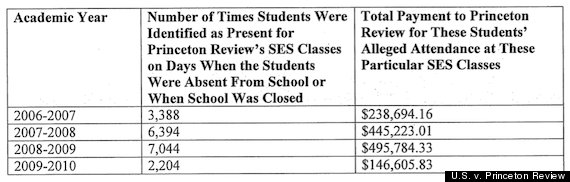
    Below: A chart from the lawsuit shows how often Princeton Review claimed reimbursements for tutoring services for students who were absent or when school was closed, and how much was paid from the federal fund to the company.

    Names were sometimes misspelled on student attendance sheets, and signatures changed in appearance from class to class. Reimbursement claims were also made for tutoring sessions held for students were were abroad or when schools were closed -- the suit claims that 19,000 such incidents occurred between 2006 and 2010. The company sought claims for a supposed 74-student tutoring session on New Year's Day at a school in the Bronx and for a student who was in Mexico for a family vacation when the student's signature was written onto attendance.
    Princeton Review does not currently serve all city schools, though some have hired the company to provide test prep courses for exams like the SAT, according to GothamSchools. More than 100 other companies are eligible to offer Supplemental Education Services tutoring to students in New York City as the number of eligible students increased this year while an unprecedented number of schools failed to meet federal performance benchmarks.
    In a statement Tuesday, the Princeton Review did not deny the claims but noted that the alleged improprieties are in the company's past -- and ended when its Supplemental Educations Services division was discontinued in 2010. The company says it is working with prosecutors to resolve the charges and none of the employees or executives involved in the program are still with the company.
    Alleged dishonesty associated with Princeton Review's bonus incentives is reminiscent of widespread cheating among Atlanta Public School educators, in which teachers and school administrators said they were pressured to maintain high scores under No Child Left Behind, as student performance on standardized exams is tied to school funding and teacher performance assessments. A number of school districts offered bonuses to teachers who had students with significant gains to testing scores. An investigation into the scandal found that Atlanta Public Schools officials created a culture of "fear, intimidation and retaliation."
    But the overhead pressure wasn't unique to Atlanta. School districts from Washington, D.C. to Pennsylvania to Texas to California saw similar problems, often identified by test erasure analyses, as investigations launched in systems across the country.
    A Detroit Free Press survey last July reported that nearly 30 percent of public school educators say pressure to cheat on standardized exams is a problem at their schools, particularly at schools that don't meet federal standards, where 46 percent say cheating is an issue.
    To lessen the strain of a one-size-fits all approach to student assessments, the Education Department has issued waivers to 11 states, allowing them more freedom from No Child Left Behind -- the Bush-era law that requires annual testing, results of which are tied to consequences for low-performing schools. States that seek waivers from the Obama administration are required to adhere to a measurement, curriculum and assessment plan proposed during the application process. An additional 26 states have applied for waivers.

    Charter Schools Are… [Public? Private? Neither? Both?]

    New post on School Finance 101

    Charter Schools Are… [Public? Private? Neither? Both?]

    by schoolfinance101
    …Directly Publicly Subsidized, Limited Public Access, Publicly or Privately Authorized, Publicly or Privately Governed, Managed and Operated Schools
    Let’s break it down:
    Directly publicly subsidized
    Charter schools are directly subsidized by a combination of (primarily) state and local tax dollars (state dependent) transferred to charter schools on the basis of their enrollments.
    This funding is analogous to a directly subsidized voucher program that would transfer tax dollars to private schools on the basis of students signing up for the voucher program.
    This funding is also analogous to the state aid that is delivered on a pupil enrollment basis to local public school districts, but the funding is different from local tax dollars that are raised based on the values of taxable properties and are not dependent on pupil enrollments.
    Note that traditional public schools or charter schools may receive a variety of non-government (non-taxpayer supported) revenues including private gifts, private foundation grants, fees/event receipts, facilities rental, etc.
    The direct subsidy for charters is distinctly different from indirect subsidies like tuition tax credits, which provide the opportunity for individuals or other entities to receive a full tax credit for donating funds to an independently operated/managed entity which then distributes those funds as vouchers or scholarships.
    An important legal distinction is that the U.S. Supreme Court has recently decided that when tuition tax credit funds are used to support religious education, taxpayers have no standing to challenge that distribution as a distribution of their tax dollars, due to the indirect nature of the subsidy. See: ARIZONA CHRISTIAN SCHOOL TUITION ORGANIZATION v. WINN
    Limited Public Access
    Charter schools are limited public access in the sense that:
    1. They can define the number of enrollment slots they wish to make available
    2. They can admit students only on an annual basis and do not have to take students mid-year
    3. They can set academic, behavior and cultural standards that promote exclusion of students via attrition.
    [may vary and/or be restricted under state policies]
    A traditional public school or “district school” or “government school” must accept students at any point during the year and but for specific disciplinary circumstances that may permit long term suspensions and expulsions. Traditional public schools cannot shed students who do not meet academic standards, comply with more general behavioral codes or social standards, such as parental obligations.
    Imagine a community park, for example, that is paid for with tax dollars collected by all taxpayers in the community, and managed by a private board of directors. That board has determined that the park may reasonably serve only 100 of the community’s 1,000 residents. The amount of tax levied is adjusted for the park’s capacity. To determine who gets to use the park annually, interested residents subscribe to a lottery, where 100 are chosen each year. Others continue to pay the tax whether chosen for park access or not. The park has a big fence around it, and only those granted access through the lottery may gain entrance. Imagine also that each of the 100 lottery winners must sign a code of conduct to be unilaterally enforced by the private manager of the park. That management firm can establish its own procedures (or essentially have none) for determining who has or has not abided by the code of conduct and revoke access privileges unilaterally. This is clearly not a PUBLIC park in the way that scholars such as Paul Samuelson describe public goods.
    Publicly or Privately Authorized [contingent on state policy]
    States have varied policies regarding the entities that may grant charters for charter schools to commence (and continue) operations and draw on public tax dollars to serve children who subscribe. In some states, only government agencies themselves can authorize charter schools and therefore may also un-authorize them. In other states, statutes grant authority to private entities to grant and revoke charters. These private entities tend to be non-profit entities, including universities which may be quasi-public, governed by boards of directors that are private citizens, not elected government officials.
    That boards of directors or governing bodies of authorizers are not public or elected officials is an important delineation. Indeed statutes may declare that they must comply with all statutes and regulations pertaining to public officials, but such requirements are not implicit.
    The non-public, non-government status of governing boards of charter authorizers has significant legal implications regarding such issues as a) whether meetings are subject to open meetings laws, b) whether records are subject to open public records laws. Further, recourse for individuals – employees or students – against these private entities differs than it would if these entities were public.
    Publicly or Privately Locally Governed [contingent on state policy]
    States have varied policies regarding the local governance of charter schools, but many states require that the local governance of independently operated charters take the form of a board of directors which consists of self-appointed private citizens, not elected or appointed public officials. States also permit local public school districts to operate their own charter schools which remain under the authority of their local board of education which is either directly elected or consists of appointed government officials (usually mayoral appointments).
    Again, the distinctions are important, having significant legal implications for taxpayers, students and employees.
    As with authorizers, private boards of directors might invoke the claim that they are not subject to open meetings laws or open public records requirements. Unless explicitly stated in state charter laws, this argument might be accepted, since private boards of directors are not implicitly subject to these requirements.
    Publicly or Privately Managed and Operated [contingent on state policy]
    Finally, whether governed by the public officials of the local public school district, or by a board of directors of private citizens, those governing boards might choose to contract a private entity to manage and operate the school.
    That entity might be the entity with which the employees of the school hold their contracts. This has significant implications for employee rights, as we have seen in the 9th circuit ruling in Caviness v. Horizon Community Learning Center. (teachers do not have certain legal recourse against private employers under Section 1983 of the U.S. Code which applies only to “state actors.”)
    It also has implications for public access to information on teacher contractual agreements. Private managers of charter schools may invoke their private status, along with their private governing boards, to claim that teacher contracts are not subject to open public records requests, even though those teachers’ salaries are paid for with public tax dollars.
    They may similarly invoke claims of their private status in limiting access to meetings. Again, unless explicitly stated to the contrary in state law, charter managers and their governing boards may succeed in avoiding disclosure.
    Private managers of charter schools, and private boards governing charter schools may also choose to require student disciplinary codes and parental participation regulations and may invoke provisions in those codes which allow them to unilaterally dismiss parents or families (to the extent permissible under state charter laws). Because the managers and governing boards are not state actors, student and family recourse may be limited.
    Scholars Preston C. Green, III, Erica Frankenberg et al. (Penn State University) have a forthcoming article discussing the implications of the Caviness decision regarding student rights in privately governed and managed charter schools. They note:
    Although charter schools are frequently portrayed as “public schools,” a recent United States Court of Appeals decision, Caviness v. Horizon Learning Center (2010) suggests that charter schools may not have to provide constitutional protections for their students.  Therefore, contract law may apply to conflicts between charter schools and their students, as is the case in private schools.  Private schools have a great deal more latitude over disciplinary issues than public schools (Shaughnessy, 2003).
    A few final thoughts...
    These are important distinctions. They are not trivial.
    Teachers choosing to sign contracts with private governing boards and/or managers of charter schools should understand that they likely do not have the rights of public employees, unless explicitly stated.
    So too should parents of children attending privately governed and managed charter schools.
    Further, so too should taxpayers and/or citizen/voters understand that depending on how the courts see it, and depending on whether charter laws are sufficiently detailed in their requirements, privately governed and privately managed charter schools may not be required to fully disclose financial documents pertaining to the expenditure of public funds, or to permit access to their meetings.
    The fact that many state charter laws and federal regulatory references to charter schools refer to them as “public” is a hollow proclamation that has little legal or practical bearing on the more nuanced distinctions I address here.
    Those who casually (belligerently & ignorantly) toss around the rhetoric that "charters are public schools" need to stop. This rhetoric misinforms parents, teachers and taxpayers regarding their rights, assumptions and expectations.
    I'm under the impression that many teachers considering working for, or currently working for privately operated charters do not necessarily understand how their rights may differ from those of traditional public school teachers and I suspect the same is true for parents and students. That's certainly not to say that all privately managed charter schools would take advantage of their increased latitude in negative ways. There are some good private management companies and perhaps some bad ones, just like there are good private schools and bad ones (I had the pleasure of working at one of each!).
    Those who characterize charter schools as purely private also don't fully capture the nuances laid out above, though some charters - by virtue of the many layers of organization laid out above and by virtue of emerging case law - may be moving in that direction.
    Note that these legal debates over whether charter schools are state actors or private entities only come about because, when an issue is raised regarding open records or meetings, or employee or student rights, it is the lawyers for the charter school that invoke the claim that they are private entities. Like here!   I surely hope those invoking their private status when legally convenient are not among those proclaiming their public status when politically convenient. You just can't have it both ways.
    schoolfinance101