Friday, December 23, 2011

Matt Damon Slams Obama, Democrats: 'One Term President With Some Balls Would Have Been Better'

Matt Damon, one of Barack Obama's earliest supporters and once one of his most staunch advocates, slammed the President in the new issue of Elle Magazine.
"I've talked to a lot of people who worked for Obama at the grassroots level. One of them said to me, 'Never again. I will never be fooled again by a politician,'" Damon tells the magazine. "You know, a one-term president with some balls who actually got stuff done would have been, in the long run of the country, much better."
Referring to the Occupy Wall Street movement, Damon continued: "If the Democrats think that they didn't have a mandate -- people are literally without any focus or leadership, just wandering out into the streets to yell right now because they are so pissed off ... Imagine if they had a leader."
That echoes the President's own words to Diane Sawyer in March of 2010 when he said, "I'd rather be a really good one-term president than a mediocre two-term president... There's a tendency in Washington to think that our job description, of elected officials, is to get reelected. That's not our job description. Our job description is to solve problems and to help people."
The slam follows in the same vein as a number of other criticisms Damon has made of the President and the Democrats, including in March, when he criticized Obama's education policy.
"I really think he misinterpreted his mandate. A friend of mine said to me the other day, I thought it was a great line, 'I no longer hope for audacity,'" Damon told CNN host Piers Morgan. "He's doubled down on a lot of things, going back to education... the idea that we're testing kids and we're tying teachers salaries to how kids are performing on tests, that kind of mechanized thinking has nothing to do with higher order. We're training them, not teaching them."
Later that month, he hit Obama on his handling of the economic crisis.
"I think he's rolled over to Wall Street completely. The economy has huge problems. We still have all these banks that are too big to fail. They're bigger and making more money than ever. Unemployment at 10 percent? It's terrible," he told the Independent. Damon also criticized the President's inability to get transformative things done, saying, "They had a chance that they don't have any more to stand up for things. They've probably squandered that at this point. They'll probably just make whatever deals they can to try to get elected again."
Currently, Obama and the Democrats arefighting with the House GOP over passing a compromise two month extension of the payroll tax cuts and unemployment benefits, amongst other things; they've already removed increased taxes on the wealthy from the deal.
Damon's criticism rings with disappointment after he so publicly lent his support to the then-Senator Obama during the 2008 election. He spent time campaigning for the then-candidate at rallies, promoting him through a MoveOn video contest and attending fundraisers for the man who would become the 44th President.
In August, the star ripped a cameraman and reporter from a conservative publication who challenged his stance on education at a Save Our Schools event in Washington, DC. He then moved on to economic policy criticism.
"The wealthy are paying less than they paid at any time else, certainly in my lifetime, and probably in the last century," Damon told a reporter at the same event. "I don't know what we were paying in the Roaring '20s; it's criminal that so little is asked of people who are getting so much. I don't mind paying more. I really don't mind paying more taxes. I'd rather pay for taxes than cut 'Reading is Fundamental' or Head Start or some of these programs that are really helping kids. This is the greatest country in the world; is it really that much worse if you pay 6% more in taxes? Give me a break. Look at what you get for it: you get to be American."
Speaking of the then-protracted negotiations over the debt ceiling, he did show some sympathy for Obama.
"I'm so disgusted," he said. "I mean, no, I don't know what you do in the face of that kind of intransigence. So, my heart does go out to the President. He is dealing with a lot."
Scarlett Johansson, Damon's co-star in the upcoming film "We Bought A Zoo," recently said that she wanted Obama elected to another four year term. The President still enjoys support in Hollywood, having recently attended fundraisers in Los Angeles filled with stars.
Obama responded jokingly to Damon's criticism at his White House Press Correspondents Dinner in late April, saying, "It's fair to say that when it comes to my presidency, the honeymoon is over ... Matt Damon said he [has been] disappointed in my performance. Well Matt, I just saw the 'Adjustment Bureau,' so ... right back atcha buddy."
For more, click over to Elle.

Taibbi - Xmas Message From America's Rich


POSTED: 
A Christmas Message From America's Rich
Dario Cantatore/Getty
http://www.rollingstone.com/politics/blogs/taibblog/a-christmas-message-from-americas-rich-20111222

It seems America’s bankers are tired of all the abuse. They’ve decided to speak out.
True, they’re doing it from behind the ropeline, in front of friendly crowds at industry conferences and country clubs, meaning they don’t have to look the rest of America in the eye when they call us all imbeciles and complain that they shouldn’t have to apologize for being so successful.
But while they haven’t yet deigned to talk to protesting America face to face, they are willing to scribble out some complaints on notes and send them downstairs on silver trays. Courtesy of a remarkable story by Max Abelson at Bloomberg, we now get to hear some of those choice comments.
Home Depot co-founder Bernard Marcus, for instance, is not worried about OWS:
“Who gives a crap about some imbecile?” Marcus said. “Are you kidding me?”
Former New York gurbernatorial candidate Tom Golisano, the billionaire owner of the billing firm Paychex, offered his wisdom while his half-his-age tennis champion girlfriend hung on his arm:
“If I hear a politician use the term ‘paying your fair share’ one more time, I’m going to vomit,” said Golisano, who turned 70 last month, celebrating the birthday with girlfriend Monica Seles, the former tennis star who won nine Grand Slam singles titles.
Then there’s Leon Cooperman, the former chief of Goldman Sachs’s money-management unit, who said he was urged to speak out by his fellow golfers. His message was a version of Wall Street’s increasingly popular If-you-people-want-a-job, then-you’ll-shut-the-fuck-up rhetorical line:
Cooperman, 68, said in an interview that he can’t walk through the dining room of St. Andrews Country Club in Boca Raton, Florida, without being thanked for speaking up. At least four people expressed their gratitude on Dec. 5 while he was eating an egg-white omelet, he said.
“You’ll get more out of me,” the billionaire said, “if you treat me with respect.”
Finally, there is this from Blackstone CEO Steven Schwartzman:
Asked if he were willing to pay more taxes in a Nov. 30 interview with Bloomberg Television, Blackstone Group LP CEO Stephen Schwarzman spoke about lower-income U.S. families who pay no income tax.
“You have to have skin in the game,” said Schwarzman, 64. “I’m not saying how much people should do. But we should all be part of the system.”
There are obviously a great many things that one could say about this remarkable collection of quotes. One could even, if one wanted, simply savor them alone, without commentary, like lumps of fresh caviar, or raw oysters.
But out of Abelson’s collection of doleful woe-is-us complaints from the offended rich, the one that deserves the most attention is Schwarzman’s line about lower-income folks lacking “skin in the game.” This incredible statement gets right to the heart of why these people suck.
Why? It's not because Schwarzman is factually wrong about lower-income people having no “skin in the game,” ignoring the fact that everyone pays sales taxes, and most everyone pays payroll taxes, and of course there are property taxes for even the lowliest subprime mortgage holders, and so on.
It’s not even because Schwarzman probably himself pays close to zero in income tax – as a private equity chief, he doesn’t pay income tax but tax on carried interest, which carries a maximum 15% tax rate, half the rate of a New York City firefighter.
The real issue has to do with the context of Schwarzman’s quote. The Blackstone billionaire, remember, is one of the more uniquely abhorrent, self-congratulating jerks in the entire world – a man who famously symbolized the excesses of the crisis era when, just as the rest of America was heading into a recession, he threw himself a $5 million birthday party, featuring private performances by Rod Stewart and Patti Labelle, to celebrate an IPO that made him $677 million in a matter of days (within a year, incidentally, the investors who bought that stock would lose three-fourths of their investments).
So that IPO birthday boy is now standing up and insisting, with a straight face, that America’s problem is that compared to taxpaying billionaires like himself, poor people are not invested enough in our society’s future. Apparently, we’d all be in much better shape if the poor were as motivated as Steven Schwarzman is to make America a better place.  
But it seems to me that if you’re broke enough that you’re not paying any income tax, you’ve got nothing but skin in the game. You've got it all riding on how well America works.
You can’t afford private security: you need to depend on the police. You can’t afford private health care: Medicare is all you have. You get arrested, you’re not hiring Davis, Polk to get you out of jail: you rely on a public defender to negotiate a court system you'd better pray deals with everyone from the same deck. And you can’t hire landscapers to manicure your lawn and trim your trees: you need the garbage man to come on time and you need the city to patch the potholes in your street.
And in the bigger picture, of course, you need the state and the private sector both to be functioning well enough to provide you with regular work, and a safe place to raise your children, and clean water and clean air.
The entire ethos of modern Wall Street, on the other hand, is complete indifference to all of these matters. The very rich on today’s Wall Street are now so rich that they buy their own social infrastructure. They hire private security, they live on gated mansions on islands and other tax havens, and most notably, they buy their own justice and their own government.
An ordinary person who has a problem that needs fixing puts a letter in the mail to his congressman and sends it to stand in a line in some DC mailroom with thousands of others, waiting for a response.
But citizens of the stateless archipelago where people like Schwarzman live spend millions a year lobbying and donating to political campaigns so that they can jump the line. They don’t need to make sure the government is fulfilling its customer-service obligations, because they buy special access to the government, and get the special service and the metaphorical comped bottle of VIP-room Cristal afforded to select customers.
Want to lower the capital reserve requirements for investment banks? Then-Goldman CEO Hank Paulson takes a meeting with SEC chief Bill Donaldson, and gets it done. Want to kill an attempt to erase the carried interest tax break? Guys like Schwarzman, and Apollo’s Leon Black, and Carlyle’s David Rubenstein, they just show up in Washington at Max Baucus’s doorstep, and they get it killed.
Some of these people take that VIP-room idea a step further. J.P. Morgan Chase CEO Jamie Dimon – the man the New York Times once called “Obama’s favorite banker” – had an excellent method of guaranteeing that the Federal Reserve system’s doors would always be open to him. What he did was, he served as the Chairman of the Board of the New York Fed.
And in 2008, in that moonlighting capacity, he orchestrated a deal in which the Fed provided $29 billion in assistance to help his own bank, Chase, buy up the teetering investment firm Bear Stearns. You read that right: Jamie Dimon helped give himself a bailoutWho needs to worry about good government, when you are the government?
Dimon, incidentally, is another one of those bankers who’s complaining now about the unfair criticism. “Acting like everyone who’s been successful is bad and because you’re rich you’re bad, I don’t understand it,” he recently said, at an investor’s conference.
Hmm. Is Dimon right? Do people hate him just because he’s rich and successful? That really would be unfair. Maybe we should ask the people of Jefferson County, Alabama, what they think.
That particular locality is now in bankruptcy proceedings primarily because Dimon’s bank, Chase, used middlemen to bribe local officials – literally bribe, with cash and watches and new suits – to sign on to a series of onerous interest-rate swap deals that vastly expanded the county’s debt burden.
Essentially, Jamie Dimon handed Birmingham, Alabama a Chase credit card and then bribed its local officials to run up a gigantic balance, leaving future residents and those residents’ children with the bill. As a result, the citizens of Jefferson County will now be making payments to Chase until the end of time.
Do you think Jamie Dimon would have done that deal if he lived in Jefferson County? Put it this way: if he was trying to support two kids on $30,000 a year, and lived in a Birmingham neighborhood full of people in the same boat, would he sign off on a deal that jacked up everyone’s sewer bills 400% for the next thirty years?
Doubtful. But then again, people like Jamie Dimon aren’t really citizens of any country. They live in their own gated archipelago, and the rest of the world is a dumping ground.
Just look at how Chase behaved in Greece, for example.
Having seen how well interest-rate swaps worked for Jefferson County, Alabama, Chase “helped” Greece mask its debt problem for years by selling a similar series of swaps to the Greek government. The bank then turned around and worked with banks like Goldman, Sachs to create a thing called the iTraxx SovX Western Europe index, which allowed investors to bet against Greek debt.
In other words, Chase knowingly larded up the nation of Greece with a crippling future debt burden, then turned around and helped the world bet against Greek debt.
Does a citizen of Greece do that deal? Forget that: does a human being do that deal?
Operations like the Greek swap/short index maneuver were easy money for banks like Goldman and Chase – hell, it’s a no-lose play, like cutting a car’s brake lines and then betting on the driver to crash – but they helped create the monstrous European debt problem that this very minute is threatening to send the entire world economy into collapse, which would result in who knows what horrors. At minimum, millions might lose their jobs and benefits and homes. Millions more will be ruined financially.
But why should Chase and Goldman care what happens to those people? Do they have any skin in that game?
Of course not. We’re talking about banks that not only didn’t warn the citizens of Greece about their future debt disaster, they actively traded on that information, to make money for themselves.
People like Dimon, and Schwarzman, and John Paulson, and all of the rest of them who think the “imbeciles” on the streets are simply full of reasonless class anger, they don’t get it. Nobody hates them for being successful. And not that this needs repeating, but nobody even minds that they are rich.
What makes people furious is that they have stopped being citizens.
Most of us 99-percenters couldn’t even let our dogs leave a dump on the sidewalk without feeling ashamed before our neighbors. It's called having a conscience: even though there are plenty of things most of us could get away with doing, we just don’t do them, because, well, we live here. Most of us wouldn’t take a million dollars to swindle the local school system, or put our next door neighbors out on the street with a robosigned foreclosure, or steal the life’s savings of some old pensioner down the block by selling him a bunch of worthless securities.
But our Too-Big-To-Fail banks unhesitatingly take billions in bailout money and then turn right around and finance the export of jobs to new locations in China and India. They defraud the pension funds of state workers into buying billions of their crap mortgage assets. They take zero-interest loans from the state and then lend that same money back to us at interest. Or, like Chase, they bribe the politicians serving countries and states and cities and even school boards to take on crippling debt deals.
Nobody with real skin in the game, who had any kind of stake in our collective future, would do any of those things. Or, if a person did do those things, you’d at least expect him to have enough shame not to whine to a Bloomberg reporter when the rest of us complained about it.
But these people don’t have shame. What they have, in the place where most of us have shame, are extra sets of balls. Just listen to Cooperman, the former Goldman exec from that country club in Boca. According to Cooperman, the rich do contribute to society:
Capitalists “are not the scourge that they are too often made out to be” and the wealthy aren’t “a monolithic, selfish and unfeeling lot,” Cooperman wrote. They make products that “fill store shelves at Christmas…”
Unbelievable. Merry Christmas, bankers. And good luck getting that message out.


Read more: http://www.rollingstone.com/politics/blogs/taibblog/a-christmas-message-from-americas-rich-20111222#ixzz1hN7hlCUg

Thursday, December 22, 2011

Segregated Charter Schools Evoke Separate But Equal Era in U.S. Education


 John Hechinger, ironically at Bloomberg News, remains the MVP for national ed reporting.

http://www.bloomberg.com/news/2011-12-22/segregated-charter-schools-evoke-separate-but-equal-era-in-u-s-education.html

Segregated Charter Schools Evoke Separate But Equal Era in U.S. Education

Q
By John Hechinger - Dec 22, 2011 12:01 AM ET
 
At Dugsi Academy, a public school in St. Paul, Minnesota, girls wearing traditional Muslim headscarves and flowing ankle-length skirts study Arabic and Somali. The charter school educates “East African children in the Twin Cities,” its website says. Every student is black.

At Twin Cities German Immersion School, another St. Paul charter, children gather under a map of “Deutschland,” study with interns from Germany, Austria and Switzerland and learn to dance the waltz. Ninety percent of its students are white.

Six decades after the U.S. Supreme Court struck down “separate but equal” schools for blacks and whites, segregation is growing because of charter schools, privately run public schools that educate 1.8 million U.S. children. While charter-school leaders say programs targeting ethnic groups enrich education, they are isolating low-achievers and damaging diversity, said Myron Orfield, a lawyer and demographer.

“It feels like the Deep South in the days of Jim Crow segregation,” said Orfield, who directs the University of Minnesota Law School’s Institute on Race & Poverty. “When you see an all-white school and an all-black school in the same neighborhood in this day and age, it’s shocking.”

Charter schools are more segregated than traditional public schools, according to a 2010 report by the Civil Rights Project at the University of CaliforniaLos Angeles. Researchers studied 40 states, the District of Columbia, and 39 metropolitan areas. In particular, higher percentages of charter-school students attend what the report called “racially isolated” schools, where 90 percent or more students are from disadvantaged minority groups.

Charter-School Birthplace

In Minnesota, the birthplace of the U.S. charter-school movement, the divide is more than black and white.
St. Paul’s Hmong College Prep Academy, 99 percent Asian- American in the past school year, immerses students “in the rich heritage that defines Hmong culture.” Its Academia Cesar Chavez School -- 93 percent Hispanic -- promises bilingual education “by advocating Latino cultural values in an environment of familia and community.” Minneapolis’sFour Directions Charter School, 94 percent Native American, black and Hispanic, promotes “lifelong learning for American Indian students.”

Charter schools, which select children through lotteries, are open to all who apply, said Abdulkadir Osman, Dugsi’s executive director.

“Some people call it segregation,” Osman said. “This is the parent’s choice. They can go anywhere they want. We are offering families something unique.”

Nobody ‘Forced’

That’s a “significant difference” between Minnesota charters and segregated schools in the 1950s South, said Joe Nathan, director of the Center for School Change at Macalester College in St. Paul.

“Nobody is being forced to go to these schools,” said Nathan, who helped write Minnesota’s 1991 charter-school law.

Ever since Horace Mann crusaded for free universal education in the 19th century, public schools have been hailed as the U.S. institutions that bring together people of disparate backgrounds.

The atomization of charter schools coincides with growing U.S. diversity. Americans of other races will outnumber whites by 2042, the Census Bureau projects.

Even after a divided Supreme Court in 2007 ruled that schools couldn’t consider race in making pupil assignments to integrate schools, Justice Anthony M. Kennedy urged districts to find other ways to fight “de facto resegregation” and “racial isolation.”

“The nation’s schools strive to teach that our strength comes from people of different races, creeds, and cultures uniting in commitment to the freedom of all,” Kennedy wrote.

Diverse Workplaces

Citing Kennedy’s words, U.S. Secretary of Education Arne Duncan and Attorney General Eric Holder this month called for schools -- including charters -- to combat growing segregation.

Along with breeding “educational inequity,” racially- divided schools deny children the experiences they need to succeed in an increasingly diverse workplace, Duncan said in announcing voluntary guidelines for schools.
Charter schools may specialize in serving a single culture as long as they have open admissions, and there’s no evidence of discrimination, said Russlynn Ali, assistant education secretary for civil rights.

The education department is encouraging charter schools to promote diversity. Charters could expand recruiting and consider lotteries that give extra weight to disadvantaged groups, such as families living in low-income neighborhoods or children who speak English as a second language, Ali said in a phone interview.

Immigrant Magnet

Minnesota, 85 percent white, is a case study of the nation’s growing diversity. Since the 1970s, Minneapolis and St. Paulhave become a magnet for Hmong refugees, who fought alongside Americans in the Vietnam War. In the 1990s, Somalis sought refuge from civil war.

St. Paul, where the nation’s first charter school opened in 1992, is 16 percent black, 10 percent Hispanic and 15 percent Asian-American, according to the U.S Census Bureau.

Charter schools should be similarly diverse, recommended a 1988 report that provided the groundwork for Minnesota’s charter-school law.

“We envision the creation of schools which, by design, would invite a dynamic mix of students by race and ability levels,” the Citizens League, a St. Paul-based nonprofit public-policy group, wrote in the report.

‘Great Failure’

Instead, in the 2009-2010 school year, three quarters of the Minneapolis and St. Paul region’s 127 charter schools were “highly segregated,” according to the University of Minnesota Law School’s race institute. Forty-four percent of schools were 80 percent or more non-white, and 32 percent, mostly white.
“It’s been a great failure that the most segregated schools in Minnesota are charter schools,” said Mindy Greiling, a state representative who lobbied for the charter-school law when she was a member of a suburban school board in the 1980s. “It breaks my heart.”

Segregation is typical nationwide. Seventy percent of black charter-school students across the country attended “racially isolated” schools, twice as many as the share in traditional public schools, according to the report from the Civil Rights Project at UCLA.

Half of all Latino charter-school students went to these intensely segregated schools, the study found. In the West and the South, the two most racially diverse regions of the country, “charters serve as havens for white flight from public schools,” the report said.

Hmong Roots

They also serve as havens for minority students who need extra help, said leaders of Minnesota charter schools.

Christianna Hang, founder of Hmong College Prep Academy, said she designed the school so children, mostly first- generation Americans, didn’t feel adrift in public schools as she did when she arrived in the U.S. in 1980.
In the Hmong academy’s central hallway, a tapestry depicts families living in Laos, fleeing the Vietnam War and arriving in America. The school’s roughly 700 students, in grades kindergarten through 12th grade, learn Hmong.
“I came here for my parents as much as for me,” said Mai Chee Xiong, a 17-year-old senior. “I was very Americanized. I wanted to be able to speak with them in our language, and I wanted to understand my roots.”
In the 2009-2010 school year, 26 percent of Hmong Academy students met or exceeded standards on state math exams, while 30 percent did so in reading. About half passed those tests in the St. Paul Public School District.

Harvard Banners

To raise expectations, classrooms adopt colleges, hanging banners from Harvard UniversityYale University andDartmouth College over their doors.

“If we don’t do something to help these kids, they will get lost,” Hang said. “If they drop out of school, they will never become productive citizens, and there’s no way they will achieve the American dream.”
Dugsi Academy, the school for East Africans, and Twin Cities German Immersion School make for some of St. Paul’s sharpest contrasts.

Until this school year, the two schools were neighbors, across a busy commercial thoroughfare in a racially diverse neighborhood. At different times of the day, the kids used a city playground in front of the German school for recess. Dugsi has since moved three miles away, across a highway from the Hmong academy.
The German Immersion School is a bright, airy former factory with exposed brick and high ceilings.

Fluent German

“Eva, was ist das?” kindergarten teacher Elena Heindl asked one morning earlier this month as she pointed a red flashlight to letters, eliciting the name of each one in German.

To succeed at the school, students must be fluent in German to enroll, unless they enter before second or third grade, Julie Elias, a parent, told prospective families on a tour this month.

“You can’t just move into the neighborhood if you want to go to our school,” Elias said. The school is legally required to take anyone picked in its lottery, though it counsels parents against enrolling in older grades without German knowledge, said Annika Fjelstad, its director.

The school, which includes many families with one parent who speaks German or that have German relatives, holds special events at the Germanic-American Institute in a $1.3 million St. Paul house with a ballroom. Children like to call the institute “our school’s mansion,” said Chris Weimholt, another parent giving the tour.

No Buses

In the 2009-2010 school year, 87 percent of children at the German school passed state math tests and 84 percent did so in reading, according to the Minnesota Department of Education. Fifteen percent qualify for the federal free or reduced lunch program, compared with 71 percent in St. Paul. The school doesn’t offer bus transportation, so most parents drive, often carpooling, Elias said.

The language requirement and lack of transportation prevents poor families from attending, said Greiling, the state legislator, who has toured the school.

“A regular public school could never have that kind of bar,” she said. “It seems an odd thing that this would be legal.”

The German program doesn’t have buses because they would cost $100,000 a year, too heavy a burden for an expanding school of 274 that wants to maintain classes of 20 students, Fjelstad said. An immersion school can’t take kids who aren’t fluent after early grades, she said.
In February, the school formed an “inclusivity” task force to find ways to make the school more reflective of the community, Fjelstad said. The school will try to improve recruiting through its relationship with community organizations, such as a neighboring YMCA, she said.

International View

The school offers a different kind of diversity, said Weimholt, a nurse whose grandfather emigrated from Germany after World War I. “It doesn’t look diverse by skin color. But families straddle two different continents. The school truly has an international perspective.”

So does Dugsi Academy. Children learn Arabic and Somali along with English and traditional academic subjects. A caller last month heard no English on a school voice mail.

One morning in late November, a sixth-grade social-studies class discussed immigration with 28-year-old Khaleefah Abdallah, who himself fled Somalia 12 years ago. The boys wore jeans and sweatshirts. The girls sported hijabs, or traditional Muslim head coverings with skirts or long pants.

‘Melting Pot’

Abdallah asked his class about the idea of the American “melting pot:” immigrants assimilating into U.S. culture. He suggested another metaphor, a “salad bowl,” where people from different backgrounds mix while retaining their own identity.

“I agree with the salad bowl,” Fadumo Ahmed, 12, dressed in a black hijab and sneakers with pink laces, told the class. “We all come from different places, but we still want to keep our culture.”

Students shared stories of the challenge of co-existing in mainstream America.

Ahmed Hassan, 12, complained about a boy on a city playground who made fun of the long traditional robe he wore one Friday.
“He told me it looked like a skirt,” Hassan said. Abdallah told the class that, under the U.S. constitution, Americans have the freedom to express themselves through their clothing.

Test Scores

Dugsi, a low-slung red-brick building in an office park, has about 300 students in kindergarten through eighth grade. Almost all qualify for federal free or reduced lunches, according to the state. Only 19 percent passed state math exams in the 2009-2010 school year, while 40 percent did so in reading.

The school’s test scores reflect families’ backgrounds. said Osman, the Dugsi director and a former employee of the U.S. Embassy in Somalia, who emigrated to the U.S. in 1993. Parents work as cab drivers, nurses and grocers, Osman said. Many had no formal schooling.

It would be better if one day Somali students could go to school with children from other backgrounds, Osman said.
“That’s the beauty of America -- Latinos, Caucasians, African-Americans and Native Americans, all together in the same building, eating lunch and in the same classrooms,” Osman said. “It would be something wonderful. That’s what I’m thinking of for my own kids and grandchildren.”

To contact the reporter on this story: John Hechinger in Boston at jhechinger@bloomberg.net
To contact the editor responsible for this story: Jonathan Kaufman at jkaufman17@bloomberg.net

More on Charter Schools as the Scam of the Century


Charter Schools Rarely Closed For Academic Performance: Report

http://www.huffingtonpost.com/2011/12/21/charter-schools-closure_n_1164104.html?ref=tw

In nearly two decades, only 3 percent of charter schools have ever been closed for underperforming, according to a new report released Tuesday.

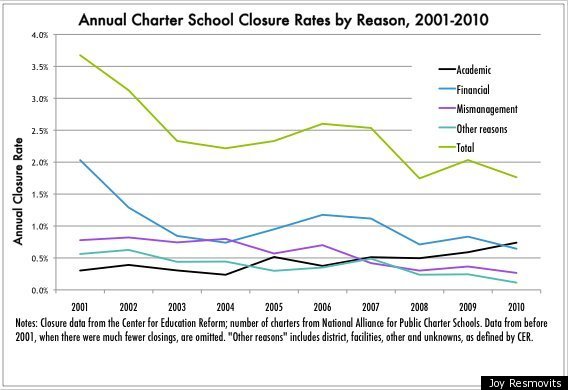
The Center for Education Reform, a pro-charter advocacy group, traced charter-school closures since 1992 in what it called the "first-ever national analysis" of its kind. It found that 15 percent of 6,700 charter schools have been shuttered, and 18 percent of those closures were attributed to academic underperformance. Other prevalent reasons charter schools were closed include financial deficiencies (41.7 percent), mismanagement (24 percent), district-related issues and facilities problems.
The data is key to deciphering whether charter schools -- which are publicly funded but can be independently run -- are holding up their end of the bargain of increased flexibility in exchange for increased accountability. The question is key given that charter-school proponents are often data-driven education reformers who advocate using test-score data to rank traditional public schools and the teachers who work there.
As the Center for Education Reform's president Jeanne Allen wrote in the report, "performance-based accountability is the hallmark of the charter school concept."
The report comes as charter-school advocates are zeroing in on quality, at least rhetorically. As the amount of students attending charter schools reaches a critical mass, some proponents worry that the schools' overall quality is not outstanding enough to politically justify their growth.
Advocates of charter schools, a favorite education-reform strategy of the Obama administration, are finding themselves on the defensive.
"Until charter schools start showing there are innovative, well-managed schools, they're still going to be on the hot seat," said Harrison Blackmond, who heads the Michigan arm of the pro-charter group Democrats for Education Reform. "It's hard to defend charter schools if they're not outperforming traditional public schools."
stream of recent research has shown that on average, charter schools don't outperform traditional public schools, though they may be more effective in some areas than others.
"The vast majority of charter schools get no better and no worse test-based results than comparable regular public schools," Matthew Di Carlo, a senior fellow at the Albert Shanker Institute, wrote in a recent policy brief that examined a large body of charter-school research. Yet, Di Carlo noted that charters do perform slightly better in urban areas. He concluded that they are best utilized as "educational laboratories."
Yet Allen said the report was designed to clear up misconceptions about charter schools.
"It's become very popular to sound like you really are concerned about quality but at the same time that you're saying it, you should know exactly what you're talking about," Allen said.
She added that the study shows that increased accountability would also benefit traditional public schools. "If the threat of closure were felt in public schools, we'd see a different picture in terms of quality," she said.
But while the report made the case for accountability in the charter school movement, saying that "bad charters do close," a closer look at the data shows that despite the report's finding of a cumulative closure rate above 15 percent, no more than 100 charter schools have closed in any given year since 1992.
And as charter-school attendance rates exploded over the last decade, the annual rate for charter-school closure has actually declined from 3.7 percent in 2001 to 1.8 percent in 2010.
Allen explained this trend by saying that as charters have learned more over time, the need for closure has declined. "The care of the charter school world has gotten better as lessons have been learned," she told HuffPost.
(Though the report contains little data for this school year, a fact sheet from theNational Alliance for Public Charter Schools reported that 157 charter schools that enrolled students last year did not exist this fall.)
The data also show that very few charters are ever closed for academic reasons. Florida, Ohio, Arizona and Texas had the five highest overall number of such closures. (In fact, overall, charter-school closures have been extremely concentrated, with 75 percent occurring in eight states.) Charters closed for academic underperformance were open for an average of 6.2 years.

The report attributed the low rate of academically-caused closures to inadequate data collection, and made the point that schools that close for managerial reasons would have likely faced academic woes later on.
"Many assert that charter laws are only working when schools are closed for failing to educate their kids," the report stated. "But the reality is that operational and financial deficiencies are apparent far before any academic assessments can be meaningful." 

"What's fascinating about charter schools is we've had it for two decades now," said Gary Miron, a Western Michigan University professor who has evaluated charter schools in several states. "I remember ten years ago, people were saying, 'now we're going to get serious, we're going to start closing bad-performing schools.' We're seeing the same thing. I thought that was a given: these poor performing schools aren't supposed to be able to continue."

As Alexander Russo, an education blogger and former Democratic hill staffer put it, "This seems too little, too late."