Friday, April 22, 2011

Real School Reform

An unorthodox school reform blueprint

--
This post was written by Joanne Yatvin, a vet­eran public school educator, author and past president of the National Council of Teachers of English. She is now teaching part-time at Portland State University.
 
By Joanne Yatvin
Having complained long and loud about the misguided school reform schemes that rule the day, I think it’s time for me to step up and offer my own ideas for making schools work. Be warned that my proposals are not only unorthodox, but also teacher-biased, and cheap. Well, at least cheaper than the test-drenched plans now in place and on the horizon.

My version of school reform is based on two premises: (1) poverty and its accoutrements are the major causes of students’ poor academic performance (2) the principals and teachers who live their professional lives in schools are best qualified to make decisions for schools and to implement them.

Convert schools in high-poverty areas to full-time community centers.
By moving as many community services as possible into school buildings and making them available in the evenings and on weekends year round, schools could provide existing social supports to poor families more efficiently and economically and add recreational and self-improvement activities now in short supply.
In restructuring building use, the only adjustment to the daytime program would be the addition of basic health and dental care for students. During evening and weekend hours, however, libraries, gyms and computer labs would be open to all, offering a variety of classes, clubs, arts, and sports. In addition, inexpensive and nutritious family meals could be served in the school lunchroom, financially supported by local charities and food banks.

Turn over the management of high-poverty schools to professional educators.
We need to lure the best principals and teachers into struggling schools by offering them incentives of autonomy, professional advancement, and higher salaries. Under the leadership of a dynamic principal, chosen by the school staff and parents, schools would be empowered to create their own structures, including a principal’s cabinet and grade level instructional teams. Within each team, roles and salaries would be differentiated according to teachers’ expertise, experience, and willingness to take on additional responsibilities.

Evaluate teachers on their own performance, not those of students
I argue that too many factors beyond a teacher’s control affect students’ test scores, even when the school uses a “value added” system. What a student learns—both good and bad—comes as much from home, the street, the state of his or her health, and personal interactions as from the classroom. And each student makes choices about what to work hard at and what to ignore.
Although principals’ views of teachers’ competence are not perfect, having a wise and alert administrator considering what teachers do to help students learn is the only rational way to evaluate them. Not only formal observations should count, but also finding a teacher in the library helping some kids with research, noticing how often a teacher volunteers to do something extra for the school, seeing a teacher eating lunch at her desk while she reads student essays, or catching him on the phone talking to a parent.

Offer early retirement to burned-out teachers and incentives for ineffective younger teachers to resign or transfer to non-teaching positions.
At present, removing an unsuccessful teacher is a long and expensive process. But the problem is not teacher tenure. It is the lack of evidence of failure that makes attempting to remove a teacher look arbitrary or vengeful. The first step is to insure systematic evaluations of all teachers with prompt feedback and offers of assistance. Ultimately, any teacher marked for dismissal should be provided with counseling, a dignified resignation process, and monetary incentives. For both older teachers and their districts the incentives would be financially advantageous, with teachers getting a portion of their retirement benefits and the district getting the chance to hire a new teacher at a much lower salary.

Cut reliance on expensive commercial materials for students while increasing teachers’ professional development opportunities to increase their expertise.
Rather than depending on slick commercial programs and their disposable materials (i.e. workbooks), schools would do better to invest in high quality literature, technology, and reference books for students; and professional books and journals, presentations from local innovators, and university courses for teachers. At the same time, schools could purchase small numbers of a variety of commercial programs in which teachers might find good ideas they could modify and expand upon to fit their students’ needs.

Provide poor children with the background knowledge and support they may have missed at home and in their community.
What makes school difficult for most poor children is not lack of ability but meagerness of social, cultural and literary experiences. What many have missed out on is being read to, having substantive conversations with adults, visiting museums, parks, forests, and beaches, and being members of a civil society. To learn academic content and skills successfully, poor children need a school environment that is not only welcoming and supportive, but also rich in books, hands-on activities, cooperative learning, and exposure to the world outside their home community.

Reduce the number of standardized tests and the time devoted to test preparation
Not only is standardized testing expensive, it also allows tested subjects to crowd out other subjects, and test preparation to become almost a subject in itself. Furthermore, tests influence teaching style, making it shallow and formulaic to fit the limitations of a multiple choice format. Both students and schools would be better served if standardized tests were given only every few years and classroom teachers wrote yearly tests that demanded student analysis, judgment, and the synthesis of ideas.
Although I could add more change proposals to my list, these are the basics. I chose to highlight ideas that run counter to much of what is being proposed for school reform today. Since I never know whether to laugh or cry when pundits and policy makers call for more testing, standardization, charter schools, academic rigor (mortis?), ending teacher tenure, and implementing merit pay, I stuck to describing the major features of the good schools I have known and the great ones I still dream of.

NYC Parents Union Says: Don't Vote for Puppets

Today is the deadline for district parents seeking to join their CEC’s.  The Charter Center, which represents charter schools is doing outreach for charter parent candidates to serve on CEC’s even though their schools claim exemption from almost all State and City laws and regulations, including those which created the CEC’s and which require PA’s and SLT’s!
Without an adequate public school parent candidate base for the CECs we face the very real possibility of having the charter school crowd – which represents only 4% of this City’s student base – controlling not only City Hall and the DOE, but also potentially co-opting our legislated elected public school parent forums meant to represent the other 96% of us.  Majority of charters don’t even have PA/PTA’s even after the NY Charter Parents Association (NYCPA) changed NYS Ed Law requiring every charter in NYC to establish a PA/PTA.  NYCPA states charter schools don’t want parents involved except to divide our communities by attending public hearings and the PEP to fight district parents for space in district school buildings; go to Albany and ask legislators for more money for the charter schools run by private ed corporations and now to undermine the district parents by placing charter parents on the CEC’s.
Below is an email from the Charter Parent Advocacy Network/Charter Puppet Advocacy Network which is run by the Charter Center to organize charter parents to serve their private ed corporations interests.  They’ve decided to take over district CEC’s which are a threat to charter school expansion.
This is a real threat to district schools and parents.  What can YOU do?
  1. Apply online yourself to join your CEC by going to: www.powertotheparents.org
  2. Tell your PA/PTA Presidents, Secretaries and Treasurers NOT to vote for any charter parents
  3. Attend the candidate forums beginning next week and make your voice heard that you DO NOT want charter parents on your CEC because charters are not part of the district but are private ed corporations
  4. Call your Borough President and tell them you will not vote for them next election if they appoint any charter parents to your CEC
  5. Join the NYC Parents Union in our fight to ensure our kids get a quality education
In Solidarity,
NYC Parents Union
_______________________________________________________________________________________________________
Below is the email from the Charter Center.
Dear Charter School Parents and Caregivers,
Please don’t miss the opportunity to be part of New York City’s Community
Education Councils (CECs). We are encouraging parents with an interest in
serving, a passion to advocate, and who have both the charter school and
district school connection to file an application and be a voice for ALL
public school students.
In order to run for a CEC seat you must satisfy one of the below criteria:
* Have children in district schools now, or
* Have had children in district schools within the last two years
(please indicate on your application)
* Note that state law currently does not allow for charter school parents to
serve on CECs unless they meet one of the above two criteria. Under the law
only parents with a child attending a district school, or one who DID attend
a district school within the past two years can serve.
This law creates an unfair divide among public school parents…district
school parents are represented, charter school parents are not. We are
working to fix that! (Remember, you don’t necessarily need to have a child
currently attending a district school, as long as one did within the past
two years you will still fit the criteria.)
What is a Community Education Council?
Community Education Councils (CECs) are education policy advisory bodies
responsible for providing guidance and input in policy decisions that affect
the local school district. CECs play an essential role in shaping education
policies for the New York City public schools. Each CEC consists of nine
elected parent volunteers who provide hands-on leadership and support for
their community’s public schools. Council members hold meetings at least
every month with the superintendent and the public at-large to discuss the
current state of the schools in the district.
If you have any questions regarding the application please feel free to
contact me. The information above was taken directly from NYS law regarding
CECs.
Sincerely,
Valerie Babb
Director, Charter Parents Action Network (CPAN)
NEW YORK CITY CHARTER SCHOOL CENTER
111 Broadway, Suite 604, New York, NY 10006
T: 212.437.8317 F: 212.227.2763
<http://org2.democracyinaction.org/dia/track.jsp?v=2&c=2tMJpM7F%2FSNcHSzOb7u
i2Bzqb2ndfI5A> www.nyccharterschools.org<http://www.nyccharterschools.org/>
It’s about great public schools.

Thursday, April 21, 2011

A crisis for teachers union reformers?


ANALYSIS: LEE SUSTAR

A crisis for teachers union reformers?

Lee Sustar looks at the debate in the union reform movement following Chicago Teachers Union President Karen Lewis' endorsement of anti-labor legislation.

April 21, 2011

TEACHERS UNION activists in Chicago are contending with their union president's decision to back legislation that all but bans them from striking and makes major concessions to the corporate education "reform" agenda.

Reform groups that lead teachers unions are also having debates in Los Angeles, where the election for the union presidency was recently won by a challenger to the incumbent reform caucus, and in Washington, D.C., where a newly elected officers offered to take a pay freeze to save jobs.

But the biggest controversy is in Chicago, where Chicago Teachers Union (CTU) President Karen Lewis shocked members of the Caucus of Rank-and-File Educators (CORE), a reform group that was the backbone of her candidacy last year, by personally giving the union's endorsement for sweeping legislation that, among other things, severely restricts teachers' right to strike, undermines seniority protections for Illinois teachers outside Chicago, and increases the school day without a guaranteed increase in pay.

To make matters worse, Lewis, a founding member of CORE, failed to report that she had already signed off on the legislation when she spoke to union delegates in a videoconference April 13, the day after she agreed to the legislation.

In a letter to CTU members [1], Lewis portrayed the deal as a victory over billionaire-backed education "reform" forces that initially pushed legislation which would have gutted tenure and effectively banned teacher strikes. "We successfully made the case that the right to strike, seniority, due process and a solid evaluation system all play an integral role to make possible the promise of democracy, equity and quality in public education," she wrote to explain why she personally gave the CTU's endorsement to the legislation. The Illinois Federation of Teachers (IFT) and Illinois Education Association (IEA) also backed the legislation, known as SB 7 [2].

But SB 7--which passed the Illinois Senate in a 59-0 vote, and still must be approved by the state's General Assembly--is also being hailed as a victory by the corporate education reform crowd because it undermines seniority as the basis of teacher job security in Illinois.

"For layoffs, which have been happening around the state, it's been last hired, first fired," said Robin Steans, the wealthy heiress who heads Advance Illinois, the corporate-driven reform group that negotiated SB 7 with the unions. "What this bill does is at every juncture it says, 'No, this shouldn't be about just who's been around the longest, it should be about how people are performing for kids, and who's doing the most effective job.'"

Chicago is exempted from this provision of SB 7 pending the outcome of litigation related to more than 1,000 layoffs last year that the union contends violated seniority rules. But it will now be much more difficult politically for the CTU to sustain that legal challenge.

- - - - - - - - - - - - - - - -

WHAT'S MORE, SB 7 singles out the CTU by placing overwhelming restrictions on the union's right to strike. Other school districts would be exempted from this provision--a replay of the state's 1995 education reform act that specifically barred Chicago teachers from striking for 18 months. Only this time, the restrictions on CTU strikes would be permanent.

If the measure becomes law, the CTU could only strike if 75 percent of the entire membership votes to do so. That's the entire membership, not just those voting--which means that anyone who abstains from voting is effectively counted as a "no" vote.

Further, SB 7 greatly delays strike action by the CTU in a variety of ways. It imposes 60 days of mandatory contract negotiations on the union, followed by an unspecified "reasonable period" of mediation. If no agreement is reached through that process, there's a further two-week delay following the publishing of the mediator's report.

In addition, SB 7 allows either party to initiate an additional fact-finding period that could last up to 75 days--which, in practice, would provide the school board with another stalling tactic. Then there's another obligatory 30-day waiting period following the publication of the fact-finder's report. The union must further provide a 10-day notice of its intention to strike.

In short, SB 7 would put at least six months between a CTU decision to strike and the union's ability to walk the picket line legally. And even then, the school board could try to bar the action by seeking a temporary restraining order or an injunction.

All this gives enormous leverage to the incoming school board and the person who will control it--Rahm Emanuel, Barack Obama's former chief of staff and an avowed champion of anti-union school "reform" measures, who takes office as mayor of Chicago May 16.

According to journalist James Warren [3], Emanuel was closely involved in the negotiations over the legislation, which were overseen by State Sen. Kimberly Lightford, a Democrat. Lightford was seen by the unions as a more labor-friendly alternative to House Speaker Michael Madigan, another Democrat who pushed even harsher anti-teacher legislation.

But according to Warren, this was a legislative good-cop, bad-cop routine that resulted in "several tough provisions singling out the CTU":

Mr. Emanuel didn't get all he wanted, especially given teachers' remaining ability to strike. But he can unilaterally lengthen the school day and set up what may be Sisyphean hurdles for the union if it wants to strike, say, if he lengthens the day by an hour or more and declines to raise pay.

- - - - - - - - - - - - - - - -

ALONG WITH the controversy over giving her blessing to anti-union legislation, Lewis is also facing hard questions over why she acted alone making that agreement--and why she then withheld that information from the CTU House of Delegates.

Although union leaders and school reformers made their deal late on the night of April 12, Lewis failed to inform delegates of that fact the following day when she addressed the regular monthly meeting of that body via Skype. Other CTU elected officers and members only learned of SB 7 a few hours later when Sen. Lightford entered it into the legislative record. Lewis' first public statement on the bill came via a CTU press release the following morning.

Lewis' decision to treat the CTU's position on legislation as her personal decision and to keep union delegates in the dark is, unfortunately, all too typical of the functioning of U.S. union locals. But it isn't what CTU members voted for when they elected Lewis president less than a year ago. Lewis was chosen by CORE members to head the caucus' slate, which campaigned as a militant, rank-and-file-led alternative to the disastrous administration of former CTU President Marilyn Stewart.

In six years in office, Stewart's United Progressive Caucus (UPC) had failed to stand up to repeated attacks on teacher job security, the privatization of public education via charter schools, and arbitrary school closings that disrupted the lives of students and their communities in mostly African American and Latino areas of Chicago. At the same time, the UPC used the CTU to give insiders bloated salaries and expensive perks while ruling the union with an iron hand.

By contrast, CORE promised to stand up to corporate education reformers, hold the line on contract concessions and build a democratic, fighting union. In the CORE newsletter published shortly before last year's union elections [4], Lewis criticized then CTU president Marilyn Stewart for both her undemocratic methods and her inability to hold the line in negotiations:

We know Marilyn will make these concessions--despite her "tough talk"--because it is UPC's practice to make backroom deals and shrug off member input. They think these sellouts will keep them "at the table." Rank-and-file members have not been brought to the table. We want the dinner, not the crumbs.

Last summer, Lewis made good on that statement by refusing to budge on the school board's demands for teachers to give up wage increases to avoid layoffs. A big rank-and-file negotiating committee joined her and other CTU officers in the talks. But now it is Karen Lewis herself who has been drawn into a backroom agreement, without member involvement.

Certainly, the final education legislation could have been even worse had Lewis and the CTU stayed away from negotiations altogether. The union had every interest in pushing back. But instead of walking out when an anti-union bill was finalized and opposing it, Lewis praised it, thereby confusing and disarming CTU members. By endorsing a bill that virtually bans a Chicago teacher strike, Lewis was surrendering without firing a shot.

The question now is whether the CTU will continue to stand by Lewis' endorsement of SB 7 or reject it. The issue could be discussed and voted upon at the next scheduled executive board meeting May 2 and the House of Delegates meeting two days later.

A vote by either body to withdraw the CTU's endorsement of SB 7 is unlikely to derail the legislation. The bill may even be signed into law by then. Nevertheless, a vote to reject the legislation is important. It would state clearly to CTU members that SB 7 is a clear defeat for the union--and that it represents the first salvo from Rahm Emanuel and his incoming schools chief, Jean-Claude Brizard.

More importantly, a vote against the legislation by the executive board and the delegates would reaffirm the CTU leadership's commitment to union democracy, as opposed to presidential fiat.

- - - - - - - - - - - - - - - -

THE DEBATE in the CTU highlights a problem for teachers union reformers everywhere: Once they get into office, how can they mount an effective resistance against billionaire-driven education reform, budget austerity and international union leaderships that refuse to lead a fight?

Certainly, rank-and-file teachers are fed up with the attacks, and are willing to give union militants a chance at office. In Chicago, reformer Deborah Lynch won office in 2001 on the promise of better defense of jobs and working conditions. But in 2003, she brought back a concessionary contract that was voted down [5]. The second agreement she negotiated, which also contained concessions, was ratified in a membership vote. But Lynch was then tossed out of office in 2004, allowing the old guard to return to power in the CTU.

Whatever positive changes Lynch had brought to the union in other respects, her failure to deliver on economic issues was her undoing.

In the midst of today's all-out assault on teachers unions, of course, it's even more difficult for reformers to hold the line, let alone make gains.

In United Teachers Los Angeles (UTLA), reformers who took office in 2005 and won reelection in 2008 were unable to resist the tide of concessions. This shaped the outcome of recent union elections in which a UTLA vice president, Julie Washington, lost her bid for the presidency [6] in a March vote.

As the union's chief negotiator, Washington agreed to deals that included concessions on health care and a cut teachers' pay through furlough days in order to avoid layoffs. She also paid a political price for her connection to the sitting president, A.J. Duffy, who lost popularity among union activists as UTLA suffered a series of setbacks.

Certainly, the United Action group revived UTLA in many ways by encouraging member activism--most visibly, through a widely supported one-hour strike in June 2008 to protest state budget cuts. But when the union then set a one-day strike later that year to protest the threat of 2,000 layoffs, it was hit with a draconian temporary restraining order [7] that threatened to bankrupt the union and fine individual teachers as well as strip them of their teaching credentials.

However, UTLA never mounted a serious political challenge to those threats and didn't prepare members to go forward despite them. About 1,000 layoffs went through.

As a result, UTLA officials were forced to bargain from a defensive posture. In 2010, union negotiators, led by Washington, agreed to seven unpaid furlough days to avert further layoffs. While members voted overwhelmingly to approve that agreement, the concessions had an impact on internal union politics. As David Rapkin, a member of Washington's slate, wrote [8], "People were eager to save jobs, but the necessity of taking concessions to do so hurt the members and weakened confidence in the leadership."

More recently, UTLA did succeed in mobilizing community support to partially turn back a so-called "school choice" initiative that would have handed over dozens of schools to charter operators in one fell swoop. That victory, however, may be short-lived, as the school board is proceeding with its charter push anyway. And on economic issues, teachers in Los Angeles went backward as a result of the furloughs and concessions on health care.

That was a major factor in the defeat of Washington at the hands of Warren Fletcher in the recent presidential election. While Fletcher's platform wasn't conservative--indeed, he has identified with the union's reform wing--he highlighted the United Action team's failure to deliver on key economic questions. In terms of pay, benefits and working conditions, LA teachers are worse off than they were six years ago--and so in a low-turnout (24 percent), mail-ballot election, teachers voted for a change.

Now the recently elected teachers union reformers in the Washington Teachers Union (WTU) face the same challenges. WTU President Nathan Saunders has, like Julie Washington, offered to forego a scheduled 5 percent pay increase [9] to try to avoid layoffs in the next school year. But the new mayor, Vincent Gray, turned him down.

- - - - - - - - - - - - - - - -

WHY THE retreat by leaders of feisty rank-and-file teacher groups once they take office? The problems can't be reduced to the shortcomings of individuals. They are the result of the enormous pressure placed on teachers unions by the corporate reformers and the bipartisan attack on public-sector labor, with austerity measures thrown in for good measure.

Simply put, breaking teachers' unions is at the top of the capitalist agenda in the U.S. If that statement sounds like an exaggeration, consider the sweeping terms of the injunction placed on the UTLA when it threatened just a one-day strike; the mass firing of teachers in Central Falls, R.I.; the recent issuing of layoff notices to all teachers in Providence, R.I., and Detroit; and, of course, the anti-strike legislation aimed at the CTU.

At the same time, the full-time union officialdom operates at one remove from the rank and file, insulated from the effects of any cutbacks. That makes union officials vulnerable to entreaties and arm-twisting from politicians, usually Democrats. Unless they're constantly engaged by an active rank and file, union officials will be under enormous pressure to accept the logic that they must accept the least bad of the options placed before them by employers, rather than mobilize their members to oppose all concessions.

Most important of all, most union reform groups, while dynamic, are still too small and weak to be a counterweight to the pressure from capital and a driving force in their own right.

In the 1970s, which saw an upsurge in strikes, many of them illegal wildcat walkouts, sizeable rank-and-file organizations existed in the Teamsters, Steelworkers, Autoworkers and Mineworkers, and the teachers unions as well. These rank-and-file organizations were able to press ahead with action--including strikes--when their union leaders refused to do so.

Such organizations will need to be revived if the teachers' union reformers are to carry out the fight, whether or not they are in office. In this political climate, union reformers who win office on the basis of a "throw the bums out" sentiment, but who don't build a politically solid and active rank-and-file movement are almost certain to fail.

That's because employers and politicians have made it absolutely clear that they will continue their effort to gut union power--and they won't stop until workers are organized and powerful enough to stop them. In this environment, even the most militant reform union leader with the strongest commitment to union democracy can't deliver without a mobilized and politically prepared rank and file.

The effort to build fighting unions can't begin with campaigning for union office. It has to start with building an organization in the rank and file that can make the union effective on the job--and with developing networks that can mobilize the membership. It is this kind of workplace organizing that can make the strike into a credible threat once again.

Indeed, the strike weapon has to be revived--no matter what the law says--if teachers and other public-sector workers are going to be able to resist the onslaught against them. The mass mobilization in Wisconsin over three weeks in February showed that unions have the capacity to resist anti-labor forces. But when union leaders refused to take the only step that could have stopped anti-union legislation--strike action--they surrendered in that battle.

There's no guarantee, of course, that strike action will win. But without strikes, public-sector unions--especially teachers unions--would never have won the right to collective bargaining in the first place. In the 1960s, illegal teachers strikes were commonplace, and union leaders--most of them by no means radical--often went to jail as a result.

Without strike action today, public-sector unions will surely keep losing ground. That's the reason Rahm Emanuel and his allies in the Illinois legislature went to such extraordinary lengths to make it almost impossible for Chicago teachers to strike. They are all too aware of the unions' potential power to mobilize the community behind them, and they're determined to prevent that from happening. If they succeed, it will undermine the struggles of teachers and public-sector workers everywhere.

That's why it's so important for the Chicago Teachers Union to take a stand against the legislative restrictions on the right to strike--and prepare for the inevitable showdown that will shape the future of teachers union reform efforts across the U.S.

- - - - - - - - - - - - - - - - -

Published by the International Socialist Organization.
Material on this Web site is licensed by SocialistWorker.org, under a Creative Commons (by-nc-nd 3.0) [10] license, except for articles that are republished with permission. Readers are welcome to share and use material belonging to this site for non-commercial purposes, as long as they are attributed to the author and SocialistWorker.org.

[1] http://www.ctunet.com/blog/sb7letter
[2] http://www.ilga.gov/legislation/97/SB/09700SB0007sam001.htm
[3] http://www.nytimes.com/2011/04/17/us/17cncwarren.html
[4] http://coreteachers.com/blog/wp-content/uploads/2010/02/CORE_Issues_vol2_iss7.pdf
[5] http://socialistworker.org/2003-2/473/473_11_ChiTeachers.shtml
[6] http://articles.latimes.com/2011/mar/31/local/la-me-0331-union-prez-20110331
[7] http://socialistworker.org/2011/04/07/what-next-for-utla
[8] http://socialistworker.org/2011/04/07/what-next-for-utla
[9] http://www.washingtonpost.com/blogs/dc-schools-insider/post/dcps-nixes-saunders-offer-of-money-for-job-guarantees/2011/04/11/AFxoFRKD_blog.html
[10] http://creativecommons.org/licenses/by-nc-nd/3.0

Monday, April 18, 2011

Michael Winerip: In Public School Efforts, a Common Background: Private Education


By MICHAEL WINERIP
Ten years ago, the No Child Left Behind bill was passed by the House of Representatives, 384 to 45, marking the first step toward a major transformation of public education in America. The law has ushered in what its supporters like to call the “reform movement.”
For the first time, human bias was removed from student assessment and replaced with scientific accountability systems.
No longer did teachers’ subjective opinions of children distort things. Scores on standardized tests became the gold standard.
No longer did a person with a clipboard have to spend days observing a school to determine whether it was any good. Because of the law, it is now possible for an assistant secretary of education to be sitting in his Washington office and, by simply studying a spreadsheet for a few minutes, know exactly how a school in Juneau is performing.
Each year since then, researchers have found new things to assess. The New York City Department of Education, a pioneer in the science of value-added assessment, can now calculate a teacher’s worth to the third decimal point by using a few very long formulas. (No word yet on whether department researchers have developed a very long formula to assess chancellors and mayors.)
For a while it appeared that the Republicans were way ahead on the reform front, but in 2007, Whitney Tilson, a hedge fund manager and Democratic fund-raiser, founded Democrats for Educational Reform to help his party catch up. By all accounts, it has worked. Today, the consensus is that there is little difference between President Obama and former President George W. Bush when it comes to education policy. Nor is it easy to distinguish differences between the secretary of education under Mr. Bush, Margaret Spellings, and the current secretary, Arne Duncan.
Those who call themselves reformers are a diverse group, men and women of every political stripe and of every race and ethnicity.
But there is one thing that characterizes a surprisingly large number of the people who are transforming public schools: they attended private schools.
Which raises the question: Does a private school background give them a much-needed distance and fresh perspective to better critique and remake traditional public schools? Does it make them distrust public schools — or even worse — poison their perception of them? Or does it make any difference?
Your call.
Following is a list of some of these national leaders and the private schools they attended:
¶Senators Judd Gregg (Phillips Exeter, Exeter, N.H.) and Edward M. Kennedy (Milton Academy, Milton, Mass.) and Representative John A. Boehner (Archbishop Moeller High School, Cincinnati) were three of the four Congressional sponsors of the education legislation, which was signed into law by Mr. Bush (Phillips Academy, Andover, Mass.) on Jan. 8, 2002. (Representative George Miller was the fourth sponsor.)
¶Mr. Obama (Punahou School, Honolulu) will be remembered for his signature education program, Race to the Top. This program rewards states with hundreds of millions of dollars in grants if they develop systems to rate teachers based on their students’ test scores and if they agree to fire teachers and principals based on those scores. In contrast, Michelle Obama, who attended public schools (Whitney Young High, Chicago), has frequently spoken out against the education law’s reliance on testing. “If my future were determined by my performance on a standardized test,” Mrs. Obama has repeatedly said, “I wouldn’t be here, I guarantee that.”
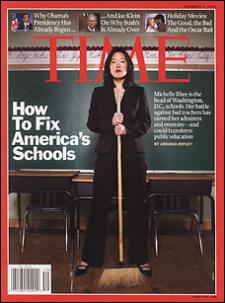
Michelle A. Rhee (Maumee Valley Country Day School, Toledo, Ohio), the former Washington schools chancellor and a founder of StudentsFirst, an advocacy group, is probably the No. 1 celebrity of the reform movement. She is education’s Sarah Palin.
¶As governor, Mitt Romney (Cranbrook School, Bloomfield Hills, Mich.) brought accountability to Massachusetts.
Bill Gates (Lakeside School, Seattle) has donated billions of dollars to public schools with the proviso that they carry out his vision of reform, including tying teacher tenure decisions to students’ test scores. In November, Mr. Gates and Mr. Duncan (University of Chicago Laboratory School) called on public school leaders to increase class size as a way of cutting costs in these hard times. The two men suggested that schools could compensate by striving to have an excellent teacher in every classroom. The private school Mr. Gates attended has an average class size of 16, according to its Web site. The home page says the best thing about Lakeside School is it “promotes relationships between teachers and students through small class sizes.” Mr. Duncan’s private school has an average class size of 19.
Jeb Bush (Phillips Andover), the former governor of Florida and the founder of the Excellence for Education Foundation, is responsible for making Florida a pioneer in the accountability movement by issuing report cards for every school based on test results. In the process he had to overcome many obstacles, including how to explain why his state’s rating system was so badly out of whack with the federal government’s rating system. One year the state report cards gave two-thirds of Florida’s schools A’s or B’s, while the federal system rated two-thirds of Florida schools as failing. As a result, there was widespread confusion among parents who couldn’t tell if their child’s school was succeeding brilliantly or failing miserably.
¶Chester E. Finn Jr. (Phillips Exeter) is the president of the Thomas B. Fordham Institute and a senior fellow of the Hoover Institution, two of the country’s leading conservative research groups. Mr. Finn is the scholarly counterpart of Ms. Rhee. Early on, he supported the privatization of public education, the use of vouchers and the development of a national core curriculum, which could possibly mean every public school would be teaching the same thing at the same time. His recommendation for reforming the public school system: “Blow it up and start over.”
¶David Levin (Riverdale Country School, the Bronx) is a co-founder of KIPP, the nation’s biggest charter chain.
Cathleen P. Black (Aquinas Dominican High School, Chicago), the former chancellor of New York City schools, had just 95 days to put her reform agenda into place before she was asked to leave.
¶Merryll H. Tisch (Ramaz School, Manhattan), chancellor of the New York State Board of Regents, along with David M. Steiner (Perse School, Cambridge, England), the New York state education commissioner, have fine-tuned the state’s extensive testing system pioneered by the former state commissioner, Richard Mills.
¶Steven Brill (Deerfield Academy, Deerfield, Mass.) is perhaps the charter school movement’s most literary advocate. He is working on a book about public school reform.
¶Marc Sternberg (Episcopal School, Baton Rouge, La.), a New York City deputy chancellor, has been a path finder in the practice of moving charter schools into district school buildings.
¶Davis Guggenheim (Sidwell Friends School, Washington) is the producer and director of “Waiting for Superman,” the widely acclaimed 2010 film that championed charter schools and dismissed traditional public schools as dropout factories. Mr. Guggenheim’s film begins with him driving his children to their private school and feeling guilty about all the bad Los Angeles public schools he is passing. This is not the first time this happened to Mr. Guggenheim. As a child, he passed bad Washington public schools on his way to Sidwell Friends.
When President Bush signed the No Child Left Behind legislation, he expressed his hope that it would combat the “soft bigotry of low expectations.” Indeed, the law could not have higher expectations: every child in the nation is required to be proficient in math and English by 2014. Schools that do not meet their proficiency goals, which are raised every year, are labeled as failing.
Last month, Mr. Duncan predicted that by the end of this year, 82 percent of schools will miss their goal. At this rate, it is highly likely that in a few years, every single public school in the United States will be labeled a failure.
This article has been revised to reflect the following correction:
Correction: April 18, 2011
An earlier version of this article referred incorrectly to an advocacy group founded by Michelle A. Rhee, the former Washington schools chancellor. It is StudentsFirst, not Sunshine First.

Computer-based tests to measure the newly-developed Common Core Standards: A critique by Krashen & Ohanian


High Tech Testing on the Way: a 21st Century Boondoggle?
 
By Anthony Cody on April 8, 2011 2:32 PM | 10 Comments | Recommend
 
In my recent exchange with the Department of Education regarding President Obama's remarks critical of our obsession with testing, it became clear that there is a vast expansion of testing on the horizon. Few reports have emerged that describe this, and I fear the public may be unaware of the resources that soon will be diverted from our already decimated classrooms. I asked two of the nation's experts on this trend to share what they have learned about this recently. Here is their report.

by Stephen Krashen and Susan Ohanian
 
 
When the plans to create Common Core Standards were announced, Secretary Duncan told us that it would be accompanied by assessments to enforce the standards. We were also told that developing standards would be relatively inexpensive, but developing assessments, by contrast, will be a "very heavy lift financially" (USA Today, June 14, 2009).
 
It is gradually becoming clear that the lift will be extremely heavy. The new tests will be computer-based, administered online, and "will make widespread use of smart technology. They will provide students with realistic, complex performance tasks, immediate feedback, computer adaptive testing, and incorporate accommodations for a range of students" (Duncan, 2010). Duncan noted that "with the benefit of technology, assessment questions can incorporate audio and video. Problems can be situated in real-world environments, where students perform tasks or include multi-stage scenarios and extended essays."
 
An example:
The National Education Technology Plan 2010 (U.S. Department of Education; Office of Educational Technology) describes one kind of testing that is being developed, testing that takes place "in the course of learning" (xvii) and that tries to find out what students are thinking while doing projects:
As students work, the system can capture their inputs and collect evidence of their problem-solving sequences, knowledge, and strategy use, as reflected by the information each student selects or inputs, the number of attempts the student makes, the number of hints and type of feedback given, and the time allocation across parts of the problem.
(pages 29-30: "Assessing during online learning").
 
Aside from the mind-control aspect of this kind of testing, how much will it cost, in addition to the cost of developing, testing and revising the new tests?
 
If we are going to have computer-based tests, and if they are to be delivered to students via the internet, the first requirement is that all students need to be connected to the internet. A recent article in the New York Times gives us some idea of what will be involved. The article begins by noting that money is scarce these days:
 
Despite sharp drops in state aid, New York City's Department of Education plans to increase its technology spending, including $542 million next year alone that will primarily pay for wiring and other behind-the-wall upgrades to city schools ... and $315 million for additional schools by 2014...
(New York Times, "In city schools, tech spending to rise despite cuts," March 30, 2011)
 
Buried deep the article is a statement by "city officials" that the huge expenditures for technology are primarily to make it possible for students to take computerized national standardized tests.
 
We can expect this to happen nation-wide. If the New York figure is extrapolated to the entire country, the cost to connect all children to the internet will be at least 50 times the cost of connecting New York City alone, or $25 billion (New York City enrolls one million students, the USA as a whole, over 60 million). This is only to connect students to the internet. The whistles and bells needed to do "computer adaptive testing" with audio and video will cost more.
Technology, of course, continues to develop all the time, and consumers have repeatedly demonstrated their willingness to discard the old and embrace the new, even at considerable expense. We can expect that after every student is connected, sooner or later the set-up will become obsolete and need to be replaced, either in part or totally. The schools, we predict, will cheerfully pay up, eager for the "newest" technology, and the computer companies will cheerfully accept their money.
 
The billions spent so that students can take national tests will have a huge payoff for the entire computer industry in other ways. This was enthusiastically announced by Education Secretary Duncan's Chief of Staff and former CEO of the New Schools Venture Fund, Joanne Weiss. Weiss noted that because all students will have internet access in order to be tested, technology companies can now profit from one giant national market for all their educational products:
 
The development of common standards and shared assessments radically alters the market for innovation in curriculum development, professional development, and formative assessments. Previously, these markets operated on a state-by-state basis, and often on a district-by-district basis. But the adoption of common standards and shared assessments means that education entrepreneurs will enjoy national markets where the best products can be taken to scale
(Weiss, 2011).
 
WHY THIS IS A BAD IDEA

We have nothing against private enterprise making an honest profit for providing a needed service or useful product. But in this case there is no evidence that the product is needed nor is there evidence that it will be useful. Just because something is high-tech doesn't mean it is good. As Gerald Bracey pointed out, computers have made it possible to do in nano-seconds what shouldn't be done at all. We are about to waste a gigantic amount of money when it is badly needed elsewhere, and where it can be put to much better use.
 
No Evidence for Standards/Test Approach
 
First, there is no evidence supporting the idea that tests to enforce national standards, no matter how subtle and refined, will have any positive impact on student learning. In fact, the evidence we have suggests that it will not: States that use more high-stakes tests do not do better on the NAEP tests than states with fewer (Nichols, Glass and Berliner, 2006), and the use of the standardized SAT does not predict college success over and above high school grades (Bowen, Chingos, and McPherson, 2009; Geiser and Santelices, 2007).
 
Of course, the administration has argued that these will be new and better tests, more sensitive to growth in learning, able to chart student progress through the year, and able to probe real learning, not just memorization. Before unleashing these "improved" tests on the country, however, there should be rigorous investigation, rigorous studies to show that these measures are worth the investment. Right now, the corporations and politicians insist that we take on faith the claim that these tests are good for students. Such claims exhibit a profound lack of accountability.
 
Second, there is overwhelming evidence that dealing with poverty is an excellent investment, one that will not only improve school achievement but also affect quality of life and personal happiness.
 
• There is very good evidence that our international tests scores are "low" because of poverty. Studies show that middle-class American students in well-funded schools score at the top of the world on international tests. Our overall average is less than spectacular because we have such a high percentage of children living in poverty, at least 20%, the highest among all industrialized countries (Berliner, 2011). In urban areas, where test scores are the lowest, the poverty level is much higher: 51% in Cleveland and Detroit, 37% in Miami, and 35% in Dallas and New Orleans. (These figures are based on the federal poverty level. If we consider the percentage of children eligible for free and reduced lunch, between 130 and 185% of the federal level, the figure is much higher, with 81% of children in Detroit and 68% in Miami living in poverty. According to the National Center for Children in Poverty (see e.g. here), families need an income of twice (200%) the official federal level to meet basic needs. Nearly 40% of children in the US live in families with incomes of less than 200% of the official federal level.)
 
 Studies show that children living in poverty suffer from conditions shown to impact educational attainment and school performance, such as "food insecurity," environmental toxins, lack of health care, and lack of access to books. The impact of these factors is enormous: No matter how good teaching is or how carefully a curriculum is put together, it will be of little value when students are hungry, malnourished, in poor health, and when they have little or no access to reading material.
 
• When these conditions are dealt with and alleviated, school performance improves. Providing food for hungry children has been shown to produce dramatic differences in behavior and performance in school (Berliner, 2009), having medical insurance improves school performance (Berliner, 2009), and increasing access to books as well as providing time to read for pleasure results in better literacy development (Shin and Krashen, 2009).

The obvious cure for poverty is full employment, with a living wage paid for honest work. Our society today provides neither of these, with unemployment high and with wages low: As of this writing, the average pay for a retail sales position, about $20,000 per year, is well below the federal poverty line for a family of four (Gibson, 2011).
 
The obvious step to take now is to make sure children are protected from the effects of poverty. A great deal of this, e.g. improving libraries in high poverty areas to the point where children of poverty have access to a print-rich environment, can be done at a fraction of the cost schools will be required to spend just on the technology aspect of the new testing program.
 
The Department of Education plans to use American students as experimental subjects to try out an extremely expensive, time-consuming and dubious testing program that will engulf classrooms. If it fails, the effect on students will be devastating, with schools robbed of money, and a generation of students poorly educated, teacher professionalism subsumed by data management, and schools robbed of funds for anything but technology repair. But the testing and technology companies will win, profiting regardless of the success or failure of their products and always ready to convince us that the next versions will be better.
 
The DOE's stubborn refusal to even consider dealing with poverty as a means of improving school performance, their insistence of "rigor" and "accountability" in testing students but willingness to give testing and technology companies a free ride, and their enthusiasm about opening new and profitable opportunities to "education entrepreneurs" is highly suspicious behavior. It raises the possibility that DOE policy is designed to profit a small part of the private sector, not the 60 million students in our public schools.
 
Update: This post by former test-scorer Todd Farley offers additional insights into the process underway to develop tests for the Common Core Standards.
 
Dr. Stephen Krashen is a professor emeritus at the University of Southern California. He has written numerous books on his research into literacy and language acquisition. In recent years he has emerged as a persistent voice pointing towards the basic steps we should take to build literacy and strong academic skills for our students.
 
Susan Ohanian, a longtime teacher, has written 25 books on education, including When Childhood Collides with NCLB and co-authorship of Why Is Corporate America Bashing Our Public Schools? Since the passage of NCLB, she has run a website of resistance, www.susanohanian.org, which received the NCTE George Orwell Award for Distinguished Contribution to Honesty and Clarity in Public language. She is a fellow at National Education Policy Center and an editor at Substancenews.net
 
Sources:
 
Berliner, David C. (2009). Poverty and Potential: Out-of-School Factors and School Success. Boulder and Tempe: Education and the Public Interest Center & Education Policy Research Unit. Retrieved 4/7/11 from Bowen, W., Chingos, M., and McPherson, M. 2009. Crossing the Finish Line: Completing College at America's Universities. Princeton: Princeton University Press.
 
Geiser, S. and Santelices, M.V., 2007. Validity of high-school grades in predicting student success beyond the freshman year: High-school record vs. standardized tests as indicators of four-year college outcomes. Research and Occasional Papers Series: CSHE 6.07, University of California, Berkeley.
 
Gibson, E. 2011. Retail sector adding jobs, but not always careers. Associated press. Ventura Star, April 6, 2011.
 
Nichols, S., Glass, G., and Berliner, D. 2006. High-stakes testing and student achievement: Does accountability increase student learning? Education Policy Archives 14(1).


Sunday, April 17, 2011

Breaking News: NYS Education Tenure Laws Shake Down! Educators Needed to Fight Back!

http://expertscolumn.com/content/breaking-news-nys-education-tenure-laws-shake-down-educators-needed-fight-back

Counteracting Attempts to Obstruct Statutory Tenure Laws for Educators

http://professor777.newsvine.com/_news/2011/04/15/6476171-counteracting-attempts-to-obstruct-statutory-tenure-laws-for-educators

OR

New York State: Covert, Organized, and Criminal Effort to Obstruct Education Statutory Tenure Laws

http://www.allvoices.com/contributed-news/8795589-new-york-state-covert-organized-and-criminal-effort-to-obstruct-education-statutory-tenure-laws

Counteracting Attempts to Obstruct Statutory Tenure Laws for Educators

advertisement
Do people understand how important and why statutory tenure laws were created? The purpose of this article is to combat current New York Sate laws and propaganda suggesting need for the obstruction of statutory education tenure laws. Legislative tenure law issues are critical subjects of concern in the education community, particularly in New York State and New Jersey.
Foremost, the very basic purpose of tenure is to protect qualified and experienced educators from enforced yielding to political pressures and to guarantee employment regardless of the vicissitudes of politics. Tenure was created so educators would not become footballs bounced around when the political tide changes. Every attempt to uproot established statutory tenure laws is an attempt to seize education for covert destruction. It is an attempt to retard civilization.
Tenure laws were enacted to provide job security for experienced educators. These laws were created to make sure experienced and qualified teachers were not discharged for insufficient and inadequate reasons.
One of the most important objectives of tenure is the maintenance of an able teaching force who have undergone a period of probation, with the concomitant result that because of such protections, more talented persons will be attracted to the teaching profession. This was determined in the matter of State v. Redman, 491 P2d 157 and this is the matter that is relevant today.
The obstruction of statutory tenure laws advances the hiring of unqualified persons under the scheme of critical shortages. Education shortages are created via the obstruction of statutory tenure laws which deliberately and maliciously effectuate the extermination of qualified and competent educators.
The purpose of tenure laws is for the safe guarding of schools as well as educators. Tenure laws are continuing contracts. As such, continuing contracts eliminate uncertainty in the employment plans of both teacher and school district. The continuing contract minimizes havoc, makes provisions for new teacher recruitment and training funding to be used for school based developments, and allows an experienced and respected staff the opportunity to prepare and focus on student achievement.
Educator’s general relationships with school boards, not mayors, are created by contract and governed by general principles of contract law. Criminals who suggest dismantling tenure laws are obstructing the very basis of contract laws.
In an article titled: Cuomo to propose statewide LIFO reform bill, the below excerpt is found:
Last year as part of “Race to the Top,” legislation was passed to overhaul the existing teacher and principal evaluation system. As a result of the legislation, a State Education Department task force is in the process of developing new teacher evaluation guidelines that includes merit and other factors in time for the 2011-2012 school year. However, the original law only covers math and English language arts teachers in grades 4-8, and would not expand to all subjects and grades until 2012-2013.
Based on this excerpt, one can see that the: “ Race to the Top Scam,” is being used to obstruct statutory tenure laws, under the disguise of overhauling teacher and principal evaluation systems. The Race to the Top scam was funneled in education initially as a funding source. Now it has changed into legislation and it is this criminal legislation that is paving and leading the way for statutory tenure obstructions.
The Race to the Top grant is being used like vaccination grants were used in schools previously. They came into the schools as a funding source and by the time the grant was allocated, the schools became controlled and ruled by vaccination grants. The grants ran the schools. The schools were turned into human research prisons. Infectious disease epidemics were infinite, particularly in high schools. The schools were run by eugenic, unregulated, human research laboratory programmers.
The Race to the Top grant that criminally turned into legislation as noted on the above excerpt is maliciously and covertly being used to destroy statutory tenure laws nationwide. It is being used to destroy every facet of a valid educator employment contract.
In the matter of Snider v. Kit Carson School District in Cheyenne County, it was clearly established that the power to employ or discharge educators is exclusively vested in the school board and cannot be delegated to any other body of official, such as a school superintendent, mayor or governor.
It was further determined that in order to have a valid teacher employment contract, the school board must act as a board and not as individuals. It is a diabolical plan and crime, to use the Race to the Top funds, as fictional administration legislation, directly involved with destroying statutory tenure laws nationwide, under the disguise of overhauling the existing teacher and principal evaluation system. The Race to the Top funds are being criminally used to enjoin governors as third party entities, in the criminal overhaul of statutory tenure.
People who read must hold leaders accountable for reading and mandate that they implement and enforce current established statutory tenure laws that advance progression. The obstruction of the rule of law management must be stopped.
The use of public education for covert psychological warfare programming must be made to stop. This includes ending the criminal enjoinment of Governor’s in the agenda to destroy education via use of Race to the Top scams targeted at criminally exterminating qualified and experienced educators.
It must be understood that the educator’s general relationships with school boards are created by contract and governed by general principles of contract laws, and not the whims of politics. The obstruction of statutory tenure laws is a crime under 18 USC Sec 371 Conspiracy to Offend and Defraud the United States.
Finally, in a civilized society the three branches of government must work amicably on behalf of public policy and safety. The people must never allow the pitting of the executive branch against the legislative branch as exemplified in this matter. Statutory tenure is a legal, needed, and protective legislative establishment.
The use of the executive branch, specifically, the use of governors as fronts to destroy the legislative establishment called tenure, is a diabolical plan for destruction. Let us counteract attempts to obstruct statutory tenure laws by reading, aligning and not destroying, the three branches of government, and enforcing established and needed statutory education tenure laws that advance civilization.
References:
American Public School Law
Kern Alexander - M. David Alexander - West Pub. Co. - 1992
Cuomo to Propose Statewide LIFO Reform Bill
http://blog.timesunion.com/capitol/archives/58906/cuomo-to-issue-statewide-lifo-reform/
Governor Seeks To Change Teacher Tenure
http://statenisland.ny1.com/content/your_nj_news_now/137375/governor-seeks-to-change-teacher-tenure/
Current Obstruction of the Rule of Law Fictional Administration: • 18 USC 241 Conspiracy Against Rights of Sovereign, Free, God Created, Spirit and Soul beings, Statutory Tenure Due Process Obstructions
S4629-2011: Relates to tenured teacher disciplinary hearings
http://open.nysenate.gov/legislation/bill/S4629-2011

Cuomo's Proposal to Abolish Tenure And Seniority All Across The State By September 2011

http://perdidostreetschool.blogspot.com/2011/03/cuomos-proposal-to-abolish-tenure-and.html
CERTIFIED W RECPTS CRIMINAL REPORT: RACE TO THE TOP, FEDERAL EDUCATION GRANT CRIME RING, MASS KILLINGS, INFESTATIONS, SCHOOL REFORM DEFRAUD & TREASON, FREE ONLINE READING
http://www.scribd.com/doc/29074990/CERTIFIED-W-RECPTS-CRIMINAL-REPORT-FEDERAL-EDUCATION-GRANT-CRIME-RING-MASS-KILLINGS-INFESTATIONS-SCHOOL-REFORM-DEFRAUD-TREASON-FREE-ONLINE-READI
Obama official to New York: Change your tenure law or else
http://gothamschools.org/2009/07/09/obama-official-to-new-york-change-your-tenure-law-or-else/

Insanity in Kansas City

Our supt is trying to fire 115 probationary teachers and hire 150 Teach for America interns to replace them. The union turned out in force tonight at the board meeting. The teachers who had received termination notices wore name tags identifying them as pink slipped teachers and they stood in the lobby of the board building as the board members walked by on their way to the board meeting. They had to walk by the teachers they were being asked to fire. It was a powerful visual!

Our local president, Andrea Flinders, gave a wonderful speech at the board meeting, telling the board we as a union didn't want to see any good teachers fired. “We as a union are going to hold you accountable that not one single effective teacher is terminated this year,” Flinders said.

And the union members, in their blue AFT shirts, packed the meeting. There were no empty seats and teachers stood in the aisles.

When Andrea finished talking, the looks on the board members faces were absolutely priceless. It was a great solidarity moment.

I talked to a reporter at the board meeting tonight who told me that the TFA contract grants $3000 per TFA intern to TFA - a $450,000 finders fee?

Local media coverage:

http://www.kctv5.com/education/27536293/detail.html

http://www.kansascity.com/2011/04/13/2798915/some-kc-teachers-wear-their-pink.html

http://www.fox4kc.com/news/wdaf-kcmo-teachers-union-not-happy-with-districts-mass-firing-plan-20110413,0,5535485.story

http://www.kmbc.com/video/27537899/detail.html

http://www.nbcactionnews.com/dpp/news/education/superintendent-says-teacher-cuts-are-about-education%2C-not-budget

Anne

Friday, April 15, 2011

The Myth of the “Crappy Teacher”

http://www.leftturn.org/myth-crappy-teacher


By: 
Crystal Sylvia
Date Published: 
March 11, 2011
 
On February 2, I attended a forum at the Fordham Institute titled “Are Bad Schools Immortal?” One of the speakers was Jeanne Allen, founder and president of the Center for Education Reform, which promotes “school choice,” a.k.a. charter schools and vouchers.

In her talk (at 56:27), Allen stated that she had recently visited an underperforming public high school in Philadelphia. To make the point about how awful this school was, she claimed that it had been open for 35 years yet “has never graduated one child who has actually gone to college.” When I challenged Allen on this outrageous claim she then said that “no child has graduated from college in 35 years.”

The purpose of both statements was to show how rotten and entrenched some public schools are. Allen’s story sounded made up to me; it would have been a monumental feat for a high school to track all of its students’ post high school lives for thirty-five years. I asked Allen for the name of the school and, not surprisingly, she said she didn’t remember.

This is not an isolated incident, as vilifying unions and teachers has become the focal point of corporate education reform. Michelle Rhee spent much of her time ”transforming” DC Public Schools (DCPS) by creating stereotypes that they were filled with incompetent teachers who were failing children. The claim was that these teachers had jobs for life, no matter how badly they performed, because the adult-serving, anti-child teachers’ union protected them.

In interviews and at countless speaking engagements, Rhee shared anecdotal stories about her experience walking into different DCPS classrooms and seeing “crappy teachers.” She recounted numerous stories of parents and students begging her to get ”good teachers” into the classrooms. The public was appalled by these stories, and this gave Rhee the upper hand in union contract negotiations, which she was using to try and secure a first-of-its-kind contract that gutted tenure and tied pay to performance. This, after all, was a public relations battle.

Attacks on welfare
Rhee and Allen’s attacks on teachers and unions are reminiscent of Ronald Reagan’s attacks on welfare, in which he promoted a stereotype of welfare recipients who were cheating the system, living high off the hog, and popping out babies just to collect more money. During Reagan’s 1976 presidential campaign he talked about a woman from Chicago who received welfare benefits:
“She has eighty names, thirty addresses, twelve Social Security cards and is collecting veteran’s benefits on four non-existing deceased husbands. And she is collecting Social Security on her cards. She’s got Medicaid, getting food stamps, and she is collecting welfare under each of her names. Her tax-free cash income is over $150,000.”

Even though this story was never corroborated, its repetition and others like it left an indelible image in the minds of people in the US and helped to shape the punitive welfare reform laws that were passed years later.
Susan Douglas, Professor of Communication Studies at the University of Michigan, offered an excellent analysis of Reagan’s strategy:
“He specialized in the exaggerated, outrageous tale that was almost always unsubstantiated, usually false, yet so sensational that it merited repeated recounting… and because his ‘examples’ of welfare queens drew on existing stereotypes of welfare cheats and resonated with news stories about welfare fraud, they did indeed gain real traction.”

This strategy of manufacturing facts or finding a think tank to support an agenda is also employed by many proponents of the corporate education model. It is used as a way to not only attack teachers’ unions, but to go after public schools in general, and push through privatization measures such as charter schools and vouchers.
Rhee has repeated outrageous anecdotes about abysmal teachers, and has also made statements that are not supported by statistics or studies in order to further her goals. In “How to Fix Our Schools: A Manifesto,” which was signed by sixteen school district chiefs, including Rhee, and was published in the Washington Post on October 10, 2010, it stated: “As President Obama has emphasized, the single most important factor determining whether students succeed in school is not the color of their skin or their ZIP code or even their parents’ income—it is the quality of their teacher.”

In this case, not only had the original statement been distorted—President Obama had said that teachers were the most important factor inside the school—the claim was not supported by any studies or data. As Diane Ravitch writes, “The single biggest correlate with low academic achievement—contrary to the film Waiting for Superman—is poverty.”

Yet because it has been reiterated over and over again, the myth of the “crappy teacher,” like the myth of the “welfare queen,” is now a common misconception.
For more on this issue, see "The 'Bad' Teacher"

Crystal,
Glad to see more people pointing out holes in the reform movement propaganda with eloquence and rigor.

I wrote a number of essays on this same front over the last year:

The Myth of the Bad Teacher (Oct 2010)
http://dailycensored.com/2010/...

Public Teachers: America's New Welfare Queens? (Feb 2011)
http://www.truthout.org/public...


Keep up the work,

Best,
Adam Bessie