Monday, December 21, 2009

Reading woes continue to plague city schools


News — By Alexandra DiPalma on December 19, 2009 at 6:33 pm

http://pavementpieces.com/reading-woes-continue-to-plague-city-schools/

Susan Klein and Sarah Gardner are 9th grade teachers at  Marta Valle Secondary School. (Photo By Alexandra DiPalma)

Susan Klein and Sarah Gardner are ninth grade teachers at Marta Valle Secondary School. Photo By Alexandra DiPalma

At Marta Valle Secondary School in the Lower East Side, more than 30 students and three aides are squeezed into mismatched tables and chairs during Sarah Gardner and Susan Klein’s ninth grade English class. Some students are facing the back of the room because their desks don’t fit any other way.

Despite the discomfort, every student listens attentively as Klein reads aloud from “Swallowing Stones,” giggling as two of the book’s characters share a kiss by the pool. Klein has an easy rapport with her kids; she cracks jokes and exchanges personal stories but does not compromise her authoritative position. When she yells “One mic!” in her booming voice, everyone immediately sits up straight and listens.

Although they work to engage students and create a positive learning environment, Klein, Gardner and the other teachers at Marta Valle appear to be fighting a losing battle.

Not one student in Klein’s class is reading on the appropriate grade level. Fewer than half of the students at Marta Valle will graduate. Klein, along with many other educators, attribute the continuing deterioration of New York City public education to misguided reform efforts put forth by Mayor Michael Bloomberg and the Department of Education, particularly in the areas of performance assessment and spending.

“I compare Bloomberg’s reforms to selling golf balls to people stranded in the desert. It just doesn’t work,” Klein said. “You need to be selling bottled water.”

In his Nov. 3 victory speech, Bloomberg vowed to “keep improving what is far and away the best public school system of any big city in the country,” citing “amazing progress” over the past eight years. But critics of the mayor’s agenda have seen little progress. Leonie Haimson, executive director of Class Size Matters, a non-profit clearinghouse for information on class size, believes that reform efforts thus far have been wholly ineffective.

“We know that there are a few education reforms that have been proven to work to improve educational outcomes,” Haimson said. “The problem is that none of these have been implemented.”

Instead, reform strategies have included a new report-card system for city schools, in which the DOE grades schools from A to F, and an effort to increase the education budget, in which it allocates money directly to schools.

Marta Valle is only one example of a school in which the strategies have severely backfired. Gardner, Klein and a number of education experts place heavy blame on the DOE’s school report card system, designed to promote accountability and transparency.

In 2009, 84 percent of New York City public schools received an A — an incredulous jump from 23 percent in 2007. These numbers indicate a trend that Klein considers one of the main problems at Marta Valle, and a major flaw in new reforms. She believes that interest in improving students’ academic abilities is superseded by the need to meet bogus department standards.

“Students whom I fail, who cannot read and should be held back, are moved to the next grade to keep the numbers up and make the school look good,” Klein said. “This is the root of the reading problem. It perpetuates the cycle and ruins kids’ chances at literacy.”

DOE Deputy Press Secretary Danny Kanner, however, says the reports are necessary and effective.

“The report-card system is a mechanism by which parents, teachers and the DOE can hold schools accountable for student progress,” Kanner said. “Then, schools can be dealt with accordingly.”

Still, the initiative has been met with harsh criticism. Jennifer Jennings, a sociologist at Columbia University, compares the progress reports to a flawed medical check-up. Just as doctors are accused of medical malpractice, she views the system as educational malpractice.

“The progress reports create an illusion of improved progress where none actually exists,” Jennings said. “It doesn’t do anyone any favors to pretend that things are better than they are.”

Schools that receive an A or B on the DOE progress report are eligible for cash rewards, while those getting a D or F are threatened with closure. As educators face unrealistic pressures that threaten job security, instances of falsifying school records, wrongful promotion of students and cases of grade tampering have become more common.

“The reports have lead, or forced, teachers into skewing data to improve results artificially without ever getting to the actual problem, which is providing students with a proper education,” Haimson said. “It’s a travesty.”

With the distractions created by the pressures of report-card data, attention has been drawn away from the students. And at Marta Valle, they need all the help they can get.

“It’s a fight to the death just to get my kids to class, let alone take an interest in their own academic improvement,” said Gardner.

One way to encourage students to take an interest in academic improvement, educators agree, is to decrease class sizes. But despite campaign promises and a 72-percent increase in the city’s education budget since 2002, class sizes have not gotten any smaller.

According to the most recent data released in late November by the DOE, all class size averages have gone up in the past year. High school English classrooms such as Klein and Gardner’s now have an average of 26.4 students compared to 25.6 in 2008.

Small classes are especially important at Marta Valle, where 75 percent of students are disadvantaged.

“It is well understood that poorer, disadvantaged kids inhabit environments that are incredibly adverse to educational opportunities,” Jennings said. “From the minute they walk into the classroom, they are behind.”

These students require more attention from teachers in order to compensate for lack of access to out-of-school opportunities and resources, which families are unable to provide. Having fewer students per teacher allows for more individual attention.

“At a place like Marta Valle, students become disengaged in large classrooms without individualized instruction,” Haimson said. “They feel like no one cares.”
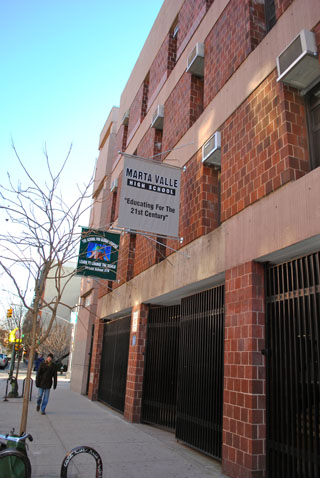
Marta Valle Secondary School in the Lower East Side.

Marta Valle Secondary School in the Lower East Side.

In addition to special attention from teachers, Jennings says that access to school resources and improved facilities help to narrow the achievement gap.

“Educational resources, because they’re not always available at home, need to be equalized for poorer students,” Jennings said. “So far, New York has done a good job at this equalization in many schools.”

According to Susan Klein, the facilities and resources at Marta Valle are still not up to par. When students were required to gather research for an essay, it had to be done during class time because many students do not have computers at home.

“We arrange trips to the school library so that students can get necessary information, but equipment problems delay progress,” Klein said.

During one trip to the computer lab, only one printer erratically worked, and all of the computer paper ran out. Klein and Gardner’s 30 students managed to print out only a few pages of information, and some left with nothing.

Doing research for a paper, a task that can typically be completed for homework in one night, occupies days of valuable class time at Marta Valle and are further delayed by facility issues. This lagging productivity, exacerbated by misguided funding, causes students in schools like Marta Valle to fall behind in academic skills across the board.

Despite the criticisms of Bloomberg’s reform efforts, Kanner is optimistic about the future of New York City public education, especially with President Obama in office. Bloomberg plans to take advantage of Obama’s Race to the Top competition, which rewards states for successful reform advances.

“Over the next four years, we will sustain and build on progress that has already been made,” Kanner said. “Significant funding opportunities made possible by the Obama administration will help to further the mayor’s vision.“

So far, Bloomberg’s vision hasn’t alleviated the challenges faced by public school teachers like Gardner and Klein. They said they struggle each day to stay optimistic and to remind themselves they are making a difference. The key, Gardner says, is to remember that each child has the ability to improve, regardless of the faults in the city’s education system.

“The big idea, that I find myself repeating in my head each day,” Gardner said, “is that every student is capable of being successful, no matter what.”

Sunday, December 20, 2009

Ugly Detroit Teacher Contract: Was Randi the handmaiden


1. The Vote No Prepare to Strike Committee meets today at 4 pm at the Gacious Savior Lutheran Church, 19484 James Couzens (Lodge northbound service drive, just north of Seven Mile)


2. The DFT contract vote was 2031 no, 3578 yes.

3. 14 DFT members filed a formal internal grievance with the DFT Election Committee last night, insisting that the committee not certify the results of the vote until they have heard our evidence about the many, many voting irregularities.

4. The Election Committee said that they will give us a date for the hearing. The Election Committee did not vote to certify the elections or issue any statement contradicting their unanimous December 15th letter, in which they insisted that the vote be suspended due to massive irregularities.

5. An appeal letter has been sent to the AFT national union president. Copies were attached to yesterday's email.

6. We are very close to having the 1000 signatures to recall Keith Johnson. The hearing to vote on his recall will be held at the next DFT General Membership meeting, Thursday January 14th after school.--If you have signed petitions call 313.645.9360 for pick up.


7. Bobb has failed in court and failed in Lansing this week to win the legal power over DPS academics, which immediately raises the question as to what authority he had to bargain this contract in the first place, and why in the world Johnson negotiated with him.


Call 313.645.9360 or email marquette6@hotmail.com for more information about the Vote No Committee


Fight Implementation of this illegitimate contract, in every school and in every classroom!

Recall Johnson! Stop the high-jacking of the DFT!

Defend public education!

Plantora wrote:

Regarding Detroit Teacher's Contract, Thanks for paying attention. I'm a Detroit Teacher, trying to find ways to get our side of the story out. The details of the contract reveal what I heard someone call "the worst contract for teachers every passed by any union". But the last sentence of Weingartartens statement is the most important. "The agreements' education reforms and provisions...are mere words on paper without the continued collaboration between teachers , their union, and the school district". This is one teacher, and there are many more, who will do whatever it takes to prove her right, and keep it no more than words on paper.

Tuesday, December 15, 2009

Do these people have no shame? Ravitch on The Race to Nowhere

The Race to Nowhere

Dear Deborah,

I understand why you were taken aback by that article in the "Style" section of The New York Times last week that described how charter schools have become a must-have among hedge-fund managers, billionaires, and other members of the social elite in New York City. The article bothered me, too. In fact, the more I think about it, the more it worries me. Having written the history of the New York City public schools, I was reminded of the origins of free schooling in certain northeastern cities in the early 19th Century, when wealthy men decided that it was their civic duty to help civilize the children of the poor. In their view and in their day, they were doing good deeds, but their schools were stigmatized as charity schools for children of paupers and were avoided by children of the middle class. Outside of big cities, public education emerged as a community response to a community's need to school its children, not as a charitable venture.

Today, with the proliferation of charter schools, we may be seeing a resurgence of the historic pattern as public schools are privatized and taken over by very rich men (and women) who see themselves as saviors of the children of the poor. Naturally, you find this a repellent portrait because it undermines the democratic foundations of public education. It means that our society will increasingly rely on the good will of wealthy patrons to educate children of color. It means that education is seen as a private charity rather than as a public responsibility. Let's hope that the new owners who have taken over these schools are able to sustain their interest. After all, having 500 children in your care is not the same as having a stable of polo ponies or a vineyard in Napa Valley. If the children don't produce results that make the sponsors proud, they may pick a different hobby.

Though the rise of the hedge-fund managers as charter school operators may distress us, it thrills others because it dovetails so perfectly with the Obama administration's Race to the Top. I don't know about you, but I am getting sick of the rhetoric of the Race to the Top, as it implies the very opposite of "equal educational opportunity." But "equal educational opportunity" is so...yesterday, so now we shall all "race to the top," to see who can get there first. Who can privatize the most schools? Who can close the most public schools? Which district can replace the most public schools with charter schools? Who can compel their teachers to focus intently on those pesky math and reading test scores? Who can boot out the most teachers whose students didn't get higher scores than last year? Who seriously believes that this combination of policies will produce better education?

We try not to be New York City-centric, but so much is happening in this city that it is hard not to see it as a bellwether. After all, NYC not only was a faithful representation of No Child Left Behind, but it is now outfitting itself to be a faithful representation of the Race to the Top. This is not a hard transition because NLCB and the Race to the Top are really the same, except that President Obama and Education Secretary Arne Duncan's "Race" has nearly $5 billion as a lure to persuade states to climb aboard the express train to privatization.

In the past few days, Chancellor Joel Klein has announced that he is closing nearly two dozen public schools. Some of these schools are the anchor in their communities; some have long histories as gateways for immigrant children. In recent years, the Department of Education decided that it does not like large high schools, so it has been closing them down and sending their lowest-performing students to other large high schools, which then have lower scores and more disciplinary incidents. Some of the large high schools were beyond saving, but most could have been improved by a thoughtful plan of action, including smaller classes, better supervision, and the kinds of resources that hedge-fund managers pour into "their" charter schools. Unfortunately the data-driven MBAs at central headquarters know nothing about instruction and curriculum or about any strategies that might improve a school. They have no school-improvement strategy. What they know best is how to shut down schools, and in this they will find funding and encouragement from the Obama administration.

As soon as the central administration decides to close a school, it is a fait accompli. New York City has a rubber-stamp "board" of 13, with a majority appointed by the mayor, serving at his pleasure; it approves every executive decision, with only a single dissenting vote (the heroic Patrick Sullivan, a public school parent). Public hearings are pro forma; no decision is ever reversed. Parents and teachers may protest 'til the cows come home, and they can't change a thing. Their school will be closed, the low-performing students will be dispersed, and either new small schools or charter schools will take over their building. Some of the schools that will close are, funnily enough, small schools that were opened by Bloomberg and Klein only a few years ago.

Does anyone believe that this sorry game of musical chairs will improve education? Does anyone in Washington or at central headquarters grasp the pointlessness of the disruption needlessly inflicted on students, families, teachers, principals, and communities in the name of "reform"? Do these people have no shame?

Diane

Best,
Norm Scott
normsco@gmail.com
norscot@aol.com
917-992-3734
Blogs: http://ednotesonline.blogspot.com/
http://normsnotes2.blogspot.com/

UFT Proposed Resolution on School Closings for Dec. 16 DA

WHEREAS Chancellor Klein and the Department of Education have announced the closure of an unprecedented number of twenty-two New York City public schools, disproportionately drawn from the ranks of high schools; and

WHEREAS the decision to close such a large number of schools, especially high schools, is based not on any educational calculus, but on the need to pursue the Chancellor’s political agenda of freeing up space to house new charter schools and new DoE schools; and

WHEREAS since 97% of the elementary and middle schools received grades of ‘A’ and ‘B’ on the School Progress Reports, reflecting the inordinate weight the reports give to state exams, Chancellor Klein and the DoE have attempted to disguise the political character of their space and closure decisions by closing large numbers of high schools; and

WHEREAS among the schools announced for a number which are in good standing with the New York State Education Department and are meeting their Annual Yearly Progress goals under No Child Left Behind, a school which it just opened four years ago and a school which received a school-wide bonus for meeting their progress goals; and

WHEREAS among the schools announced for closure are those which have made academic progress in recent years; and

WHEREAS there are serious and fundamental flaws in the School Progress Reports which are used as a basis for these decisions:

· the inordinate weight [85% of the total grade] given to scores on New York State ELA and Math exams for the elementary and middle school levels;

· the establishment of new cut scores for grades this year at the same time that old ‘peer index’ [the measurements of student need] were maintained, even though many schools with low grades had greater numbers of high needs students;

· the use of scores on the 8th grade New York State ELA and Math exams to establish the ‘peer index’ for high schools, thus failing to give the schools that take in large number of “over the counter” students, some of whom are the highest needs students in our schools [i.e., recent immigrants who are English Language Learners with limited formal education in their native country], full credit for their challenging student populations;

· the failure to distinguish between special needs students in “less restrictive” and “more restrictive” environments in the calculation of ‘peer index’, thus treating schools with large numbers of students with more severe learning disabilities as if those students had less severe disabilities;

· the placement of schools with concentrations of high needs students in ‘peer groups’ with schools which do not share many of the same challenges;

· the failure to provide appropriate credit for academic progress to schools with large numbers of transfers and “over the counter” students who do not have scores on 8th grade ELA and Math exams;

WHEREAS as a consequence of these flaws, the School Progress Report grades for high schools reflect as much the concentration of student need as the actual academic performance of a school -- by the DoE’s own measures the high schools targeted for possible closure because of poor grades have a ‘peer index’ over 20% lower, reflecting far greater need, than high schools receiving a grade of ‘A’;

WHEREAS the Chancellor and the DoE have failed in their basic responsibility to provide schools with concentrations of high needs students the supports and the resources necessary for their education, and are now blaming those schools for their management failures;

WHEREAS the decision of the Chancellor and the DoE to close so many high schools and replace them with charter schools and new schools that do not serve high school grades will result in an overcrowding of the remaining high schools and in the rolls of teachers placed in the Absent Teacher Reserve [ATR];

WHEREAS under the new governance law recently passed, the decision to close a school should not be made unilaterally by the Chancellor, but require an educational impact statement by the DoE and a process of consultation with the Community Educational Council and School Leadership Team that allows for public reaction and comment; therefore be it

RESOLVED that the United Federation of Teachers condemns Chancellor Klein’s decision to close an unprecedented number of New York City public schools in order to create space for new charter schools and new district schools; and be it further

RESOLVED that it is the “persistently failed management” of Chancellor Klein and the DoE -- and in particular, the concentration of students with high needs in a number of existing schools and the failure to provide those schools with the supports and resources necessary for the education of those students -- that needs to be phased out, not schools; and be it further

RESOLVED that the UFT condemns the cavalier decision of Chancellor Klein and the DoE to close schools in a way that will greatly increase school overcrowding and the ranks of teachers in the Absent Teacher Reserve, thus exacerbating problems already created by their “persistently failed management”; and be it further

RESOLVED that when a New York City public school slated for closure determines that they will oppose this decision as without educational merit, the UFT provide full and complete political, logistical and educational support to that school in their efforts to overturn that decision; and be it further

RESOLVED that the UFT support efforts to utilize the process of consultation for closing schools outlined in the new governance law to overturn closure recommendations without educational justification; and be it further

RESOLVED that the UFT mobilize the membership in all schools to provide support for schools fighting educationally unjustified closure decisions.

Monday, December 14, 2009

Move Jan. 26 PEP Out of Staten Island to Central Location

There are no closing schools in Staten Island, yet the Jan. 26 PEP meeting that will decide the fate of over 20 schools from other boroughs is being held there. We need your help to try to move the meeting. Copy and paste the petition below, sign it and electronically send it back to me at norscot@aol.com. Or print it out and circulate it and then send it to 518 Beach 134 St. Belle Harbor, NY 11694. You don't have to include any more info than your name if you do not wish to.

Dear Chancellor Klein:


cc: Michael Best


We urge you to move to a more central location the Panel for Educational Policy meeting that will decide the fate of 36 schools, many of which are slated for closure, as well as a host of critical regulations that relate to parent involvement and the role of parents and teachers in decision-making at the school and district level.


We object because this time and location — January 26 at 6 PM on Staten Island — does not afford stakeholders and members of the community who will be most affected by these momentous decisions a reasonable opportunity to be heard.


The site would take more than an hour and a half to get to for most NYC parents, students, and teachers, making it impossible for those with daytime responsibilities to get to the meeting in time to comment.


To hold such a meeting in a location and time inaccessible to overwhelming majority of NYC students, teachers and parents is wrong and legally suspect.


We ask that you respond to this request as soon as possible.


SIGN HERE: Name, (parent or teacher?), school, district, office or organizational affiliation if any:

Norm Scott, Retired teacher, Education Notes, ICE, GEM


Thank you.

March 4th Strike and Day of Action is now a national call

Please forward widely!

There is now a national call regarding March 4th. UTLA's West Area called for a strong job action on that day as well. There is a draft call being worked on from an adhoc group that has been working via email and phone from a variety of locations throughout the country. I will post it as soon as possible. A letter of support from US Labor Against the War will also be following.

CAll # 1 from California:

National Call for March 4 Strike and Day of Action To Defend Public Education

California has recently seen a massive movement erupt in defense of public education -- but layoffs, fee hikes, cuts, and the re-segregation of public education are attacks taking place throughout the country. A nationwide resistance movement is needed.

We call on all students, workers, teachers, parents, and their organizations and communities across the country to massively mobilize for a Strike and Day of Action in Defense of Public Education on March 4, 2010. Education cuts are attacks against all of us, particularly in working-class communities and communities of color.

The politicians and administrators say there is no money for education and social services. They say that "there is no alternative" to the cuts. But if there's money for wars, bank bailouts, and prisons, why is there no money for public education?

We can beat back the cuts if we unite students, workers, and teachers across all sectors of public education — Pre K-12, adult education, community colleges, and state-funded universities. We appeal to the leaders of the trade union movement to support and organize strikes and/or mass actions on March 4. The weight of workers and students united in strikes and mobilizations would shift the balance of forces entirely against the current agenda of cuts and make victory possible.

Building a powerful movement to defend public education will, in turn, advance the struggle in defense of all public-sector workers and services and will be an inspiration to all those fighting against the wars, for immigrants rights, in defense of jobs, for single-payer health care, and other progressive causes.

Why March 4? On October 24, 2009 more than 800 students, workers, and teachers converged at UC Berkeley at the Mobilizing Conference to Save Public Education. This massive meeting brought together representatives from over 100 different schools, unions, and organizations from all across California and from all sectors of public education. After hours of open collective discussion, the participants voted democratically, as their main decision, to call for a Strike and Day of Action on March 4, 2010. All schools, unions and organizations are free to choose their specific demands and tactics -- such as strikes, rallies, walkouts, occupations, sit-ins, teach-ins, etc. -- as well as the duration of such actions.

Let's make March 4 an historic turning point in the struggle against the cuts, layoffs, fee hikes, and the re-segregation of public education.

- The California Coordinating Committee

(To endorse this call and to receive more information contact march4strikeanddayofaction@gmail.com and check out www.defendcapubliceducation.wordpress.com )

Sunday, December 13, 2009

Columbus HS Letter to NY State Regents

Dear Team,

Today is a vital day. It is our last chance to reach the Regents prior to their meeting tomorrow. I sent each of them a detailed 18 page report going through our accountability data point by point, but Regent Rosa lead me to think that they may still be reading emails this weekend, therefore lets make sure they are flooded with material. Additionally - please go to the NYSED website and email Commissioner Steiner.

Garnering support from Bronx Borough President Ruben Diaz is also extremely important - please try to send him an email today also urging him to support our community.
His email address is: webmail@bronxbp.nyc.gov

Again - feel free to tailor the letter below - but remember that the focus must be on urging postponement tomorrow.

Finally -check out the comments following the blog - Karen Sherwood put in another outstanding attack.

Here's the form letter...

Dear Regent _____________

(personal intro)

On the eve of the December Board of Regents meeting I am writing once more to urge you, at the very least, to postpone the decision on Christopher Columbus High School. While you have already received a detailed rationale for this, I would like to make one further point.

The way the accountability is structured presumes that a school receives a fairly constant population guided basically by urban geographic and socioeconomic factors that change extremely slowly over time. This is not the case for Columbus - we have received a major influx of the highest needs students that has left AYP and absolute 4 year graduation rates a virtual impossibility. We are not a failing school - although we can and do always strive for improvement - we have many students who graduate over 5, 6, and 7 years. Our most recent 7 year statistics are a graduation rate of 81.5% (NYC average being 72.2%) and our drop out rate was 18.2% (city average 27.8%). Many of our students, and notably our English Language learners who arrive in their junior or senior years with no English take far longer to pass Regents Exams - particularly English.

Our population is mobile and vulnerable and needs to be supported rather than crushed. The DoE plans to replace Columbus with an existing school (KAPPA) from district 10. The students from this school are much lower need than those at Columbus, in fact they are lower need than the prestige programs already housed on the campus. This is one more step in the segregation of students that has been going on for that last 10 or so years - bringing in a large number of high ability students from this existing school in September and having no place for our special needs students and recent immigrants who will then be sent to a more distant large high school.

We believe that our community will reject this move at our January 7 public hearing. Columbus has projects on two sides of the school and we do need to serve a large number of high needs students from our immediate locality.

Please recognize that education is far more than outcome data and that our most vulnerable students who struggle to achieve ARE important, not only to this school community, but to our State. Allow us to go through the process in New York City without circumventing the outcome with a decision as to our future now. Your placement of Columbus on the RTTT application at this time will effectively make you the ones responsible for the de facto banishment of the highest needs children from this neighborhood in the Bronx. It is a mixed neighborhood and deserves services for all of its students.

Your postponement of this decision would allow for a public process around Columbus, and for the community to have a say in its future.


Sincerely,

Thursday, December 10, 2009

Ravitch: Obama and Duncan Launch NCLB 2.0

Susan Ohanian Comment: I admit to being surprised by the negative comments Diane's observations provoked at the Education Week site. Maybe it says something about people who read that rag. I don't know.


Diane asks good questions and doesn't pretend to have the answers. That is refreshing.


by Diane Ravitch

Dear Deborah,

We promised to keep a close watch on what is happening at the federal level, and now it begins to get interesting. And a bit scary, if you care about the future of public education.
The U.S. Department of Education announced its plan to spend at least $3.5 billion to push local officials around the country to close failing schools and reopen them with new teachers and principals. At this time of fiscal crisis and budget cuts, districts are desperate for federal dollars. To qualify for these dollars, districts must do one of four things: 1) fire the principal and at least half the staff and reopen the school with new staff; 2) turn the school over to a charter operator or other private managers; 3) close the school and send the students to higher-achieving schools in the district; or 4) replace only the principal and take other steps to change the school.

Sounds just like the sanctions in NCLB. The Obama-Duncan plan might as well be called "NCLB 2.0."

Arne Duncan is certainly familiar with school turnarounds. He closed down a number of schools in Chicago. Studies done by Chicago think tanks have shown that most of the brand-new, turned-around schools enrolled few of the students who previously attended "failing" schools. The Consortium on Chicago School Research produced a report revealing what happened to students when their "failing" school was closed: 80 percent of the students enrolled in low-performing schools transferred to other low-performing schools. There is no evidence that the turnaround strategy in Chicago has produced positive results. Catalyst, the first-rate independent group that covers education issues in Chicago, reported in September that high school test scores in Chicago were stagnant, even in the highly-touted transformation schools.

Charter school organizers and management companies must be licking their chops, waiting to scoop up the new federal dollars and new opportunities for market expansion. The charter movement began as an effort to strengthen public education, but it has turned into a movement to get rid of public sector unions and to turn public schools into private schools funded by public dollars.

Is the charter movement up to the challenge? According to a thoughtful report by Tom Toch, the best charter management organizations are already overstretched. They don't have the financial resources to grow (but the federal dollars will solve that problem), but more importantly, they have a high rate of turnover among principals and teachers. Not every teacher can sustain that 60-65 hour work week that is expected of charter teachers. Tom wrote the original report (a draft of which was printed on Dean Millot's blog), but defenders of the charter movement at Ed Sector edited the report so heavily that Tom took his name off the report before it was released. Is the charter movement so fragile that it must muzzle the voice of a friendly critic?

For more on the new face of the charter movement, see Scholarly Investments in the Dec. 5 issue of The New York Times. There we learn about the aggressive hedge-fund managers—millionaires and billionaires—who are thrilled to have their own school. One gets the sense that these guys--whose innovative investment strategies helped to bring our economy down—see the public schools as charities, in which they can "leverage" public funding while playing the role of do-gooders. One of the m/billionaires says he likes the cash flow associated with charters. He gets to put his name on a privately managed school paid for with public dollars. Will the entrepreneurs stick with their new investments, or will they dump them like a penny stock if the scores don't rise enough to satisfy their board members? If they get bored with "their" school, will they look for other forms of amusement?

I wonder about the students in the 5,000 schools that Obama and Duncan want to close. Will they be shuffled off to other low-performing schools, as they have been in both Chicago and New York City?

I wonder, too, about who will work in the 5,000 brand-new schools? Are there 5,000 super principals waiting in the wings to lead them? Where will they find the tens of thousands of "great" teachers who will staff them? Or will they play musical chairs with the principals and teachers from the schools that were closed?
What we are witnessing now is the culmination of the plans of the education entrepreneurs who are driving national education policy at the highest levels. They are not educators. They do not understand how to help or support a school, so their first instinct is to close it down and start over. I think that is called creative destruction. Just watch: It will be coming soon to a school near you.

— Diane Ravitch
Education Week blog
2009-12-08
http://tinyurl.com/ykb6avj

The Real Chicago Way: A Privatization Scheme That's A Loser For Taxpayers

The Real Chicago Way


A Privatization Scheme That's A Loser For Taxpayers


By Thomas Frank

Wall Street Journal

December 8, 2009

http://online.wsj.com/article/SB10001424052748703558004574584232074750544.html


When the entertainers of the right aren't declaring

their disgust with President Obama for groveling before

foreign potentates, they're pretending to fear him as a

left-wing thug, an exemplar of what they call "the

Chicago way." As imagined by the right, the men in the

West Wing are like a demonic cross between the antiwar

demonstrators who gathered in Grant Park in 1968 and

the Chicago cops who cracked their hippie skulls.

Tremble, men of commerce, before this infernal

combination.


Myths like this are fun to invent. The problem, as

ever, is reality.


Consider one of the actual news stories to emerge from

Chicago of late: The city's decision to privatize its

parking meters. Thanks to a deal finalized in 2008,

Chicago's parking meters will be operated for the next

75 years by a group of investors put together by Morgan

Stanley, including the sovereign wealth fund of Abu

Dhabi. DaleyJmp Chicago Mayor Richard Daley DaleyJmp


As it happens, Chicago is the nation's leader in

municipal privatization efforts. That's right: The city

that conservatives portray as the citadel of the power-

grabbing, government-growing left has been selling

itself off in pieces for years. It signed a 99-year

lease for the Chicago Skyway, a toll road in the city's

South Side, back in 2005. It did the same for its big

downtown parking garages in 2006. Last year, it

approved a deal to privatize Midway Airport;

fortunately, the arrangements fell through.


The city's longtime mayor, Richard M. Daley, is such a

keen enthusiast of privatization that he has promoted

it as the budget solution for every government in the

land. "If they start leasing public assets—every city,

every county, every state and the federal

government—you would not have to raise any taxes

whatsoever," Mr. Daley told the Chicago Sun-Times in

January. "You would have more infrastructure money that

way than any other way in the nation."


Selling public property is the true Chicago way. Had

Mr. Obama not been elected president, the nation's

business journals would be falling over one another to

praise his city for its daring, market-friendly

innovations.


And if they chose, they would also find just as much to

criticize in Mayor Daley's real-life privatization

spree as they do in the brutality that they imagine

President Obama shows his opponents.


The details of the parking meter deal, for example,

were negotiated by the Daley administration with almost

no public scrutiny. When it came time to approve the

billion-dollar arrangement, the city council got

exactly two days. It was a farce. According to a report

issued by Chicago's inspector general, "No financial

analysis was provided of the value of the parking-meter

system to the City if it retained the system, since no

such analysis had been done. . . . There was no public

comment; no testimony from critics or experts; no

presentation of recent studies" on privatization

elsewhere.


It was not until months later that Chicagoans

discovered what a lousy deal it was. The inspector

general's report estimates that the private investors

paid a little more than half the amount that the system

would have generated had the city held onto the meters

itself.


One alderman, described at length in the Chicago Reader

last May, figures that the parking system might be

worth four times what the investors paid. "The

taxpayers had been hosed," the Reader concluded.


Meanwhile, the cost of parking increased dramatically,

as the new parking-meter proprietor sought to maximize

its return. Meters broke down from the unaccustomed

load of quarters. Tickets were handed out with abandon.

Chicagoans were furious.


What they eventually learned is that they had handed

over a component of self-governance to a private

company that is, by definition, unconcerned with the

public interest. Chicago police will still hand out

parking tickets; the state of Illinois will still

suspend drivers' licenses; but for the next 75 years

all of it will be done to ensure that citizens render

proper tribute to Wall Street.


And now comes the inevitable denouement. Last week, the

Chicago City Council voted to plug a hole in its 2010

budget using funds remaining from the billion-dollar

parking-meter haul, despite earlier plans to invest the

money for the long term. Almost all of it will be gone

by the end of next year.


It may not fit the myth, but that's the real Chicago

way. Sell off public property without public scrutiny.

Prohibit public input on an essential public service.

Rationalize the whole thing, as Mr. Daley's

administration has done, by insisting that government

can't run such things as well as the private sector

can.


And then, when the money runs out, privatize something

else: The water supply, maybe. The sewer system. An

airport or two.


Why not privatize a U.S. Senate seat, too? Just imagine

what Abu Dhabi would pay for that.


Write to thomas@wsj.com.

Monday, December 07, 2009

NY Times on Hedge Funds and Charters

December 6, 2009

Scholarly Investments

By NANCY HASS

THEIR company names were conspicuously absent from their nametags, but that is how these hedge fund managers and analysts — members of a field known for secrecy — preferred it. They filled the party space at the W Hotel on Lexington Avenue in late October, mostly men in their 30s. Balancing drinks on easels adorned with students’ colorful drawings, they juggled PDA’s and business cards, before sitting down to poker tables to raise money for New York City charter schools.

Working the room, the evening’s hosts, John Petry and Joel Greenblatt, who are partners in the hedge fund Gotham Capital, had an agenda: to identify new candidates to join their Success Charter Network, a cause they embrace with all the fervor of social reformers.

“He’s already in,” Mr. Petry said as he passed John Sabat, who manages a hedge fund for one of the industry’s big stars. (Like Voldemort in the Harry Potter novels, no one in the group would name him aloud.)

“I wasn’t hard to turn,” said Mr. Sabat, 36, whom Mr. Petry drafted last year to be a member of the board of Harlem Success Academy 4, on East 120th Street, the latest in its network of school in some of the city’s poorest neighborhoods. Boards agree to donate or raise $1.3 million to subsidize their school for the first three years. “You can’t talk to Petry without taking about charters,” Mr. Sabat added. “You get the religion fast.”

Mr. Petry, 38, and Mr. Greenblatt, 52, may spend their days poring over spreadsheets and overseeing trades, but their obsession — one shared with many other hedge funders — is creating charter schools, the tax-funded, independently run schools that they see as an entrepreneurial answer to the nation’s education woes. Charters have attracted benefactors from many fields. But it is impossible to ignore that in New York, hedge funds are at the movement’s epicenter.

“These guys get it,” said Eva S. Moskowitz, a former New York City Council member, whom Mr. Petry and Mr. Greenblatt hired in 2006 to run the Success Charter Network, for which they provide the financial muscle, including compensation for Ms. Moskowitz of $371,000 her first year. “They aren’t afraid of competition or upsetting the system. They thrive on that.”

Hedge fund managers may be better known for eight-figure incomes with which they scoop up the choicest Manhattan penthouses and Greenwich, Conn., waterfront estates. But they also dominate the boards of many of the city’s charters schools and support organizations. They include Whitney Tilson, who runs T2 Partners; David Einhorn of Greenlight Capital; Tony Davis of Anchorage Advisors; and Ravenel Boykin Curry IV of Eagle Capital Management.

The Tiger Foundation, started by the hedge fund billionaire Julian Robertson, provides a large chunk of financing for several dozen charters across the city. Mr. Robertson’s son, Spencer, founded his own school last year, PAVE Academy in the Brooklyn, while his daughter-in-law, Sarah Robertson, is chairwoman of the Girls Preparatory Charter School on the Lower East Side.

The Robin Hood Foundation, the high-profile Wall Street charity founded by Paul Tudor Jones II, a legendary hedge fund manager, considers charter schools “right there at the top of our list of priorities,” said Marianne Macrae, a spokeswoman.

Ms. Macrae said that the foundation has given more than $150 million to schools and management organizations, especially in New York, over the last decade.

“If you’re at a hedge fund, this is definitely the hot cause,” said Joe Williams, the executive director of Democrats for Education Reform, a nonprofit group that lobbies for charters and is financed by hedge fund heavies. “These are the kind of guys who a decade ago would have been spending their time angling to get on the junior board of the Met, the ballet.”

That hedge fund multimillionaires have embraced the charter movement may seem odd: their own children are unlikely ever to see the inside of a neighborhood school, and there are more traditional routes to social prominence through philanthropy, like support of hospitals and cultural institutions. But to those who know the sociology of Wall Street, it makes sense. Charter schools appeal to the maverick instincts of many who run hedge funds.

Younger on average than top executives at financial giants like Goldman Sachs and Morgan Stanley, hedge fund managers are often numbers-driven refugees of those banks, who chuck the suit and tie and work with a small staff, studying spreadsheets for investment opportunities.

“At heart we are still the kids who in eighth grade were in the backyard doing science experiments while the cool kids were at football practice,” said Mr. Curry, 43. “We’re the kind of people who could never survive in the slick political environment of an investment bank.”

The claim of Mr. Curry to nerdiness is undercut by the fact he is married to Celerie Kemble, a Palm Beach-raised decorator and socialite, and is partners in a planned Caribbean resort with Moby, Richard Meier and Charlie Rose.

Still, Mr. Curry has been “knee deep in educational issues” since his 20s, he said. He co-founded two Girls Prep schools and is head of the board of the newer one, in the Bronx. The schools are “exactly the kind of investment people in our industry spend our days trying to stumble on,” Mr. Curry said, “with incredible cash flow, even if in this case we don’t ourselves get any of it.”

The reference is to the fact that New York State contributes 75 to 90 percent of the amount per student that public schools receive. State law mandates that each charter have its own board, and the need to recruit trustees, including many from Wall Street, has turned “a group of unlikely people into an army of foot soldiers for the movement,” said Joel I. Klein, the city’s schools chancellor, who along with Mayor Michael R. Bloomberg is a strong charter-school advocate.

The mayor has asked the State Legislature to nearly double the number of charters allowed in the city, to 200, over the next four years. Although the New York charity world trembled last year as financial firms bled — the Robin Hood Foundation’s annual gala raised a disappointing $56.6 million in 2008, 21 percent less than the previous year — Wall Street, and its expected bonuses, are back in a big way. (Robin Hood raised more than $72 million at its auction this spring.)

Across the country, charters are a focus of debate, often bitter, over their hiring of nonunion teachers, experimental curricula and potential siphoning off of motivated students. In New York, space issues have exacerbated the conflict. The city allows some charters to share space with under-used public schools; the new desks, computers and small teacher-student ratios paid for by private donors draw envious stares. There have been protests in some neighborhoods.

“I think it’s all good and well that these people are finally stepping up to support education,” said Michael Mulgrew, president of the United Federation of Teachers, referring to wealthy hedge funders. “But I would wish they would do it in a more foundational way, a way that would help all the children instead of just a small group.”

Charter schools often have a longer school year, Saturday classes, uniforms and a passion for measuring results. Most of them are in the city’s poorest neighborhoods and admit children by lottery. Approximately 30,000, or 2.5 percent of the city’s public school students, attend charters, although in Harlem and parts of Brooklyn the figure is closer to 20 percent.

The schools present the kind of opportunity that “electrifies” hedge fund managers, said Mr. Tilson, 43, who is on the board of the Knowledge Is Power Program, which manages charter schools around the country. A founding member of Teach for America in the late 1980s (before earning an M.B.A.), Mr. Tilson also blogs about charters at edreform.blogspot.com. “It’s the most important cause in the nation, obviously, and with the state providing so much of the money, outside contributions are insanely well leveraged,” he said.

Charter schools’ reliance on metrics and tests to measure progress is another attraction for hedge funders. Mr. Petry, who cultivates a schlumpy aura that is more headmaster than Master of the Universe — he carries an eight-year-old Blackberry the size of a Stephen King paperback stuffed in a nylon backpack and favors fleece pullovers — said he reads spreadsheets of education statistics as much as those for new investments he’s chasing. “I can’t understand how anyone could look at the raw numbers and not see what’s at stake,” he said during an interview in a restaurant near the Upper West Side apartment where he lives with his wife, a former teacher, and three young children.

Whether charters do a better job of educating children, even with the extra help from private donors, is much debated. A study released in September by researchers headed by Caroline M. Hoxby, an economist at Stanford who is a fellow at the Hoover Institution, concluded that on average New York City charters outperform local schools. But another study by a different group of Stanford researchers last summer suggested that nationally the numbers are muddier.

The idea that eventually their schools might be “scalable,” that is, provide a model that could be rolled out in many communities, also excites the hedge fund crowd. “The underlying drive is to build something that can spread, can be recreated in different cities; otherwise it’s not as meaningful to us,” Mr. Petry said.

He said the most important thing he learned tutoring illiterate adults after graduating from the University of Pennsylvania was that “helping the world one person at a time just isn’t for me.”

In addition to raising money, charter school boards, which also include educators and community activists, evaluate test scores and curriculum approaches, oversee budgets and develop teacher hiring protocol, said James Merriman, chief executive officer of the New York City Center for Charter Schools, a nonprofit group that offers planning and grants to those thinking of starting a school.

“It takes a lot more time and energy that being on the junior committee of an art museum,” he said.

The workload didn’t scare off Robert Reffkin, 30, a vice president in the private equity department of Goldman Sachs who is chairman of the board of the Success Charter Network’s newest school, scheduled to open in the Bronx this summer pending state approval. It took only a week for Mr. Reffkin, who jokes that in charter circles working for an investment bank makes him a rebel, to recruit a half-dozen of his friends from banks and hedge funds, all between 25 to 32, to join his board. All have pledged $50,000 a year for three years.

Mr. Reffkin, who was raised poor by a single mother in Oakland, Calif., and says he aspires to run for city office one day, considers charter schools “the civil rights struggle of my generation.”

Persuading pals to join his school’s 13-member board was “much, much easier than it would have been convincing them to give half as much to, say, a mainstream cultural institution,” he said. In October, his board rounded up 400 contributors for a $125-a-head fund-raiser for the school at the nightclub 1 Oak, with music by DJ Cassidy and D-Nice, an event intended to recruit other young financiers to the cause.

“In the past, we’ve had one or two big hedge fund guys footing most of the bill for each school,” Mr. Reffkin said. “But now enough of my peers in this industry who may not have the money to carry the whole thing understand what’s at stake and what the return can be.”

Email no.9


Hi, good evening.

There's so much going on now, and practically all of it is negative. But, I'll plough on anyway.

Best regards,

JW


===========================================================================

SCHOOL CLOSINGS

They're closing more schools, which means more and more educators will become ATRs and the senior ones have little hope of finding a real position again. You can get a feeling for all the damage this creates by going to the blogs, particularly:

A flyer is being circulated to join the protest this coming Wednesday against the closing of Maxwell Vocational HS in Brooklyn. It's one of those things that everyone should try to attend:

Come join us to expose the injustice of school closures!

W.H. Maxwell H.S. CTE, a vocational school since 1951, should have had a B rating had it not been for the Mayor’s unfair changing of the cutoff scale. Expose the plans to make space for the mayor’s charter school takeovers.

Maxwell FACTS:
· 4 year weighed graduation rate : 72.5 %
· In 2006, our physics students won 1st prize in the city’s science fair sponsored by Con Edison.
· In 2008, 21.66% of the seniors successfully tested for and received the HSTW Award for Educational Achievement – which also requires college preparatory classes in English, Math , and Science.
· Two current students are the President of the New York State Health Occupations Students Association (HOSA) and Vice Senior President.
· Our HOSA contingent made it to the National Competition last year.
· We have graduates who attend Cornell, NYU, SUNY, CUNY
· Our graduates have become Opticians, Physicians, Nurses, Medical Assistants, Engineers, Cosmetologists, Graphic Artists, Advertisers, etc…check out our Facebook page by searching “ Maxwell Grads – we really need your support”

Come voice your demand that Bloomberg and the Billionaire’s Club listen to the neighborhoods they claim to want to help!

There will be two rallies at W.H. Maxwell HS (CTE) - 145 Pennsylvania Ave, East New York,11207. C train to Liberty Avenue station:

Wed: Dec. 9th parents/community forum– 6pm
&
Tues: Jan. 12th CEC / SLC / DOE forum– 6 pm
Open mike sign up starts 5:30, ends 15 minutes after speakers start.

For Further info, contact Seung Ok: Positivelypessimist@gmail.com.

===========================================================================

KLEIN & THE DOE FINALLY GET SUED

On Norm's Notes is the Village Voice story on the lawsuit of several Rubber Room teachers, as well as David Pakter's comments about this case. A very interesting read.


================================================================================

THE BROKEN REGENTS SYSTEM

This is an excerpt from a Nov. 25 post on the parents' blog

Yet Another Nail in the NYS Regents Exam Coffin

On November 19, the Office of the NY State Comptroller released a report of its findings from an audit of local district scoring of high school Regents exams. The results, while not surprising to those closest to high school education in NY State, was nevertheless stunning in its confirmation of just how badly skewed the entire Regents examination system has become. . . .

Combine this pattern of fraudulently inflated grading with the persistent dumbing down of Regents exams and the concomitant lowering of the raw score needed for a passing scaled score grade, and the end result is an examination system that is utterly meaningless as a measure of knowledge or understanding. Even worse, as the Comptroller’s report makes clear, SED has failed completely to follow up on any of these issues, even having in hand another report from 2003/2004 detailing almost exactly the same problems.

What has become clear in the past five or six years (noticeably since the advent of NCLB), is that the NY State Regents examination system, once a moderately respectable measure of academic achievement, is now broken almost beyond repair. As long as the numbers are up, everyone rests easy; nobody seems to care that they are meaningless, as witnessed by the high levels of remediation required of first-year college student products of our state education system. As usual, the losers in this breakdown are the students and their sadly unaware parents.

It seems clear as well that the time has come for a major investigation and overhaul of SED and the Regents system. Governor Paterson and others in Albany, when will you wake up and start doing what’s right for the children in your state?

=================================================================

A WIN FOR A U-RATED TEACHERS IN STATE SUPREME COURT

On the ICE blog, DOE HANDED STUNNING DEFEAT IN “U” RATING APPEAL is a story of how a judge "rebuked the DOE for affirming a "U" rating given by an elementary school principal to a 20 year veteran when few of the procedural safeguards were followed." It's nice to see someone at some level in government asking DoE administrators to follow procedures. Nevertheless, it would have been nicer if this were an arbitration decision, so it could be applied across the school system. On a case-by-case lawsuit, I'm not sure anything applies, unless of course you hire your own lawyer and he builds your case by precedent. (JK: if you're reading this, your input would be helpful on this.)

=========================================================================================

MORE ON TEACHER FILES

I got some clarification about our files. There is only one "file," and it is the one that houses the LIFs, the observations, the counseling memos, etc. Principals, APs, and other people may keep other files on staff members, but they are personal files for their own use and cannot be used in disciplinary action. As everyone knows, you must see everything that goes into your file and sign for it. Any response you put in writing gets attached to the letter you've been given and becomes part of the legal record in any future legal proceedings.
In light of this clarification, I may change my opinion on whether to write a response, esp. when I know adminstrators don't care to receive negative reactions and my written response might exacerbate the tension. I generally feel it's not worth it, but I do not know whether a response generated at a later time (like if they bring a case against you down the line) will be given the same legal status or be rejected. In the discussions with UFT person representing me in my Step III to get my job back, I got the feeling that he was building my case from anything I had to say, written or verbal. But that wasn't a disciplinary issue, so I don't know if the same kinds of rules apply.


=======================================================================================

A USEFUL LINK from Jeff Kaufman:

"Anyone interested in learning more about leaves of absence, FMLA, LODI and sabbaticals click on http://www.learningtimes.net/dhrarchives.html#11032009"

-------------------------------------------------------------------------

SPECIAL ED VIOLATIONS and WHISTLEBLOWING

"Under Assault" is doing a number of articles on this issue. Here's an excerpt about the nature of the protection you can receive from the whistleblower law enacted in 2007. I feel the need to broadcast this because the UFT has this big campaign going to report special ed violations (there's a link at the end of that post to file a complaint online), when they are in facttotally unempowered by law to offer you any legal protection for your bravery.

According to a City Council whistleblower law enacted in 2007 (described in the NY Teacher at this link), reporting a wrongdoing to a UFT official doesn't trigger the law's protection against retaliation. To get that, you must send your report to at least one of eight offices: the public advocate, the comptroller, a City Council member, the city's Dept of Investigations (DOI), the DoE's Office of Special Investigations (OSI), the mayor, the chancellor, or the deputy chancellor. The UFT is not in that list.

Also, reporting a violation doesn't mean something is going to be done to fix the problem. And of course there's also the question of retaliation. The same article says it might take the form of "dismissal, suspension, discipline and a U-rating," but there's no mention of one option that has been used to marginalize outspoken teachers for years: excessing.

===========================================================================

A REMINDER to SPEND A LITTLE TIME IN UNIONISM

This article about an auto parts plant out in Ohio describes that the "muscle" of unions gets the job done, so if anyone is thinking of going off and working in a charter school, perhaps think twice. Here's the last

By DAVID MACARAY

. . . It was revealed that, while Delphi’s union members would be receiving their full pensions, a significant percentage of Delphi’s white-collar employees would be receiving only partial ones. . . .

. . . Rather, labor lost its influence because (1) the country abandoned its core manufacturing sectors, (2) the Republican party, led by Ronald Reagan, launched a furious attack on unions at a time when, arguably, they were most vulnerable, and (3) deregulation of trucking made it feasible for businesses to move to anti-union, right-to-work states. All of this—coupled with the dread Rise of the Outside Contractor—resulted in labor’s membership rolls plummeting. There were other causes, but these were the critical ones.

And with that staggering drop in membership, labor unions lost the patronage of everyone who mattered: the politicians, the academic wonks and the media outlets who regularly courted them. When you have the whiskers to get 200,000 workers in a major industry to walk off the job, people tend to listen to you. Conversely, when you have nothing to back up your threats except empty saber rattling and some old press clippings, people tend to brush you off.

Thus, the Delphi incident is both a cautionary tale underscoring the importance of muscle, and an exercise in nostalgia, harking back to a time when labor unions guaranteed working people a place at the table. And even though the “right thing to do” was to give those salaried Delphi employees the pensions they deserved, it didn’t happen. It didn’t happen because they weren’t union members.